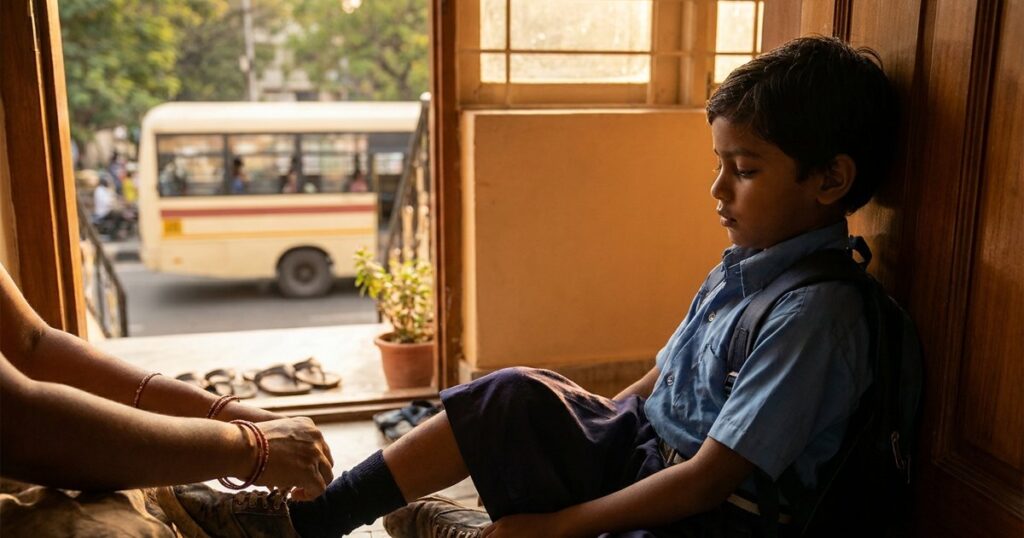
I keep seeing school buses on Mumbai roads before sunrise. Small children, often still half asleep, sit behind fogged windows while their parents rush to get them ready. The reason Indian schools start so early is not that children learn better at 6.30 am. It is usually a mixture of heat, traffic, the need to run multiple school shifts, parental work schedules, and an old belief that waking early is automatically virtuous. The timetable is designed around the convenience of the system. The child is expected to adjust.
That is backwards.
A school beginning at 7.10 am may look reasonable on paper. But the timetable does not begin when the first bell rings. A child may need to wake at 5.15 am, leave home at 6 am, and spend an hour in a bus. If she returns home at 2 pm, she may then attend tuition, sports coaching, music class or simply wait for working parents to return. By the time homework is finished and dinner is eaten, bedtime slips to 10.30 or 11 pm.
We call this an early school day. In reality, it is a long working day imposed on a child.
The timetable has been inherited, not designed
Many Indian schools start early for perfectly understandable historical reasons.
In much of India, the afternoon is hot. Starting at 7 am allows a school to finish by 1 or 2 pm, before the worst heat. In crowded cities, early hours reduce the time children spend in traffic. Some schools share buildings and run two shifts, with one batch arriving early and another using the same classrooms later. Parents may also prefer an early finish because a child can reach home before the working day ends.
There is another practical reason: schools often have to fit into the timetable of the entire city. Buses, roads, offices, domestic help, coaching classes and siblings all impose constraints. A school cannot change its bell time in isolation.
But a historical explanation is not a defence forever. The world around the timetable has changed.
Three decades ago, most children did not spend their evenings at cricket academies, coding classes and entrance-exam coaching. There was no IPL match to watch on a phone in bed, no WhatsApp group sending homework at 10.45 pm, and no parent returning from work after 9 pm while still needing to supervise schoolwork. Many children today live in apartments far from school and spend a substantial part of the day commuting.
The school timetable has remained frozen while family life has moved on.
I am not suggesting that every school should simply start at 9.30 am tomorrow. That would create problems of its own. But I do object to pretending that a 5 am wake-up is harmless because the first period begins at 7.30.
Why do Indian schools start so early? The four real reasons
When I speak to parents and school leaders, I hear four recurring explanations.
- Heat. In cities such as Nagpur, Lucknow, Delhi and Ahmedabad, the afternoon can be punishing for much of the year. Schools want children to be home before the hottest hours.
- Traffic. An early start is meant to avoid peak-hour congestion. Ironically, when every school adopts the same strategy, thousands of buses and cars still crowd the roads.
- Building utilisation. A school may run a morning shift and an afternoon shift, especially in municipal or space-constrained settings. The first shift has to begin early so the second can begin on time.
- Adult convenience. Parents can leave for work after dropping children at school. Schools also find it easier to organise staff and transport around a conventional early schedule.
These are real constraints. But none of them proves that young children should sleep less.
The most common mistake is to treat sleep as the variable that can be squeezed. If the school cannot move, the child must wake earlier. If homework takes longer, bedtime moves later. If coaching is scheduled in the evening, sleep loses again.
A 7 am school start can mean a 5 am childhood. The bell time is not the child’s morning; the wake-up time is.
The biology is not a matter of discipline
Parents often tell me that their child is lazy because he cannot wake up at 5.30 am. I am wary of that judgement. A tired child is not necessarily an undisciplined child.
Young children need a great deal of sleep. The American Academy of Sleep Medicine recommendations advise 9 to 12 hours for children aged 6 to 12, and 8 to 10 hours for teenagers. These are not luxury targets. Sleep supports attention, memory, mood, immunity and physical growth.
Teenagers have an additional problem: their internal clocks tend to shift later. They may not feel sleepy at 9 pm even when they must wake at 5.30 am. Telling them to “just sleep early” does not completely solve a biological shift. It is rather like telling a patient with high blood pressure to “just relax”. Advice is not the same as a solution.
In my IVF practice, I see how casually adults sacrifice sleep. They work late, commute long distances, answer messages in bed and then expect their bodies to function perfectly the next morning. We understand, at least in adults, that chronic sleep deprivation affects health. Yet we impose the same pattern on children and call it character-building.
The cost is visible in classrooms. Teachers describe children yawning through the first two periods, falling asleep during lessons or becoming irritable over small things. Parents report that their children are unable to concentrate after lunch, although the real problem may have begun many hours earlier.
A survey conducted at Jaslok Hospital in Mumbai reported significant sleep deprivation among urban adolescents. I would not use one survey to claim that every Indian teenager is sleep deprived, but it matches what many parents and teachers observe. The Centers for Disease Control and Prevention’s guidance on adolescent sleep also makes the basic point clearly: insufficient sleep affects learning, behaviour and health.
Early rising is not the same as productive learning
There is a moral story attached to early mornings in India. The child who wakes before sunrise is considered sincere. The child who struggles to get out of bed is considered careless. Many of us grew up hearing that early to bed and early to rise makes a person healthy, wealthy and wise.
There is nothing wrong with an early morning if the child has slept enough. The problem is confusing the clock with the outcome.
A well-rested child arriving at school at 8.30 am is likely to learn more than an exhausted child arriving at 7 am. I would rather see a student alert for six meaningful hours than physically present for seven hours while mentally absent for the first two.
This is the same mistake that Indian schools make in other areas. We measure attendance instead of attention, hours in class instead of understanding, and marks instead of curiosity. I have written earlier about why Indian schools still rely so heavily on rote learning. The early start is part of the same mindset: if the child is sitting at a desk, the system assumes learning is happening.
It is not.
What about the heat?
The strongest argument for early school is the Indian climate. I take it seriously. A school that ends at 3.30 pm in May may be unpleasant, especially if classrooms lack ventilation, shade or reliable electricity.
But “the weather is hot” should lead to better building design and flexible calendars, not an automatic demand that six-year-olds wake before dawn.
Schools can consider several options:
| Problem | Common response | Better question |
|---|---|---|
| Very hot afternoons | Start at 6.45 or 7 am | Can the school shorten the summer day, improve ventilation or shift outdoor activities? |
| Peak traffic | Start every school early | Can schools stagger start times across neighbourhoods? |
| Limited buildings | Run two shifts | Can the first shift begin later, even if the second ends later? |
| Working parents | Send children home early | Can schools provide supervised after-school time rather than leaving children alone? |
There is no perfect answer. A later start may mean a later finish. That may inconvenience parents and increase electricity costs. But inconvenience for adults should not automatically be converted into sleep loss for children.
We need to make the trade-offs visible. At present, the child absorbs them silently.
The working-parent problem is real
I understand why some parents defend early school. If both parents work, a child who returns home at 1.30 pm may be able to eat lunch with a grandparent or a domestic worker. If school ends at 3.30 pm, the child may be alone until 7 pm.
This is not a trivial concern. A timetable that is better for sleep but leaves a seven-year-old unsupervised for four hours is not automatically better.
But the answer cannot be to pretend that every child goes home to a caring adult. Many do not. Some wait in empty homes. Some spend the afternoon with a maid who is responsible for several households. Some go straight from school to tuition because nobody is available to care for them.
Schools should therefore think beyond the bell. A supervised after-school programme, a quiet reading room, sports facilities and a simple meal may help families more than an early dismissal. It need not become another coaching centre. Children need safe time, unstructured play and the ability to finish homework without being rushed.
This is where I see a connection with the companies I invest in. Founders often build for the customer they imagine rather than the customer who actually exists. Schools do the same. They design a timetable for a household with one parent at home, no commute, no evening classes and a child who sleeps at 9 pm. That household is increasingly fictional.
A timetable should be tested against the lives of ordinary families, not against the preferences of the school administrator.
What should parents do when they have no choice?
Most parents cannot change their school’s timing. They may have spent years trying to obtain admission and may not be able to move their child. I do not want to give them advice that assumes unlimited choice.
I would begin with a simple audit. For one week, write down:
- When the child actually falls asleep, not when lights are switched off.
- When the child wakes up.
- How long the commute takes in each direction.
- When homework, tuition and activities finish.
- At what time the child becomes visibly sleepy or irritable.
The result is often revealing. A child may be described as getting eight hours of sleep because bedtime is supposedly 9.30 pm and wake-up is 5.30 am. But if the child spends 30 minutes worrying, reading messages or finishing homework, actual sleep is closer to seven hours.
I would then protect sleep before cutting play. Parents often remove outdoor activity first because marks appear urgent. That is a mistake. Physical activity helps children regulate mood and sleep. I have written about why sports matter more than marks in Indian schools. A child who plays for an hour is not wasting an hour.
Families also need to be honest about evening commitments. A child cannot attend three coaching classes, watch television late, complete extensive homework and still wake cheerfully at 5 am. Something has to go. In my view, the first thing to remove should be the least valuable activity, not sleep.
Parents can also ask the school specific questions rather than making a general complaint:
- How many children are falling asleep in the first two periods?
- How much homework is expected after a 7 am start?
- Can the school bus route be changed so children do not leave home at 5.30 am?
- Can tests and demanding subjects be scheduled later in the day?
- Can the school trial a later start for one term and measure attendance, concentration and parent feedback?
Schools may not agree. But a concrete request is harder to dismiss than “the timings are bad”.
Should every school start at 9 am?
No. I do not believe in one national timetable.
A rural school where children walk to class, a large urban school with a 90-minute bus commute, and a school in a very hot town cannot be treated identically. Children in primary school and students preparing for board examinations also have different needs.
But I would establish a presumption: primary schools should not begin so early that children need to wake before 6 am. For older students, a start around 8 or 8.30 am deserves serious consideration, especially in cities where children travel long distances. Schools should be required to justify an earlier start with evidence, rather than assuming that parents and children must accept it.
The recent decision in Maharashtra to require schools up to Standard IV to begin at 9 am reflects this concern. I am not sure that a government order is the best way to manage every school timetable. Regulations can create unintended difficulties, particularly for schools running multiple shifts. But the direction is sensible: younger children need protection from adult-designed schedules.
There is also a danger in extending the debate only to the start time. If a school begins at 9 am but sends three hours of homework home, the child has not gained much. If the school starts at 8.30 but the bus picks up children at 6.45, the practical benefit may be limited. We must measure the child’s entire day.
The right question is not “What time does school start?” It is “How many hours of alert, healthy childhood remain after school, travel, homework and coaching are deducted?”
The surprising answer may be to shorten the school day
We tend to argue about whether school should begin at 7 or 9. I suspect the more important question is why children need to be in school for so many hours in the first place.
Indian schools often use time as a substitute for quality. If students are not learning, we add another period. If marks are weak, we add remedial classes. If parents are anxious, we add tests. The school day expands, but learning does not necessarily improve.
A shorter, better-designed day could include focused teaching, reading, physical activity, lunch and time for reflection. Older students could have supervised study periods rather than being sent home with large amounts of repetitive homework. Teachers could spend less time completing notebooks and more time explaining ideas.
This would require courage. Schools would have to tell parents that more hours do not mean more education. Parents would have to stop treating a packed timetable as proof of seriousness. Boards would have to reduce content and examine understanding rather than memory.
I know how difficult this is. In IVF, patients often ask for more injections, more tests and more procedures because they believe more treatment must mean a higher chance of success. It is my job to explain that additional intervention can sometimes add cost, anxiety and risk without adding benefit. Education has the same problem. More worksheets, more classes and earlier mornings can create the appearance of effort without producing better learning.
Schools should run an experiment
I would like to see schools stop arguing from habit and conduct a simple experiment.
Choose one grade for one term. Start at 8.30 or 9 am. Keep the curriculum and teachers the same. Measure sleep duration, lateness, attendance, classroom attention, disciplinary incidents, test performance and parent satisfaction. Compare the results with a similar grade following the old schedule.
This does not require a grand national commission. It requires a principal willing to learn.
Perhaps the later-start group will perform no better academically. Even then, if the children sleep longer and arrive less distressed, that is useful information. Perhaps transport costs will increase. Perhaps afternoon heat will create a new problem. Good decisions are made by seeing these trade-offs clearly, not by defending an inherited timetable.
School leaders often tell me that they have followed the same schedule for 30 years and have received no complaints. I am not persuaded by silence. A child who is exhausted does not usually write to the principal. A parent who fears losing admission may not complain. The absence of a formal complaint is not evidence that the arrangement is healthy.
In medicine, we have learned to ask patients about symptoms rather than waiting for them to volunteer everything. Schools should ask children directly: Are you sleepy in class? How long do you travel? When do you finish homework? Do you have time to play? The answers may be uncomfortable, but they are more relevant than the timetable printed in the prospectus.
My own position
I would not close every school before 8 am. I would not dismiss the problems of heat, traffic, transport and working parents. But I am convinced that a primary-school child who wakes at 5 am for school is being failed by the adults around her.
We should stop praising early rising when it is actually sleep deprivation. We should stop calling a tired child lazy. We should stop designing school schedules around the convenience of buildings and buses while treating children’s biology as an inconvenience.
The first change I would make is modest: no school for young children should require a wake-up before 6.30 am, and every school should publish the expected total time spent by a child in school, travel and homework. Parents deserve to see the full day, not only the official start and finish.
The deeper change is cultural. We must accept that a child’s rest is not time stolen from education. It is part of education.
When I see a six-year-old stepping off a school bus at 6.45 am, already yawning before the day has begun, I do not see discipline. I see an adult timetable being paid for by a child’s sleep. That is a price we should no longer be willing to pay.