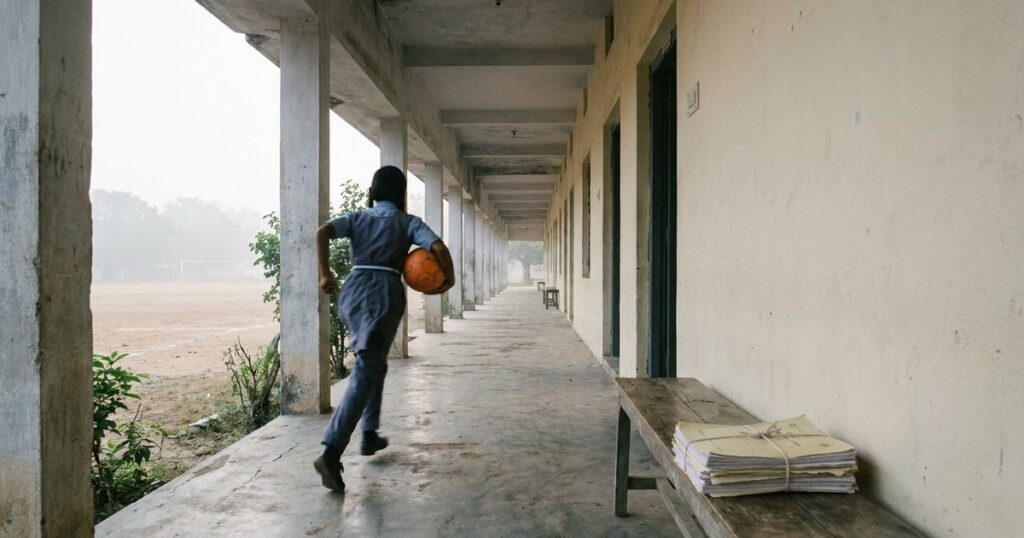
I have watched Indian parents spend an extraordinary amount of time worrying about whether their child will score 95 or 97 per cent, and almost no time asking whether the child can run, lose, recover, cooperate, or persist. This is a mistake.
The importance of sports in schools in India is not that every child will become an athlete. It is that sport teaches physical health, discipline, emotional resilience, teamwork, judgement and how to deal with failure—capacities that marks alone cannot measure. A school that treats sport as a spare-period activity is not preparing children for adult life. It is preparing them only to write examinations.
I say this as a doctor, a parent, an investor and someone who has spent years thinking about how children learn. The obsession with marks is understandable. Indian families face real economic pressure, and examination scores appear to offer a clean, measurable path to a better college and a better job. But the neatness of the number is precisely the problem. We have started confusing what is easy to measure with what matters.
The comfortable belief I had to unlearn
For many years, the implicit bargain in Indian schooling was simple: study hard, score well, get into a good college and life will take care of itself. Sport was permitted, but only after the “important” work was done. A child who spent two hours playing cricket was often asked why those hours had not been spent preparing for a test.
I understand why parents think this way. I have had patients whose families made enormous sacrifices to pay school fees and coaching fees. I have met founders whose parents believed that medicine, engineering or a government job was the only respectable route to security. When the stakes are perceived to be so high, play begins to look irresponsible.
But the bargain no longer works as advertised. A high score may help a child enter a particular college. It does not guarantee curiosity, good judgement, health, communication, creativity or the ability to work with people unlike oneself. I see these gaps in medicine. I see them in the young founders I meet. A brilliant academic record can coexist with an inability to handle uncertainty or accept criticism.
Sport exposes these weaknesses early, and that is one reason adults often dislike it. In a classroom, a child may memorise the correct answer and receive a mark. On a football field, the child must decide in real time, under pressure, with incomplete information. A bad pass cannot be hidden behind beautiful handwriting. A missed catch is visible to everyone. The next ball still has to be played.
That is not a distraction from learning. It is learning.
Why sports matter in Indian schools
When I speak about sport, I am not speaking only about competitive excellence. I am speaking about regular, structured physical activity for every child: the fast runner, the awkward beginner, the child who is overweight, the child who dislikes cricket, and the child who will never represent the school.
The school is often the only place where an Indian child can reliably access space, equipment, coaching and peers. Many urban children live in apartments, study in tuition classes and spend their evenings in traffic. Many girls face additional restrictions on where and when they can play. A school that removes sport is not merely removing an optional subject. It is removing one of the few daily opportunities for movement and social interaction.
There are several reasons this matters.
Physical health is the obvious one. Children need strength, coordination, balance and cardiovascular fitness. I do not need a complicated argument to explain why a child who spends every day sitting at a desk and then sitting with a phone is at greater risk of poor health than a child who moves regularly. Doctors can prescribe advice, but schools shape habits long before a patient enters my clinic.
Sport teaches delayed gratification. Improvement is usually slow and frustrating. A child may practise a tennis serve for weeks before it becomes reliable. A swimmer may train without seeing an immediate change in race time. A batsman may be dismissed repeatedly before learning to leave the ball outside off stump. This is a useful antidote to the instant feedback offered by screens and the instant rewards offered by rote memorisation.
Sport teaches emotional regulation. Losing is not a theoretical possibility in a match. It is a scheduled event. Children learn that disappointment is painful but survivable. They learn to shake hands, return for practice and try again. This lesson is missing from a school system that treats every low mark as a catastrophe and every mistake as evidence of inadequacy.
Sport teaches cooperation without pretending that everyone is equal at everything. A cricket team needs a fast bowler, a wicketkeeper, a patient opener and an alert fielder. A relay team needs people with different strengths. Children learn that contribution is not identical to rank. The child who is not the best striker may still be the person who saves the match with a catch.
Sport teaches judgement under uncertainty. Should a captain declare? Should a player attempt the difficult shot? Should a defender hold position or attack the ball? These decisions cannot be solved by memorising a chapter. They require observation, risk assessment and accountability.
These are precisely the qualities I look for in founders. A founder must act without perfect information, recover from rejection, understand a team’s different abilities and continue after a plan fails. I would rather back a young person who has learned to compete fairly, reflect after losing and return to practice than one who has collected marks but has never been tested outside an examination hall.
Marks tell me how well a child answered a particular set of questions on a particular day. Sport gives me a glimpse of how the child behaves when the answer is not known, the clock is running and the result is public.
Sport is not a luxury reserved for talented children
One objection I hear is that schools should concentrate on academics because only a small number of children can become serious athletes. This misunderstands the purpose of physical education.
We do not teach mathematics because every child will become a mathematician. We teach music because every child will become a professional musician. We teach literature because every child will write a novel. The purpose of a subject is not limited to producing professionals in that field.
Sport deserves the same respect. A child who learns to enjoy a brisk game of badminton may never win a medal, but may remain physically active for decades. A child who learns to swim may one day save a life. A child who plays basketball may find friends, confidence and a sense of belonging. These outcomes do not appear in the school prospectus because they are difficult to quantify. They remain valuable anyway.
We also need to stop equating sport with expensive academies and private coaching. A school does not need an Olympic-standard facility to give children meaningful physical education. It needs time, safe space, competent supervision and a willingness to let children play. Kho-kho, kabaddi, athletics, volleyball, running, yoga and simple games can be organised with modest resources. The absence of a swimming pool is not an excuse for the absence of movement.
In fact, an obsession with elite sports can make school sport worse. When only the best players receive attention, the majority of children conclude that the field does not belong to them. The school team gets coaching; everyone else gets a free period. That is not physical education. It is talent selection.
What should schools actually do?
I am not arguing that schools should abolish examinations or pretend that academic knowledge does not matter. Reading, writing, mathematics and scientific reasoning are essential. My argument is that we should stop allowing marks to consume the entire school day and the entire identity of a child.
A sensible school would make a few practical changes.
- Protect a daily period for movement. It should not be cancelled whenever an examination approaches. If sport disappears precisely when children are under the most pressure, the school is teaching them that health is expendable.
- Assess participation and learning, not just victory. A child’s grade can include attendance, effort, improvement, fair play, understanding of rules and care for equipment. This will not make every child love sport, but it will signal that the activity is real.
- Offer several activities. Cricket should not become the default simply because it is popular. Children should be able to try athletics, football, basketball, badminton, table tennis, martial arts, dance, yoga, swimming where possible and traditional Indian games.
- Train teachers to include beginners. A sports teacher who humiliates the slowest child has defeated the purpose of the class. The first objective is participation without fear.
- Give girls equal access to space and coaching. Many girls stop playing not because they lack interest but because of clothing rules, safety concerns, social expectations or the assumption that boys deserve the field first. A school that takes equality seriously must timetable and resource sport accordingly.
- Teach parents what sport is for. If the school celebrates only medals, parents will demand medals. If it explains the value of fitness, teamwork and persistence, families may begin to see sport as part of education rather than a threat to marks.
The order matters. I would begin with protected time and universal participation, not with expensive infrastructure. A school that has two hours of unused ground each week but no timetable commitment does not have a facilities problem. It has a priority problem.
How parents can resist the marks treadmill
Parents have less control over school policy, but more control over the home than they sometimes believe.
I would start by asking a child a different set of questions. Instead of asking only, “How much did you score?”, ask: What did you practise today? What did you find difficult? Did you help a teammate? What did you learn after losing? These questions do not lower academic standards. They widen the definition of progress.
I would also be careful about using sport as a reward for finishing homework. When play is always presented as payment for “real work”, children learn that play is frivolous. Physical activity should be treated as a normal part of the day, like sleep and meals.
Parents should resist the temptation to turn every game into a performance review. I have seen adults shout instructions from the sidelines, argue with referees and make a child’s weekend match feel like another examination. The child then learns that sport is simply a more public way to disappoint a parent.
Let the coach coach. Let the child own the experience. If the child wants to improve, help find a good teacher and create regular practice. If the child does not want to compete, do not assume that the activity has failed. Recreational sport is not an inferior version of competitive sport.
There is also a practical question of time. Indian children are often over-scheduled: school, tuition, entrance coaching, music lessons and homework. Something has to be removed. In my view, the first candidates should be the activities that produce anxiety without producing understanding. One hour of outdoor play may be more valuable than one additional hour of coaching based on memorising model answers.
I know this is difficult for parents who fear that their child will fall behind. I have felt that anxiety myself. But a child who is exhausted, sedentary and frightened of mistakes is not necessarily ahead. The marks may look respectable while the person behind them becomes increasingly fragile.
What sport teaches that classrooms often do not
My work in IVF has made me wary of false certainty. Patients often want a guaranteed outcome from a process that can only offer probabilities. They ask which treatment will definitely work, which embryo is definitely the best, and which decision will eliminate risk. I have to explain that biology does not provide guarantees.
Children need a similar education about uncertainty. Examination culture encourages the belief that there is one correct route and that a high enough score can control the future. Sport gives a more honest model. Preparation improves the odds, but the bounce of the ball, the opponent’s decision and one moment of poor judgement can still change the result.
That does not mean effort is pointless. It means effort is valuable even when it does not guarantee victory.
This is also what I tell founders. I cannot promise an entrepreneur that a good product will succeed. I can ask whether the founder is learning quickly, listening to customers, managing cash and responding intelligently when the first plan fails. In sport, as in startups, the result matters, but the process reveals character and capacity.
Schools should therefore make room for post-match reflection. Not a long worksheet and not a moral lecture. A few honest questions are enough:
- What was our plan?
- What actually happened?
- Where did we make a good decision?
- What would we try differently next time?
That is a better preparation for adult life than simply telling children to work harder after every failure.
But what about academic competition?
Some readers will say that this argument is idealistic. Indian students compete for too few seats in good colleges. Families cannot afford to gamble with academic performance. Sport may be admirable, but marks still determine access.
They are right about the competition. I would not advise a child to neglect mathematics or language in the name of balance. Nor would I pretend that every school can immediately create excellent sports programmes. The constraints are real: limited land, crowded classrooms, poorly trained teachers, safety concerns and parents who may resist change.
But these constraints do not justify the current imbalance. The choice is not between six hours of study and six hours of sport. It is between a school day that includes meaningful movement and one that treats children as examination machines.
We should also be honest about what academic competition is producing. If a child scores well only by attending coaching classes late into the evening, sleeping poorly and abandoning all physical activity, we should not automatically call that success. A system that produces high marks and poor health has not solved the education problem. It has merely postponed the bill.
Perhaps the deeper issue is that adults want a single ranking system. Marks provide one. Sport refuses to cooperate. A child may be academically average and athletically gifted, or academically excellent and physically uncoordinated, or socially shy but a superb team organiser. Human ability is inconveniently varied.
This is why I have written before about why Indian schools continue to rely on rote learning. Rote learning survives partly because it makes children easy to compare. Sport reminds us that comparison is not the same as education.
The school that gets this right
I do not expect every school to produce national champions. I would be satisfied with a school where every child moves every day, where the grounds are not reserved for the strongest players, where losing is not treated as shameful, and where teachers understand that physical education is not a convenient place to park children.
I would like to see schools publish a timetable showing how much protected time is allocated to physical activity, not merely display photographs of medal winners. I would like parents to ask whether their daughter gets the same access to the field as her brother. I would like school inspections to ask whether children participate, not only whether a team has won a tournament.
A simple comparison makes the choice clear:
| School culture | What children are rewarded for | What children are likely to learn |
|---|---|---|
| Marks-only | Correct answers and rank | Performance under familiar conditions |
| Elite-sport-only | Winning and selection | Competition, but often at the cost of inclusion |
| Sport for every child | Participation, practice, fair play and improvement | Health, resilience, judgement and cooperation |
The third model is not anti-academic. It is pro-education.
Parents who want to understand how children can build lives beyond the narrow academic-professional pipeline may also find my reflections on career design in India relevant. A child’s future should not be reduced to the first examination result that happens to be available.
My own bottom line
I am not suggesting that sport will solve every problem in Indian education. It will not repair bad teaching, unequal access, unsafe schools or an examination system that rewards memorisation. But it is one of the clearest ways to change what schools value every day.
When a school protects time for sport, it tells children that their bodies matter. When it allows them to lose without humiliation, it tells them that failure is survivable. When it gives the slowest child a place on the field, it tells them that belonging is not reserved for winners. When it asks a team to reflect after a match, it teaches them how to learn from reality rather than from an answer key.
Those lessons are not extras. They are the education.
I would much rather see a child arrive at adulthood with slightly fewer marks and the ability to handle disappointment, take a sensible risk, work with others and care for her own health than with a perfect score and a fear of making the next decision. The school that gives every child a ball, a court, a running track or simply permission to play may be doing more for that child’s future than the school that adds one more hour of examination coaching.
The next time I meet a parent who proudly tells me that her child scored 98 per cent, I hope I remember to ask a second question: “And when did your child last play?”