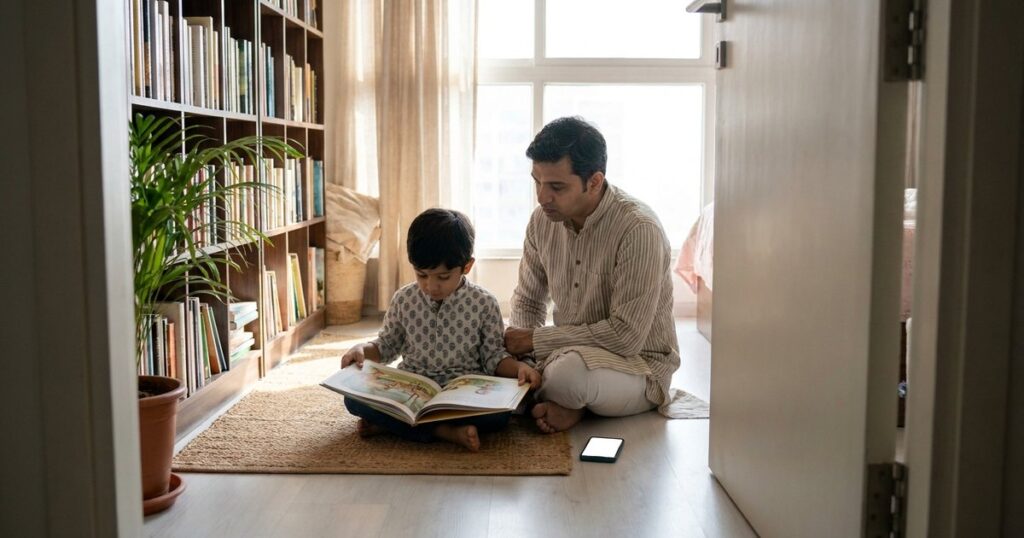
I notice it in my clinic, in conversations with founders, and especially when I speak to parents. Indian children are reading less for pleasure, even when they are doing well in school. They read textbooks, worksheets, coaching material and messages on a screen. What is disappearing is the quiet habit of picking up a book because one wants to know, imagine or think about something.
The reason is not that Indian children have suddenly become lazy. Their homes have become hostile to sustained attention. Parents are anxious about marks, schools reward memorisation, phones provide an endless supply of short stimulation, and very few adults model reading as a source of pleasure. If we want better reading habits for children in India, giving them another worksheet will not help. We need to change what reading means inside the home.
I am not nostalgic for a golden age that never existed. India has always had unequal access to books, weak public libraries and large differences in literacy. But I do believe that something important is being lost now: the ability to stay with a difficult, slowly unfolding idea without demanding an immediate reward.
The comfortable story is that children are reading all the time
When I raise this subject, parents often point out that their child reads WhatsApp messages, online articles, game instructions and school notes. They are right. Children do read words on screens.
But reading a notification is not the same as reading a biography. Scanning a search result is not the same as following an argument. Watching a book summary is not the same as inhabiting the book.
Reading, in the richer sense, requires the eyes and the mind to work together for long enough to understand both what the writer says and what the writer leaves unsaid. It requires vocabulary, memory, inference and the willingness to be temporarily confused. A child who reads only material designed to be consumed quickly may become very good at extracting information while remaining poor at interpretation.
This distinction matters in my work as a doctor. Patients who can read a prescription may still misunderstand risk. They may know the words “ovarian reserve” or “embryo quality” without understanding the uncertainty behind them. Good healthcare depends on a patient being able to follow a chain of reasoning, not merely recognise medical terms.
The same is true of education. A student may memorise the definition of democracy and still be unable to understand a newspaper editorial. A founder may read hundreds of posts about startups and still be unable to judge whether a business has a real customer problem. Reading is not the same as consuming text.
My worry is not that Indian children are reading nothing. It is that many are learning to read only what is short, easy and immediately useful.
Why reading habits among children in India are weakening
There is no single culprit. The decline is produced by several forces, and the most powerful one is the way adults organise children’s time.
Many Indian children have a timetable that leaves little room for unstructured curiosity. School is followed by tuition, then homework, then a class in coding, music, sport or spoken English. Parents may sincerely want their children to read, but reading is placed in the small leftover space after every activity that is considered productive.
This sends a clear message: reading is optional. Marks are serious. Coaching is serious. Reading a novel is what one does if nothing more important is pending.
The second force is the examination system. I have written before about why Indian schools still teach rote learning. The problem is not simply that children memorise. Memorisation has its place. The problem is that our system often rewards the child who reproduces an expected answer rather than the child who asks a better question.
When every activity is judged by whether it improves a test score, parents naturally ask, “What will my child get out of this book?” That is a damaging question. A book may not improve a mark in the next examination. It may improve judgement five years later. It may give a child the language to recognise manipulation, the imagination to understand another person, or the confidence to disagree with an authority figure. These outcomes are real but difficult to measure on a report card.
The third force is the phone. I do not think screens are inherently evil. I use them every day to read papers, communicate with patients and stay in touch with companies I have invested in. The issue is not digital versus print. The issue is whether the child controls the device or the device controls the child’s attention.
A book asks for a sustained investment of attention and gives its reward gradually. Social media gives a small reward every few seconds. Once the brain becomes accustomed to that rhythm, a chapter can feel intolerably slow. The child does not necessarily dislike reading. The child has lost the ability to tolerate the beginning of reading.
There is also the example set by adults. A parent who says, “Put down the phone and read,” while scrolling through Instagram is not teaching a habit. A parent who reads a newspaper, biography or novel after dinner is teaching one without saying anything.
Children copy the status of activities. If they see adults discussing books, lending them to friends and returning to favourite passages, books become part of family life. If books exist only as expensive objects purchased before an examination, children understand their place immediately.
The home matters more than the school library
Schools have an important role, but I am sceptical of programmes that treat reading as another period on the timetable. A child can sit in a library for forty minutes and still learn that reading is a supervised obligation.
The strongest reading habit I have seen in children comes from homes where books are ordinary and available. They lie beside the bed. They travel on holidays. Someone reads aloud even after the child has learned to read independently. Parents talk about characters and ideas without turning the conversation into a comprehension test.
This is one reason the old National Book Trust readership survey, which looked at young people aged 13 to 35, was revealing. Fewer than one in five respondents reported being encouraged to read by parents. I would treat the exact figure with care because the survey is old, but the direction is familiar: Indian parents often encourage reading for examinations or language improvement, not as a lifelong source of pleasure.
Teachers are not always able to compensate. A teacher handling a crowded classroom, a demanding syllabus and pressure from parents may not have the time to recommend books personally. A 2009 study of teacher trainees cited in the reference material found that only a small minority described reading as a habit, while many read mainly to improve skills. Again, I would not treat this as a precise picture of every teacher. But it raises an uncomfortable question: how can we expect teachers to create readers if adults in the education system are themselves being asked to read only for utility?
Reading for pleasure is not an indulgence. It is practice in independent thought. A child who chooses a book is making a small decision about what deserves attention. That decision is more educational than it appears.
Children do not need better books as much as better conditions
Parents often ask me which books their children should read. I understand the question, but I think it is usually asked too early. The first task is not to identify the perfect book. It is to create the conditions in which a child can discover what she likes.
There is no virtue in forcing a ten-year-old to read a classic that she cannot understand. There is also no reason to dismiss comics, adventure stories, mythology, sports biographies or books about animals as inferior. The child who reads a graphic novel may later move to a novel. The child who starts with cricket may discover history through a player’s biography. The child who loves fantasy may eventually become interested in science because a story has made the subject emotionally real.
I would rather see a child read five books she has chosen than complete one “important” book under parental supervision. Choice is not the enemy of standards. It is the beginning of ownership.
Parents should also stop treating finishing a book as a moral achievement. Adults abandon books all the time. We should allow children to do the same. A book that is too difficult, too slow or simply uninteresting may be wrong for that child at that time. The goal is to build a relationship with reading, not to make the child obey a reading target.
| What adults often do | What the child learns | A better alternative |
|---|---|---|
| Buy books only before exams | Books are tools for marks | Keep books available throughout the year |
| Insist on finishing every book | Reading is another obligation | Permit children to abandon and choose again |
| Correct every unfamiliar word | Reading is a test of vocabulary | Let meaning emerge from context, then discuss a few words |
| Compare reading speed with siblings | Reading is a competition | Talk about what the child noticed or wondered about |
| Give a phone as the default reward | Books are less rewarding than screens | Protect a daily period when reading is the normal activity |
What parents can actually do
I do not believe in elaborate reading plans. Most families abandon them because they turn reading into another project. A few simple changes are more likely to survive.
- Make books physically easy to reach. A child should not need permission, money or a special outing to find something to read. A small shelf in the living room is more useful than a locked bookcase in the study. Borrowing from a library or exchanging books with neighbours can solve the cost problem.
- Protect a short daily period. Twenty minutes without phones is enough to begin. The time should be predictable. It should not be offered only after homework, tuition and chores have been completed, because then it will rarely happen.
- Read aloud beyond the early years. Reading aloud is not only for children who cannot read. It gives them access to books above their independent reading level and lets parents share the pleasure of language. A chapter read together can create more conversation than a lecture about the importance of books.
- Let the child choose widely. Include English and Indian languages, fiction and non-fiction, comics and poetry, contemporary writers and older ones. India has extraordinary writing in Marathi, Bengali, Malayalam, Tamil, Hindi and many other languages. Translation can help children cross these linguistic borders.
- Talk, do not examine. Ask what surprised the child, which character she trusted, or what she would have done differently. Avoid turning every book into a book report. Conversation builds comprehension better than interrogation.
- Change the adult example. If a parent reads only forwarded messages, the child will understand that books are ceremonial. I would not ask a child to develop a habit that I am unwilling to demonstrate myself.
These steps sound modest because they are. The problem is not a lack of sophisticated reading technology. The problem is that the family has not decided that reading deserves protected time.
What about children who struggle to read?
We should be careful not to moralise about reading. A child who avoids books may have dyslexia, poor eyesight, limited vocabulary, anxiety, or a history of being humiliated in class. Some children have never found a book at the right level. Others are trying to read in a language they do not speak comfortably at home.
In such cases, “read more” is as unhelpful as telling an infertile couple simply to relax. The advice sounds reasonable but ignores the problem. The child may need an assessment, a different format, audio support, larger print, bilingual books or patient individual teaching.
Parents should distinguish between unwillingness and inability. A child who reads eagerly about dinosaurs but refuses the school reader may not hate reading; he may hate being made to read material that is too difficult or irrelevant. A child who loses her place, guesses words repeatedly or complains of headaches may need help rather than discipline.
Technology can help here. Audiobooks, text-to-speech tools and e-readers can give children access to stories while their decoding skills catch up. I would not use these tools as a substitute for learning to read, but I would certainly not deny a child the pleasure of stories because independent reading is difficult.
Reading is a form of intellectual independence
As an angel investor, I spend time with young founders who are trying to solve difficult problems with limited information. The best founders I meet are rarely the ones who have memorised the largest number of business frameworks. They are the ones who can listen carefully, identify the assumption hidden inside a claim and change their mind when evidence demands it.
Those abilities are strengthened by serious reading. A good book gives a reader access to another person’s mind for several hours. It teaches the reader to hold competing explanations, notice patterns and remain uncertain without becoming paralysed. These are precisely the qualities we say we want in entrepreneurs, doctors, teachers and citizens.
Reading also protects children from a narrow definition of success. Indian education often pushes a child towards the next examination, the next credential and the next salary package. Books introduce other ways of living. A biography can show that a career is rarely a straight line. A novel can make a child curious about a country she has never visited. A travel book can reveal that geography is not merely a chapter to memorise. This connects with what I have written about career counselling for Indian students: children need exposure to possibilities before they can make sensible choices.
In my own life, the books that mattered most were not necessarily the ones I read for an examination. They gave me language for experiences I had not yet had. They helped me understand people whose decisions initially seemed irrational. They made the world larger than my immediate surroundings.
That is why I resist the demand for proof that reading improves marks. It may. It often improves vocabulary and comprehension. But its deeper value is harder to capture. Reading helps a child become less dependent on the loudest adult in the room.
A child who can read independently is not merely better prepared for an examination. She is less dependent on other people to tell her what to think.
Books cannot compete with phones on the phone’s terms
Many parents try to solve the problem by promising a reward after reading: read ten pages and you can use the tablet. This may work briefly, but it tells the child that the tablet is the real pleasure and the book is the toll paid to reach it.
I would rather change the environment. Keep phones outside the bedroom at night. Do not allow notifications during reading time. Make the dining table a place for conversation rather than individual screens. Let adults accept some boredom. A child who is never bored will rarely invent a reason to read.
Schools can help by giving students time to choose books without grading the choice. They can invite local authors, create class libraries and allow children to recommend books to one another. Public libraries need more attention, especially outside large cities. A good library is not just a room containing books; it is a place where a child learns that curiosity is a normal public activity.
Publishers also have a responsibility. Books need to be affordable, attractive and available in Indian languages. Online bookstores have improved access in cities, but access is not the same as discovery. A child cannot want a book she has never encountered. School libraries and local reading groups can bridge that gap better than advertising alone.
I am encouraged by the crowds at book fairs, including the large annual fairs in cities such as Kolkata. But footfall is not the same as reading. People may visit for the atmosphere, buy gifts or purchase books that remain unopened. The real test is what happens on an ordinary Tuesday evening when nobody is watching.
The reading habit has to be rebuilt at home
I do not think Indian children are uniquely incapable of reading. I think Indian adults have made sustained attention difficult and then blamed children for failing to maintain it.
We have filled their schedules, measured their performance, interrupted their concentration and placed a powerful entertainment device beside them. Then we complain that they do not read for pleasure. That is not a fair diagnosis.
The repair will not come from one more campaign, one more compulsory reading list or one more app that counts pages. It will come from small, repeated signals: books are visible, reading is protected, choice is respected, difficulty is supported and adults read too.
I would begin tonight by switching off the television and putting away my own phone. I would give the child a book I had actually enjoyed, sit beside her with my own book, and resist the temptation to ask how many pages she had completed. If she reads only three pages but returns to the book tomorrow, that is a better beginning than thirty pages read under threat.
The most honest measure of a reading-friendly Indian home is not the number of books on its shelves. It is whether a child reaches for one when nobody has asked her to.