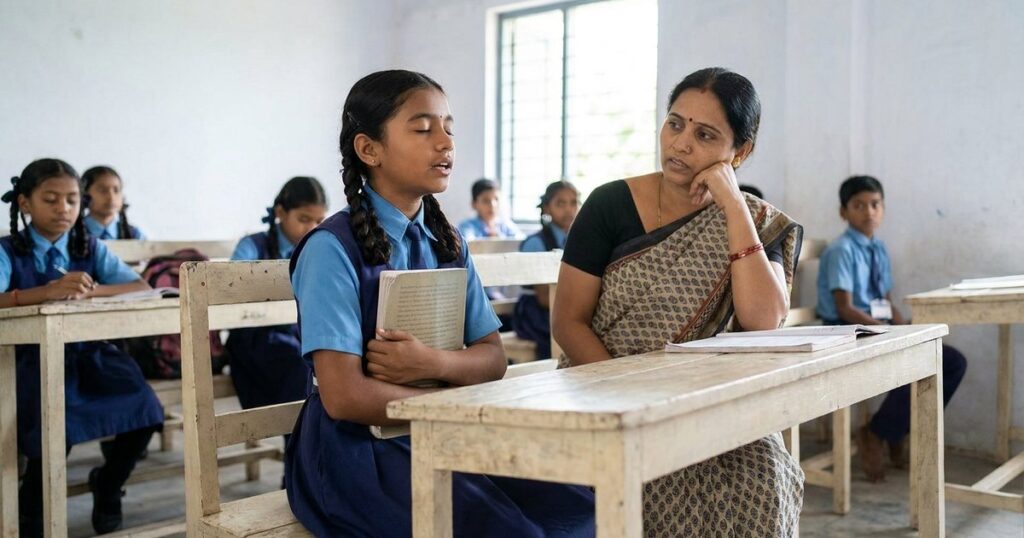
I recently watched a bright school student struggle to explain a science answer she had reproduced perfectly in an examination. She had memorised the paragraph, the headings and even the diagram labels. But when I asked her what would happen if one small condition changed, she had no idea.
That, in a nutshell, is rote learning in India: the ability to recall an answer without necessarily understanding it, applying it or questioning it. Indian schools still rely on it because examinations reward memory, classrooms are crowded, teachers are overburdened, parents demand visible marks and the system has not found a credible replacement at scale. Rote learning is useful for some basics, but when it becomes the main method of education, it produces students who can pass tests and struggle with unfamiliar problems.
I do not blame the child. I do not even blame the teacher. I blame a system that has made memorisation the safest strategy for everyone in it.
Why rote learning survives in Indian schools
It survives because it works—at the narrow task for which we have designed school.
If the task is to reproduce a definition, solve a familiar algebraic equation, write a prepared essay or remember the causes of the Revolt of 1857, repetition is efficient. A child must memorise multiplication tables before doing arithmetic quickly. A medical student must remember drug names and dosages. A musician practises scales. A doctor cannot rediscover the normal range of haemoglobin every time she sees a patient.
Memory is not the enemy of education. It is the raw material of education.
The trouble begins when memorising the map is mistaken for knowing the territory. A student may remember that photosynthesis requires sunlight, carbon dioxide and water, yet be unable to explain why a plant kept in darkness becomes pale. A student may recite the formula for compound interest but not recognise it when looking at a loan agreement. A student may reproduce a chapter on democracy while being punished for asking why the school itself does not permit students to question a rule.
Indian schools still teach this way for several practical reasons.
First, our examinations are designed to test recall. A board examination must evaluate millions of students with some consistency. Asking every student to write a long, open-ended response creates problems of time, language, examiner subjectivity and appeals. It is much easier to award marks for the expected points in the expected order.
Second, the teacher-to-student ratio in many classrooms makes discussion difficult. A teacher handling forty, fifty or more children cannot easily conduct an individual inquiry into how each child thinks. Dictating notes and asking students to copy them is crude, but it is manageable.
Third, coaching has converted education into a preparation industry. Parents want marks because marks are the most visible currency available. A school that says, “Your child is becoming curious, independent and resilient,” may be offering something valuable. But a school that says, “Your child scored 94 per cent,” offers a number that can be compared at the dinner table.
Fourth, teachers themselves were often educated through the same system. We expect them to teach differently without giving them time, training, autonomy or better assessment tools. That is unfair. If a teacher’s performance is judged by examination results, and the examination rewards memorisation, the teacher will quite rationally teach memorisation.
I have written earlier about what Indian classrooms actually teach. The formal curriculum is only one part of the lesson. The hidden curriculum teaches obedience, dependence on authority and fear of mistakes. These lessons are absorbed more deeply than the printed textbook.
When a child learns that the safest answer is the one already written in the teacher’s notebook, we are not merely teaching memory. We are teaching the child not to think aloud.
Is rote learning always bad?
No. The slogan that children should never memorise anything is as foolish as the belief that memorisation is education.
There are facts that must become readily available in the mind. A child should not need a calculator to know that seven times eight is fifty-six. A reader needs a vocabulary before she can appreciate a novel. A doctor needs a mental library of symptoms, anatomy and treatment options before she can reason efficiently with a patient.
In my IVF practice, I see this distinction every day. A fertility specialist must remember protocols, drug actions, hormone patterns and warning signs. But no responsible doctor treats a patient by blindly applying a memorised recipe. The same ovarian stimulation protocol may not be appropriate for two women of the same age. We use knowledge, but we also interpret the individual in front of us. We ask what has changed, what does not fit and what risk we are willing to accept.
Education should work in the same way. Memorisation should create fluency, not replace judgement.
| What the student memorises | What genuine understanding adds | What the student should eventually do |
|---|---|---|
| A formula for area | Why the formula works and when it applies | Choose or adapt the right method for an unfamiliar shape |
| The definition of evaporation | How temperature, surface area and wind affect it | Explain a real-world observation |
| A historical date | The events, causes and competing interpretations around it | Build an argument rather than list facts |
| A grammar rule | How meaning changes when the rule is broken | Write clearly for a real reader |
The problem is not that Indian children memorise. The problem is that they are rarely asked to do anything with what they have memorised.
The cost appears later, not in the classroom
Rote learning is attractive because its costs are delayed. In the short term, the child scores. The parent feels reassured. The school advertises results. The teacher completes the syllabus.
The damage becomes visible when the child encounters a situation for which there is no model answer.
I see a similar pattern when I meet young founders. Some can present a polished pitch deck and repeat the language of startup funding—market size, customer acquisition cost, defensibility, exit—but become uncertain when I ask them to describe one customer’s actual problem. They have memorised the grammar of entrepreneurship without learning the practice of building a company.
Students trained in the same way often arrive at university expecting instructions. They ask, “What should I study for the exam?” They are uncomfortable with a book that has no chapter-wise question bank. They interpret a difficult problem as an unfair problem because nobody has shown them the correct procedure.
This is not a failure of intelligence. It is a predictable result of training.
Rote learning also makes mistakes frightening. If education means reproducing the authorised answer, a wrong answer feels like exposure. A child who has been rewarded for certainty may avoid guessing, experimenting or asking a question that reveals confusion.
But learning requires all three.
In medicine, I would rather have a junior doctor say, “I am not sure; these are the possibilities,” than confidently repeat a diagnosis that does not fit the patient. In investing, I would rather back a founder who can explain what she does not yet know than one who has memorised a perfect story. The same preference should govern school. Honest uncertainty is often a sign that real thinking is taking place.
Why parents continue to demand marks
It is easy to criticise parents for pushing children towards coaching and memorisation. I understand why they do it.
For many Indian families, education is not an abstract pursuit. It is the safest available route to economic security. A good examination score can open a door that remains closed to a child’s parents. Families who have sacrificed to pay school fees are understandably unwilling to experiment with an educational method whose benefits are difficult to measure.
When the entrance examination asks for speed and recall, parents will prepare their children for speed and recall. Telling them that creativity matters while ranking their children by marks is hypocrisy.
The first change must therefore happen in assessment. We cannot ask schools to teach curiosity while examinations continue to reward only the reproduction of notes. A student who has spent a year investigating local water quality, interviewing shopkeepers and presenting evidence may have learned far more than a student who memorised ten chapters. If the final examination ignores that work, the system has sent a clear message about what counts.
I am not arguing that every examination should become an unstructured essay. That creates its own unfairness. Children from affluent families may receive extensive help with projects, while children without such support may be penalised. Good assessment requires thought about language, access, examiner training and consistency.
But we can ask better questions without abandoning fairness.
Instead of asking a child to state that friction opposes motion, ask her to explain why shoes have grooves and why oil is used in machines. Instead of asking only for the definition of inflation, give a household budget and ask what has changed. Instead of asking students to reproduce a poem’s meaning, ask them to compare two interpretations and defend one.
These questions still test knowledge. They simply test whether knowledge has become usable.
What can a teacher do tomorrow?
I do not believe every teacher needs an expensive smart classroom or a new education app. Some of the most effective changes cost almost nothing, but they require the teacher to give up control of the conversation.
I would begin with a simple sequence:
- Teach the basic fact. Give students the vocabulary, formula or process they need. Do not pretend that children can reason about concepts they have never encountered.
- Ask for an explanation in the child’s own words. Do not accept a copied paragraph as evidence of understanding.
- Change one condition. Ask what happens if the temperature falls, the price doubles, the evidence conflicts or the usual assumption is removed.
- Allow competing answers. Ask students to explain why they disagree. The quality of the reasoning matters more than immediate agreement with the teacher.
- Return to the fact. Once students have explored the idea, help them organise it accurately. Discovery without correction can leave children with confident misconceptions.
This is not a rejection of teaching. It is better teaching.
A teacher explaining fractions can ask children to divide a roti among three people, then discuss why one-third is not the same as one-half simply because the pieces look different. A history teacher can ask why two groups might describe the same event differently. A biology teacher can ask students to predict what they will observe before showing them the result of an experiment.
The teacher does not need to know every answer. In fact, saying “I do not know; let us find out” may be one of the most valuable lessons a child receives. Authority becomes more credible when it is not pretending to be omniscient.
What can parents do at home?
Parents cannot redesign the board examination by themselves. They can, however, change the conversation around marks.
When a child returns with a high score, ask what was interesting, confusing or surprising. Ask the child to teach one idea to you without looking at the book. Ask where the idea might be useful outside school. These questions take little time, but they tell the child that marks are not the only evidence of learning.
Parents should also be careful about praising effortless correctness. If a child says, “I am bad at mathematics,” the response should not be a lecture or another worksheet. Ask which part is difficult. Work through one problem slowly. Praise persistence and the willingness to revise an answer.
At the same time, parents should not turn every family interaction into a lesson. Children need play, boredom, conversation and the freedom to pursue an interest without producing a project report. Curiosity dies when every activity is converted into a competition.
I have seen parents spend heavily on tuition while rarely asking their child what she thinks. The spending is visible; the listening is not. Yet the latter is often more influential.
My own view is that a child should be allowed to memorise what needs memorising, but should never be permitted to stop there. If she can recite the water cycle, I want her to explain why clothes dry faster on a windy day. If she knows a historical date, I want her to ask who benefited from the way that history was recorded. If she has learned a formula, I want her to know when not to use it.
What schools and policymakers must change
There is a limit to what individual teachers and parents can accomplish when the larger incentives remain unchanged.
Teacher training must include actual classroom practice, not only lectures about child-centred learning. Teachers need examples of good questions, ways to manage disagreement and methods for assessing reasoning. They also need time. A teacher who is required to complete an overloaded syllabus cannot spend meaningful time on discussion.
Curricula should contain fewer topics taught more deeply. The Indian instinct is to add another chapter whenever a problem is identified. The result is a syllabus that becomes a catalogue. Children touch everything and understand little.
Assessment should include unfamiliar applications, oral explanation, practical work and revision. A first answer should not be treated as the final measure of learning. In real life, the ability to improve a weak answer after receiving feedback is often more valuable than the ability to produce a flawless answer under pressure.
Schools should also publish what they mean by learning. If a school claims to value creativity, it should show parents examples of student work, not only a board examination result. If it claims to teach critical thinking, it should allow visitors to observe students disagreeing respectfully. Claims should be visible in behaviour.
There are already Indian educators and schools experimenting with these approaches. I would not pretend that one model can simply be copied across every government school, low-fee private school and elite institution. Context matters. Language matters. Teacher capacity matters. But the existence of constraints cannot become an excuse for doing nothing.
We should also be wary of technology as a shortcut. An app can deliver quizzes, videos and adaptive practice. It cannot by itself create a child who asks better questions. A digital worksheet that rewards rapid recall may simply automate rote learning. The medium changes; the educational philosophy does not.
I have written about career counselling for Indian students because career choices are another area where children are often trained to reproduce respectable answers rather than understand themselves. “Engineer” and “doctor” become memorised destinations. The child’s interests, strengths and tolerance for uncertainty are treated as irrelevant details.
That is particularly dangerous now. Work is changing, but the deeper point is not that every child must become a coder or entrepreneur. The point is that no career can be sustained by memorising instructions alone. A nurse must notice a change in a patient. An engineer must understand a failure. A founder must hear what customers are not saying. A teacher must recognise when the class has stopped learning.
The one change I would make first
If I were allowed to change only one thing in Indian schools, I would change the question asked after every lesson:
“How do you know?”
Not as an interrogation. As an invitation.
How do you know this answer is correct? How could we test it? What would change your mind? Can you explain it to someone younger? Where would this rule fail?
These questions turn memory into thought. They also teach intellectual humility. A child learns that knowledge is not merely a pile of answers supplied by an adult; it is something that can be examined, tested and revised.
That is the quality I look for in founders I meet and doctors I work with. They do not need to know everything. They need to notice reality when it disagrees with their theory.
Indian schools still teach rote learning because the system rewards it, parents depend on it and teachers are given few safer alternatives. We should preserve memorisation where it builds fluency, but refuse to confuse fluency with understanding.
The real test of a school is not whether a child can reproduce what was taught on Tuesday. It is whether she can recognise, on Thursday, that the world is asking a different question—and have the confidence to work out an answer.