Part 13 of 19 in Why Schools are Broken: and How to Fix Them← Part 12Part 14 →
This chapter describes Indian learning experiments that use small groups, local apprenticeships, and AI-supported teaching instead of conventional schools. It helps readers understand what these arrangements show about motivation, adult roles, credentials, and the possibility of scaling local alternatives.
- Parent-led learning pods in Bengaluru and Mumbai combine projects, online resources, AI tutors, art, nature, and practical skills.
- Rural learning centres in Maharashtra and Tamil Nadu combine remedial teaching with apprenticeships such as tailoring, mobile repair, and organic farming.
- Children often learn more actively when they have choices and connect learning with real activities.
- AI can provide content and practice, allowing adults to focus on higher-value roles.
- India may need many small, locally rooted arrangements rather than a few perfect alternative schools.
Across India, small experiments already embody parts of Goodman’s vision. These are not perfect, and they do not scale automatically, but they prove that different arrangements are possible.
Home-schooling Pods in Bengaluru and Mumbai
In several Indian cities, groups of parents have withdrawn their children from conventional schools and formed small pods. Children of different ages work on projects, use online resources and AI tutors for academic basics, and spend significant time on art, nature, and practical skills. Some pods hire a facilitator; others rotate parental responsibility. The children often show stronger curiosity and better social skills than their schooled peers, though parents must still navigate board-exam requirements if they want formal credentials later.
Rural Learning Centres
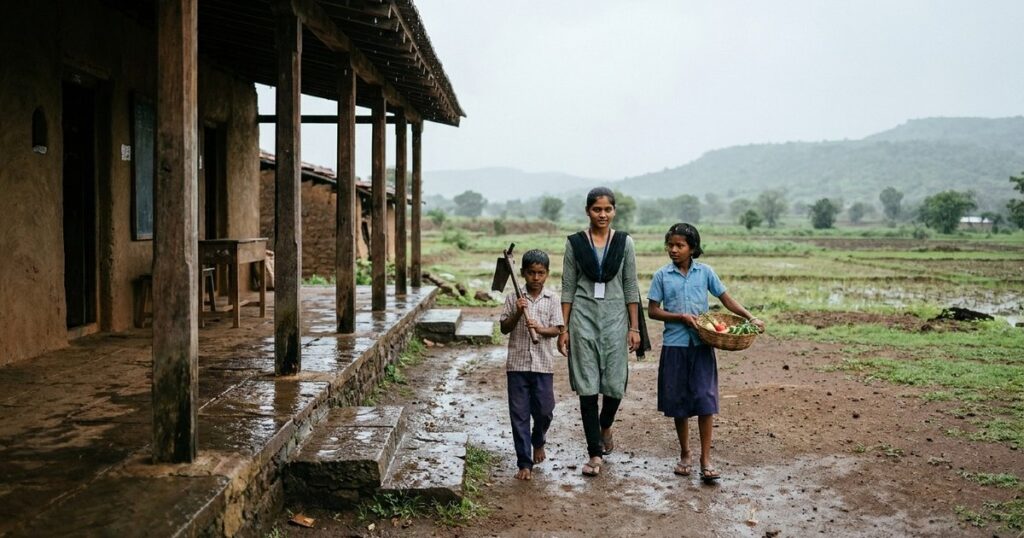
In parts of Maharashtra and Tamil Nadu, young graduates have started after-school centres that combine AI-supported remedial teaching with local apprenticeships. Children who were failing in government schools improve their basic literacy and numeracy while also learning tailoring, mobile repair, or organic farming from village practitioners. The centres charge modest fees or operate on a teach-to-earn model, creating income for the facilitators.
What These Experiments Teach
They show that motivation rises when children have some choice and when learning is connected to real activity. They show that AI can handle a large part of content delivery, freeing adults for higher-value roles. And they show that legal and social obstacles remain: many parents still fear that non-standard paths will close future options. Changing this fear requires both more successful examples and a gradual reduction in rigid credential requirements.
A Note on Scale
India does not need a few perfect alternative schools. It needs tens of thousands of small, imperfect, locally rooted learning arrangements. AI makes this decentralised approach more feasible than it was in Goodman’s time, because high-quality explanations and practice materials no longer depend on scarce expert teachers.
Frequently asked questions
How do homeschooling pods work in Bengaluru and Mumbai?
Parents form small groups where children of different ages work on projects, use online resources and AI tutors, and spend time on art, nature, and practical skills. Some pods hire a facilitator, while others rotate parental responsibility.
What do rural learning centres in Maharashtra and Tamil Nadu teach?
They combine AI-supported remedial teaching with local apprenticeships. Children may improve literacy and numeracy while learning tailoring, mobile repair, or organic farming.
What problems do alternative learning arrangements face in India?
Parents may fear that non-standard paths will limit future options, and families may still need to meet board-exam requirements for formal credentials.
Why does AI make decentralised learning more feasible?
AI provides high-quality explanations and practice materials without relying as heavily on scarce expert teachers, making many small local arrangements more practical.