Part 4 of 19 in Why Schools are Broken: and How to Fix Them← Part 3Part 5 →
This chapter examines what Indian classrooms teach beyond their official lessons, including dependence on teachers, memorization, and obedience. It helps readers understand why students may score well while losing curiosity and independent thought.
- Classrooms often reward reproducing textbook answers instead of understanding ideas.
- Priya scores well but cannot connect a science explanation to plants on her balcony.
- The system rewards syllabus coverage and recall, making discussion and deeper reasoning difficult.
- Schools teach habits such as waiting for permission and measuring worth by marks.
- Pressure from tests, teachers, and parents can discourage children from asking questions.
Goodman wrote that many classrooms taught young people nothing they valued. Indian classrooms often teach something worse: they teach children that they are not capable of independent thought, that knowledge comes from the teacher or the textbook, and that the goal of learning is to reproduce answers rather than to understand.
Story: Priya’s Science Class
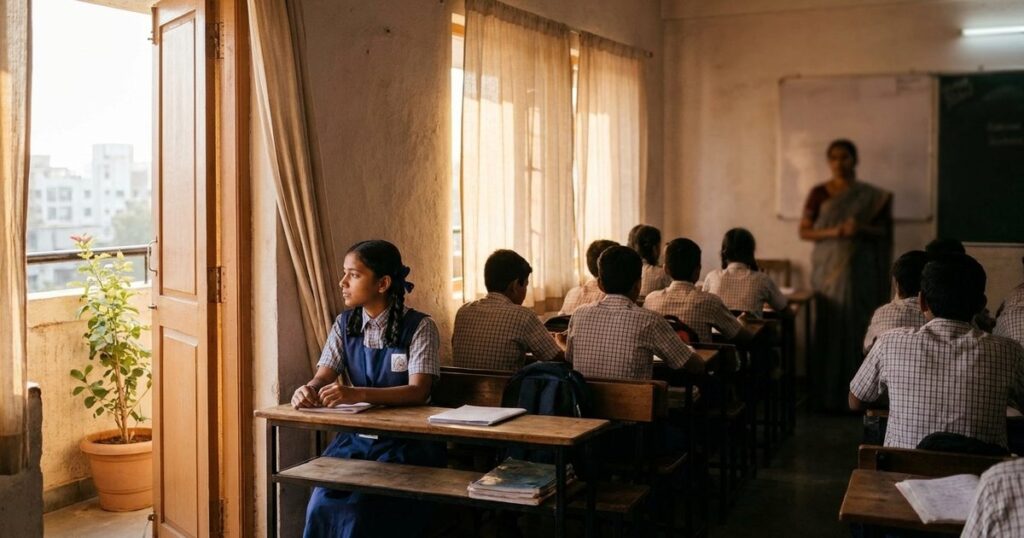
Priya is in Class 8 in a private school in Pune. Her science teacher is hardworking. Every period, the teacher explains a concept, writes key points on the board, and assigns exercises. Priya copies everything neatly. She scores well in unit tests. Yet when asked to explain why plants need sunlight, she repeats the textbook sentence without being able to connect it to the plants growing on her balcony. The class has trained her to be a good student. It has not trained her to be a curious person.
This is not the fault of the individual teacher. The system rewards coverage of the syllabus, not depth. Large class sizes make discussion difficult. The board exam at the end of Class 10 or 12 will test recall more than reasoning. So the rational strategy for both teacher and student is to focus on what will be tested.
The Hidden Curriculum
Beyond the official syllabus, Indian schools teach a hidden curriculum: sit still, raise your hand, wait for permission, accept that the adult is always right, and measure your worth by marks. These habits may prepare a person for certain kinds of employment. They do not prepare a person for entrepreneurship, for scientific discovery, or for raising children who can think for themselves.
Story: The Boy Who Stopped Asking
When Rahul was in Class 4 in a school in Jaipur, he constantly asked “why”. Why does the moon change shape? Why do we have to stand in line? Why is the answer in the book different from what his grandfather said? His teacher found the questions disruptive. His parents were told he was “too talkative”. By Class 7, Rahul had stopped asking. He still scored reasonably well, but the spark was gone. He had learned the most important lesson the system teaches: do not question.
This is not an isolated case. Across India, the pressure to finish the syllabus and prepare for tests systematically discourages curiosity. Teachers who try to encourage questions often find themselves falling behind the academic calendar. Parents who value marks over understanding reinforce the same message at home.
Frequently asked questions
What do Indian classrooms teach beyond the syllabus?
They teach students to sit still, raise their hands, wait for permission, accept adult authority, and measure their worth by marks.
Why do students focus on memorizing answers in Indian schools?
Teachers and students are rewarded for covering the syllabus and preparing for board exams, which test recall more than reasoning.
How can students score well but lack understanding?
Students may copy explanations and reproduce textbook sentences without connecting them to real examples or understanding the ideas.
Why do children stop asking questions at school?
Pressure to finish the syllabus and prepare for tests discourages curiosity. Teachers may see frequent questions as disruptive, while parents may value marks over understanding.