Part 19 of 26 in What I Want to Tell My School Teacher: An Indian Adaptation of Letter to a Teacher← Part 18Part 20 →
This chapter examines the hidden lessons children learn at school about belonging, voice, language, caste, and gender. It helps teachers recognize exclusion in everyday classroom practices and respond through clear, visible acts of inclusion.
- Schools teach children who may speak, who belongs, and whose identity is valued.
- Caste can shape seating, sharing food or water, expectations, and everyday remarks.
- Treating one speech variety as correct can make children view their family language as a defect.
- Teachers can interrupt exclusion by using names correctly, stopping mockery, mixing seating, and valuing children’s knowledge.
- Every child should be expected to learn and teach, with the goal that everyone understands.
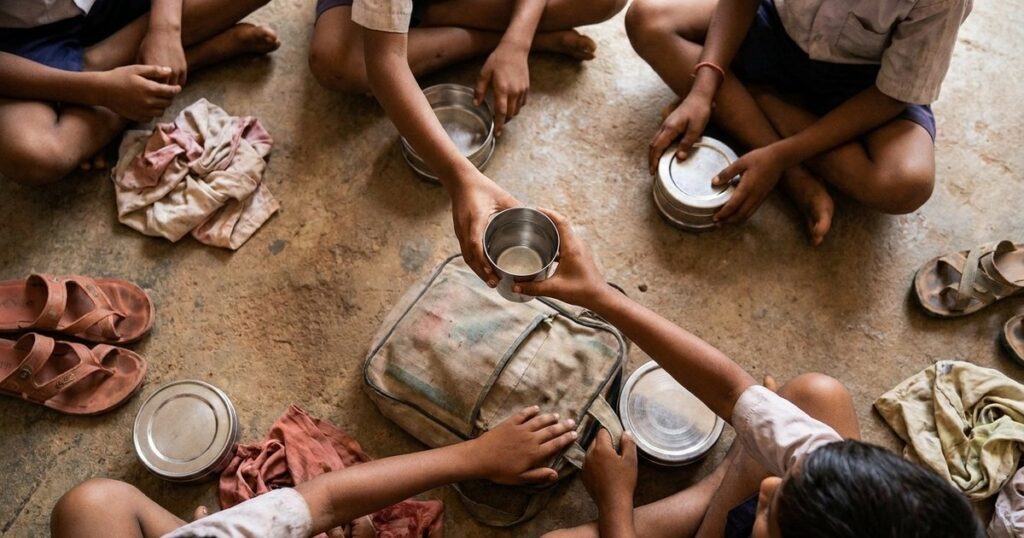
Beyond the official syllabus there is another curriculum that children learn quickly. It is the curriculum of who is allowed to speak, who is laughed at, who sits where, whose food is accepted, whose absence is noticed, and whose name is remembered. This hidden curriculum often teaches marginalised children that they do not fully belong.
In many Indian classrooms this curriculum still carries the marks of caste. Separate seating, reluctance to share water or food, casual remarks about “people like you,” lower expectations expressed in tone rather than words—these are documented across regions. Even when overt discrimination is absent, the quieter message that the school’s culture belongs to someone else can be enough to silence a child.
Language is part of the same curriculum. When only one variety of speech is treated as correct and all others are treated as errors to be erased, children learn that the way their family speaks is a liability. Gender adds another layer: girls are sometimes steered, explicitly or implicitly, toward lower academic ambition or earlier exit.
Barbiana’s response was to make the opposite message unmistakable. Every child was expected to learn. Every child was expected to teach. Every child’s language was a starting point rather than a defect. The wall said “I care.” The daily practice tried to make the words true.
A teacher who wishes to interrupt the hidden curriculum can begin with small, visible acts: learning and using children’s names correctly, stopping mockery immediately, mixing seating, inviting the quietest children to explain something they know from home, and stating clearly that the goal is for everyone in the room to understand. These acts do not dismantle larger structures. They change what the children in that room experience every day.
Frequently asked questions
What is the hidden curriculum in a classroom?
It is the unofficial learning about who may speak, who is laughed at, who sits where, whose food is accepted, and whose name is remembered.
How can caste appear in everyday school practices?
It can appear through separate seating, reluctance to share water or food, remarks about “people like you,” and lower expectations expressed through tone.
How does language affect whether children feel they belong at school?
When only one speech variety is treated as correct, children may learn that the way their family speaks is a liability rather than a starting point.
What can teachers do to interrupt the hidden curriculum?
Teachers can use children’s names correctly, stop mockery immediately, mix seating, invite quiet children to share knowledge from home, and state that everyone should understand.