Part 11 of 26 in What I Want to Tell My School Teacher: An Indian Adaptation of Letter to a Teacher← Part 10Part 12 →
This chapter explains how artificial intelligence can extend patient, adaptive learning support to more children in India. It helps readers understand how AI can support students and teachers while preserving human care, judgment, and relationships.
- AI tutors can explain ideas repeatedly, adjust difficulty, and support children at times that suit them.
- AI can connect home languages and school languages while providing more speaking and writing practice.
- AI can help teachers identify learning gaps, prepare materials, and reduce mechanical correction work.
- Children can use AI for collective research and drafting while keeping control of arguments and ethics.
- Low-cost, multilingual AI is needed so technology does not deepen existing inequalities.
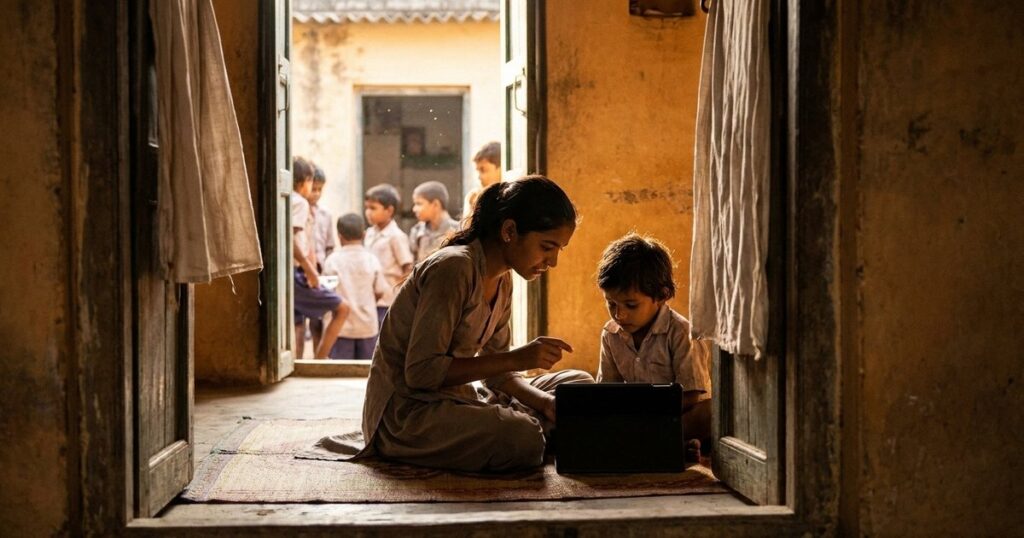
The students of Barbiana had one extraordinary teacher, a small number of books, long hours, and one another. They produced a lasting critique and a working model of a different school. Today we possess tools that can multiply patient, adaptive attention in ways they could not have imagined. Used with the same spirit of “I care,” artificial intelligence can help us offer something closer to Barbiana’s intensity to far larger numbers of children.
Personal pace and endless patience
An AI tutor can explain a concept as many times as needed, in different words, with different examples, without irritation or exhaustion. It can begin from the child’s actual current understanding rather than from the point the syllabus assumes. It can generate practice that is neither boringly easy nor impossibly hard. It can be available at night after the day’s labour is finished, or early in the morning, or on days when the human teacher is absent. For the child who is shy about asking a question in a crowded classroom, the AI removes the social risk.
Language as a bridge rather than a wall
Modern AI systems can operate in many Indian languages and can move between them. A child can receive an explanation first in the home language, then see the same idea expressed in the school language, then practise producing it. Immediate feedback on speaking and writing becomes possible without requiring a fluent adult to be present at every moment. Examples can be drawn from the child’s own region and daily life rather than from distant textbooks. This does not eliminate the need for human teachers of language; it multiplies the hours of useful practice.
Support for the teacher, not replacement
AI is most powerful when it serves the teacher. It can show which concepts large numbers of children have not yet mastered, so the next lesson can be adjusted. It can generate additional examples or simplified texts. It can help the teacher prepare materials in more than one language. It can free the teacher from some of the mechanical work of correction so that human energy can be spent on the children who need conversation, encouragement, or a home visit. The teacher remains the person who decides what matters and who notices when a child is in distress.
Collective work in the Barbiana tradition
Barbiana’s collective writing and newspaper discussions can be extended with AI as a research and drafting partner. A group of children can investigate a local problem—the broken handpump, the irregular bus, the price of fertiliser—gather information, and produce a clear letter or report. The AI can help locate public data, suggest clearer sentences, and translate drafts, while the children and the teacher retain control of the argument and the ethics. Older children can use the same tools while they teach younger ones, exactly as Barbiana practised.
The risk of widening the gap
If high-quality AI tutors remain available mainly to children in expensive schools or to families that can pay for premium services, the existing inequalities will deepen. The corrective is deliberate: make robust, multilingual, syllabus-aligned AI tutors available at no or very low cost through the phones that large numbers of ordinary families already own, and train teachers in government and low-fee schools to use them as everyday allies. Several such efforts already exist in India. The task is to reach the children who currently have the least access to patient academic help.
Barbiana’s core insight survives the change in technology. The child who is behind needs more skilled attention, not less. AI can multiply that attention. It cannot supply the human decision to care, nor can it replace the relationships in which children learn that they are worth the effort. Used inside that decision, it can help us finally build, at Indian scale, the school that does not reject the sick.
Frequently asked questions
How can artificial intelligence help students learn at their own pace?
An AI tutor can explain concepts repeatedly, use different words and examples, and begin from a child's current understanding. It can also provide practice that is neither too easy nor too difficult.
Can AI support learning in Indian languages?
Modern AI systems can work in many Indian languages and move between a child's home language and school language. They can also provide examples from the child's region and daily life.
Will artificial intelligence replace teachers?
AI is presented as support for teachers, not replacement. Teachers still decide what matters and notice when a child is in distress, while AI can help with learning gaps, materials, and correction.
How can AI avoid increasing educational inequality?
Robust, multilingual, syllabus-aligned AI tutors should be available at no or very low cost through phones many ordinary families already own. Teachers in government and low-fee schools also need training to use them.