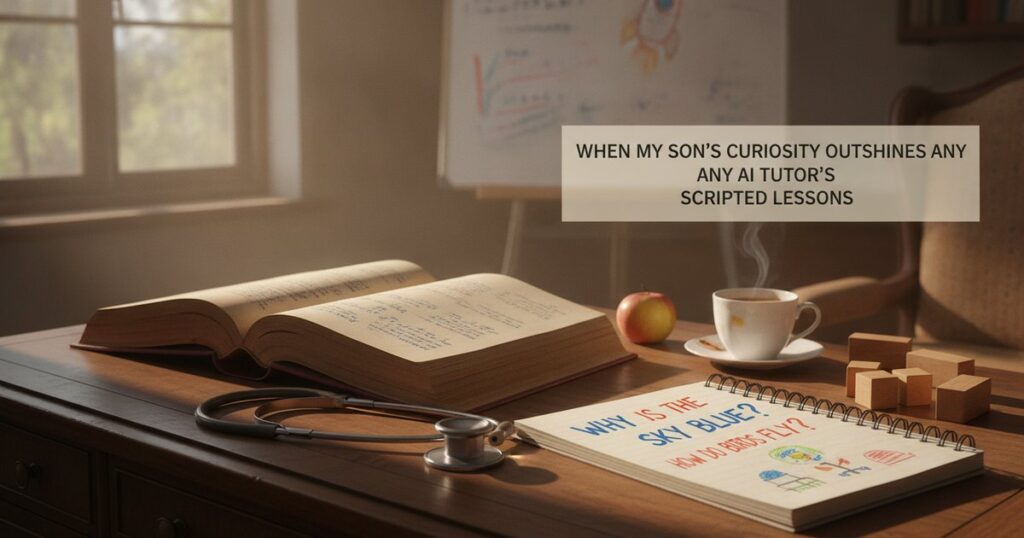
When My Son’s Curiosity Outshines Any AI Tutor’s Scripted Lessons
I’ve often found that the most profound insights come not from the lectures I deliver or the investments I make, but from the simple, unfiltered questions posed by my own children. Last week, my son came to me with a question about why the sky is blue. It was a classic, almost cliché question, one that we’ve all encountered in our childhood. Yet, it wasn’t the question itself that struck me; it was the cascade of curiosity that followed. His questions expanded, touching on light, colors, and even the vastness of the universe. This simple query led us on a journey that no AI tutor, however sophisticated, could have predicted or navigated.
As someone who has dedicated a substantial portion of my life to education reform, I find myself at odds with the burgeoning reliance on AI tutors. There’s no denying the allure of AI in education. Tools that promise personalized learning, available 24/7, without the fatigue or impatience of human tutors, sound like a dream—especially to busy parents. But as I sat with my son, I realized that AI lacks something crucial: the ability to nurture the unpredictable, chaotic beauty of a child’s curiosity.
AI tutors, like the ones offered by platforms like LittleLit, are designed to adapt to a child’s learning pace, offering hints and encouragement along the way. For many parents, this seems like a godsend, especially when faced with the daunting task of helping with homework after a long day at work. However, I wonder if we’re not inadvertently teaching our children to seek answers rather than questions.
In my practice as an IVF specialist, I’ve learned that the best outcomes often stem from asking the right questions. Whether it’s a patient hesitant about a procedure or a founder unsure about a business pivot, the ability to question effectively can be transformative. Yet, this skill is one that must be cultivated, not programmed.
I recall a founder I once mentored who was enamored with the idea of using AI to automate customer service for his startup. On paper, it made sense—cost-effective, efficient, scalable. However, he quickly learned that his customers valued human interaction and the empathy that came with it. Similarly, while AI can simulate a tutor’s function, it lacks the emotional intelligence to engage with a child on a deeply personal level.
In education, as in medicine and investing, there is no substitute for the human touch. AI can provide data, structure, and feedback, but it cannot replace the nuanced understanding that comes from human interaction. My son’s curiosity led us to explore topics far beyond the scope of his initial question. We delved into physics, philosophy, and even a bit of poetry. An AI tutor might have answered his initial question more efficiently, but it wouldn’t have encouraged the exploration that followed.
One of the challenges we face in education is the pressure to produce results—measurable, quantifiable outcomes that can be reported and analyzed. AI fits neatly into this paradigm, offering metrics and progress reports that reassure anxious parents and educators. But in focusing on these metrics, we risk overlooking the less tangible but equally important aspects of learning: creativity, critical thinking, and the joy of discovery.
I’ve often argued that the Indian education system needs a fundamental overhaul. We need to move away from rote learning and standardized testing towards a model that prioritizes curiosity and independent thought. In this context, AI should be a tool, not a crutch. It should spark ideas, not provide all the answers. It should encourage children to explore, to question, and to imagine—qualities that are essential not only for personal growth but also for innovation and progress.
At home, I’ve made a conscious decision to use AI as a starting point, not an endpoint. When my children have questions, we sometimes use AI to gather initial information. But we always take it further, discussing, debating, and exploring together. This approach not only enhances their understanding but also strengthens our relationship, fostering an environment where curiosity is not only encouraged but celebrated.
In the world of startups, I’ve seen firsthand how curiosity can be a powerful driver of innovation. The most successful entrepreneurs are those who question the status quo, who aren’t satisfied with easy answers, and who are willing to explore uncharted territories. These are the qualities we should be instilling in our children, preparing them not just to navigate the future but to shape it.
As we embrace AI in education, we must be vigilant about preserving the essence of what it means to learn. My son taught me a valuable lesson that day—a lesson that no AI could replicate. Curiosity, with all its unpredictability and wonder, is a gift. It’s a reminder that sometimes the most important answers are the ones we discover ourselves.
In closing, I urge parents, educators, and policymakers to view AI as a tool that complements, not replaces, the human element in education. Let us be mindful of the balance between efficiency and exploration, between answers and questions. After all, it’s in the questions that we find the seeds of innovation, the spark of creativity, and the foundation of lifelong learning.