Part 3 of 29 in Helping Your Children Learn: What Parents Need to Know← Part 2Part 4 →
I find myself reflecting on a conversation with a young founder recently. She was passionate, full of ideas, but also burdened by the weight of expectation. Her parents had sent her abroad for education, and now she was back, expected to multiply the family’s prestige. She was more a project than a person, and it struck me how often this pattern repeats, not just in startups but in our homes, our schools, and our lives.
John Holt’s words haunt me: “Trust children.” Such a simple demand, yet profoundly difficult. Trust is a two-way street. To trust a child is to trust oneself, and therein lies the rub. Many of us were taught, explicitly or implicitly, that we couldn’t be trusted. Under the watchful eyes of parents and teachers, our mistakes became small public failures. We grew up and repeated the cycle, armed with better stationery but the same old scripts.
In an Indian household, this lack of trust has a whole set of heirlooms. Marks aren’t just personal scores; they carry family honor, become wedding conversations, WhatsApp forwards, and a reason for an uncle to boast about “Sharma ji’s son who scored 98.” The child senses this weight long before she can articulate it. She learns that the safest path is to toe the line, to perform what is expected, and to hide her ignorance.
But what if we dared to trust? Not a laissez-faire approach where we abandon a child with a smartphone and call it autonomy. Real trust means believing that a child’s innate curiosity is enough. She wants to know why the pressure cooker whistles, why the autorickshaw takes the flyover, how her older cousin ties a sari, why the moon follows the car to Lonavala. This natural curiosity is the engine of learning. Incentives and punishments are what we resort to after we’ve flooded that engine.
The Urgency of Trust
We live in a world that equates trust with negligence. In a colony filled with children juggling tuitions and weekend test series, trust can seem like a luxury. But let’s be precise. Trust isn’t the absence of standards; it’s the refusal to treat a child like a project needing constant supervision. It’s about allowing her to be the architect of her own questions.
Consider this: Trust is saying “show me” instead of “let me check your notebook.” It’s answering the question she asked rather than the one you wish she had asked because it’s in tomorrow’s syllabus. It’s letting a tower of cushions fall, or leaving an evening free twice a week even when the tuition teacher warns that the batch is moving to the next chapter. It’s telling the family group that you won’t be posting unit-test marks.
Trust also involves boundaries. You still decide on bedtime, street safety, and what’s permissible in the house. Holt wasn’t suggesting a home without adults. He was arguing against adults who mistake control for teaching. A child can be safe and still be the owner of her questions.
Real Trust in Action
Let’s look at what trust looks like on a Tuesday. It’s the difference between a child who is told to memorize the multiplication table and one who is shown how it helps in everyday life. It’s letting her fumble through tying her shoelaces even if you’re running late for a meeting. It’s about allowing her to narrate her version of a story, even if it doesn’t match the textbook.
Trust doesn’t mean perfection. It means space for imperfection, for learning and unlearning. In medicine, I’ve often found that the most insightful moments come not from what I know but from what I don’t. A patient asks a question I hadn’t considered, and suddenly, there’s a new avenue to explore. The same holds true for children. The questions they ask, the stories they tell, and the games they invent are not just precursors to learning—they are learning itself.
The Cost of Distrust
Distrust is expensive. It costs us creativity, innovation, and resilience. We see this in startups where founders are risk-averse, more concerned about meeting expectations than exploring possibilities. We see it in medicine, where doctors stick to protocols, fearing the repercussions of a misstep. And we see it in education, where children are trained to recite rather than think.
This cost is particularly evident in India, where the competition is fierce, and the stakes are high. The fear of missing out is palpable. Missing a year in Class 11 is treated as a fracture, a setback from which recovery seems impossible. But what if we reframed this narrative? What if we saw a gap year not as a failure but as an opportunity for exploration, for finding one’s true interests?
The Way Forward
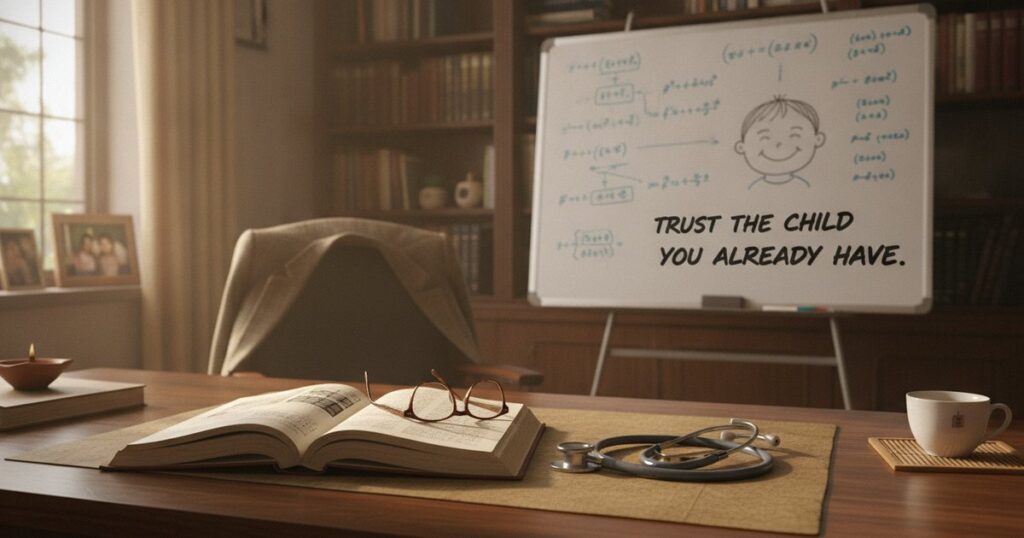
So, how do we break this cycle? How do we trust the child we already have? It starts with trusting ourselves. As parents, educators, and mentors, we must first confront our insecurities. We must ask ourselves why we feel the need to control, to manage, to direct. Are we afraid of what might happen if we let go? Or are we more afraid of what might happen if we don’t?
The answer isn’t easy, and it won’t come overnight. But it begins with small steps. It begins with listening to a child’s question, even if it’s inconvenient. It begins with valuing curiosity over correctness. It begins with celebrating effort over achievement.
In my experience, the most successful founders, the most innovative doctors, and the most fulfilled individuals are those who were trusted, who were allowed to make mistakes, and who learned from them. They are the ones who were told, “I trust you to figure it out.”
This week, I challenge you to find a moment where you were about to correct a child who was already figuring it out. Pause. Trust. You might be surprised by the outcome. After all, trust isn’t just a gift we give our children; it’s a gift we give ourselves.