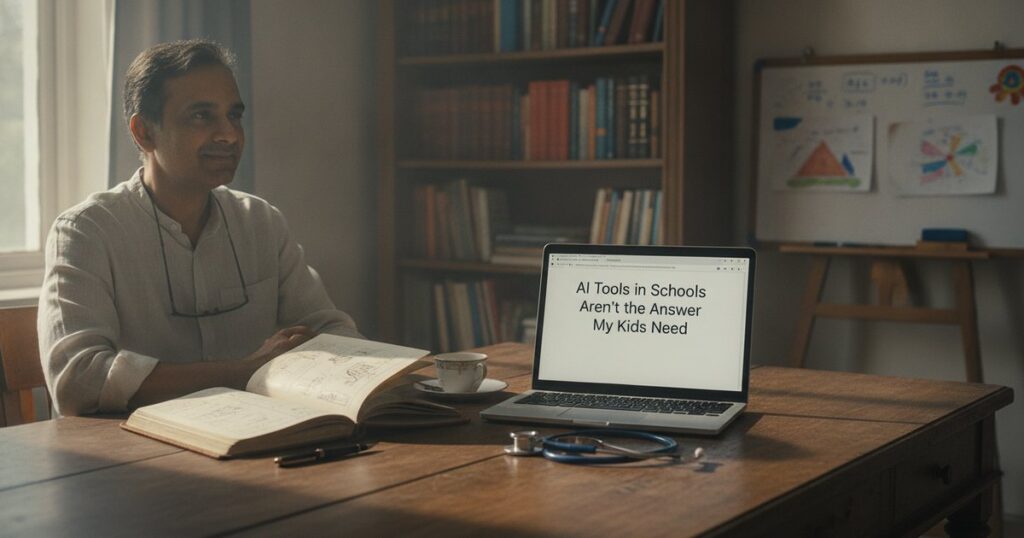
I’ve been thinking about the whirlwind of AI tools being thrust into educational systems lately. Just last week, I watched my son, engrossed in his computer, ask ChatGPT about a history assignment. He got an instant answer, neatly packaged, but I couldn’t shake off the nagging thought: did he really learn anything? This moment epitomizes a larger issue I’ve been wrestling with — the role of AI in education and its implications on genuine learning.
There’s no denying that AI is here to stay, infiltrating every nook of our lives, including education. But should we be handing over the reins of our children’s learning to algorithms and chatbots? I have my reservations. Education, to me, is not about instant answers but about the journey of discovery, the struggle through complex problems, and the satisfaction of connecting the dots independently. In my experience, both as a doctor and an investor, the process, not just the outcome, is what builds true capability.
When I see AI tools being marketed as revolutionary solutions for personalized learning, I can’t help but think of the promises that often accompany new technology. We’ve seen it in medicine, where every new gadget claims to be the next big thing. But just like in healthcare, in education too, it’s not the tool itself but how we use it that matters. AI can certainly help teachers identify learning gaps or automate mundane tasks, but it cannot replace the nuanced guidance that a passionate educator provides.
The Greek initiative to introduce AI in schools is a bold experiment, but I question its long-term impact. The idea of teaching teachers first makes sense — they are, after all, the architects of the learning process. But are we equipping them only to make them conduits for technology, or are we preserving their role as mentors who inspire critical thinking and curiosity?
In India, we are at a crossroads. Our education system, already burdened with rote learning and exam-centric approaches, risks becoming even more mechanized with the introduction of AI. What we need is not just another tool, but a profound shift in how we view education. We should be asking ourselves: Are we preparing our children to be thinkers, or are we conditioning them to be mere consumers of information?
I believe that meaningful learning occurs in the interplay of human interaction, where questions lead to discussions, and mistakes are opportunities for growth. AI lacks the empathy, the understanding, and the ability to inspire that a human teacher inherently possesses. My concern is that relying too heavily on AI could dilute these vital human elements of education.
In my practice, I often see parallels between education and medicine. In both fields, technology is a powerful ally but not a substitute for human insight. Just as I wouldn’t trust a machine to deliver the nuanced care my patients need, I wouldn’t want my children to rely solely on AI for their education. It’s the human touch, the encouragement, the challenge that fosters true learning and growth.
We also need to consider the implications of AI on skills like critical thinking and problem-solving. If students are spoon-fed answers, how will they learn to think for themselves? How will they develop the resilience to tackle problems that don’t have easy solutions? In a world where AI is omnipresent, the ability to think critically and independently will be more important than ever.
Furthermore, there’s the issue of privacy and data security. As AI tools collect vast amounts of data to personalize learning experiences, how can we be sure that our children’s data is protected? The potential for misuse is enormous, and it’s a risk we cannot afford to ignore.
The excitement around AI in education is understandable, but we must tread carefully. It’s not about banning AI or embracing it blindly; it’s about finding a balance where technology enhances but does not overshadow the human aspects of learning. We should strive for an educational model where AI serves as an assistant, not a replacement. This requires thoughtful design, with clear boundaries and objectives, ensuring that AI is used to support, not supplant, the educational experience.
For parents and educators, the challenge is to remain vigilant and engaged. We need to be active participants in our children’s education, guiding them to use AI wisely and critically. This means setting boundaries, just as we do with screen time or online content. It means teaching children to question, to discern, and to think deeply, even when answers are a click away.
In conclusion, while AI presents opportunities for innovation in education, we must not lose sight of the fundamental goal: nurturing well-rounded, critical thinkers capable of navigating a complex world. As I continue to observe my children and their interactions with AI, I am reminded of the need for a balanced approach — one that values technology as a tool, but cherishes the irreplaceable role of human insight and interaction in learning.
The real question we should be asking is not whether AI will help our children succeed, but how we can help our children succeed in a world where AI is just one of many tools at their disposal. Let’s ensure that as we embrace the future, we do not forget the lessons of the past: that education is a deeply human endeavor, rich with challenges, rewards, and the joy of discovery.