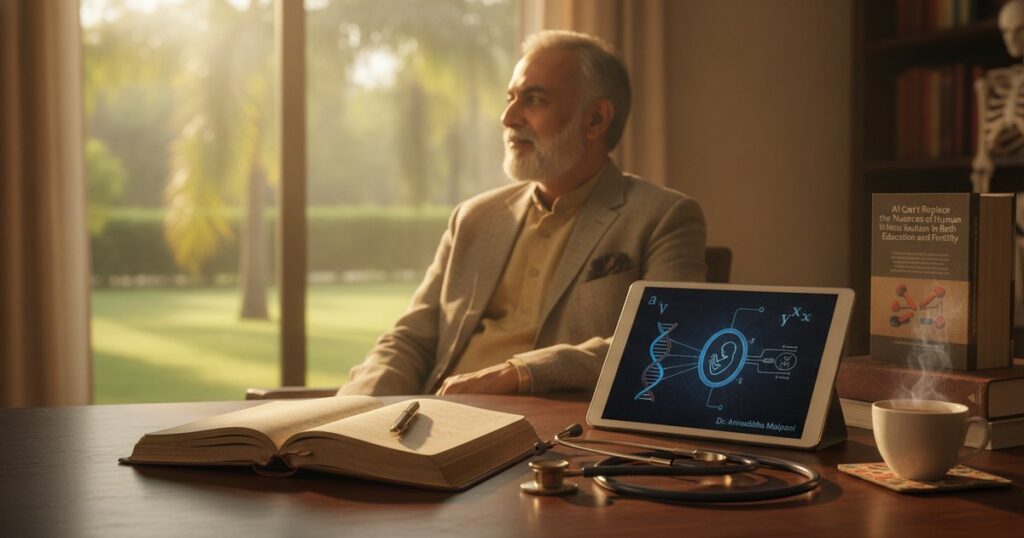
I recently sat across from a young couple in my clinic, their eyes filled with hope and trepidation. They were here to start their IVF journey after years of unsuccessful attempts to conceive naturally. As we discussed the intricacies of their treatment options, I couldn’t help but reflect on how much fertility treatment has evolved, particularly with the advent of AI technologies. Yet, even as I explained the potential benefits of AI-assisted diagnostics, I found myself emphasizing the irreplaceable role of human intuition in this deeply personal process.
This juxtaposition of AI and human intuition isn’t just confined to the walls of my clinic. It’s a theme that reverberates across my work as an angel investor and education reform advocate. In both education and fertility, AI offers remarkable tools that can enhance efficiency and accuracy. Still, it lacks the empathetic touch of a seasoned teacher or the nuanced understanding of a fertility specialist who can read between the lines of a patient’s fears and hopes.
Take the educational sector, for instance. AI-powered adaptive learning systems can personalize content delivery, theoretically catering to the unique learning pace of each student. But can they truly replace the intuition of a dedicated teacher who senses when a child is struggling silently or when a bit of encouragement could turn a student’s day around? I’ve written about this before in my blog post AI Tutoring Can’t Replace a Teacher’s Intuition—Here’s What I’ve Seen, highlighting how the subtleties of human interaction remain beyond the grasp of algorithms.
In the realm of fertility, AI can analyze vast datasets to identify patterns and predict outcomes that might elude a human eye. Yet, the comfort a patient finds in a doctor’s confidence and the instinctive decisions based on years of experience are beyond the reach of machines. I’ve often found that the most critical element in a successful IVF cycle isn’t just the scientific precision but the human connection that empowers a couple to navigate their emotional journey. It’s a sentiment echoed in my discussion on AI and IVF: Why Automated Solutions Can Never Replace Human Intuition.
This isn’t to dismiss the contributions of AI; rather, it’s to underline the necessity of a balanced approach where human intuition complements technological advancements. The danger lies in over-relying on one at the expense of the other. In the startup ecosystem, I’ve seen founders overwhelmed by data, losing sight of their vision and the gut instincts that initially drove their entrepreneurial spirit. It’s a topic I delve into in Why I Trust My Intuition More Than Data in Both IVF and Investments.
In education, the risk is similar. While AI can help identify gaps in learning, it’s the human educator who can instill a love for learning, a spark that no algorithm can manufacture. Education reform must prioritize nurturing this human capacity alongside the integration of technology.
Ultimately, the most profound insights often emerge at the intersection of intuition and technology. The founders who succeed are those who blend data-driven decisions with an intuitive grasp of their market’s pulse. In education and fertility, the most meaningful outcomes arise when human empathy and AI capabilities work in tandem.
As we continue to embrace AI across various domains, let’s not forget the irreplaceable value of human intuition. It’s this balance that will drive true innovation and progress, both in the classroom and the clinic.