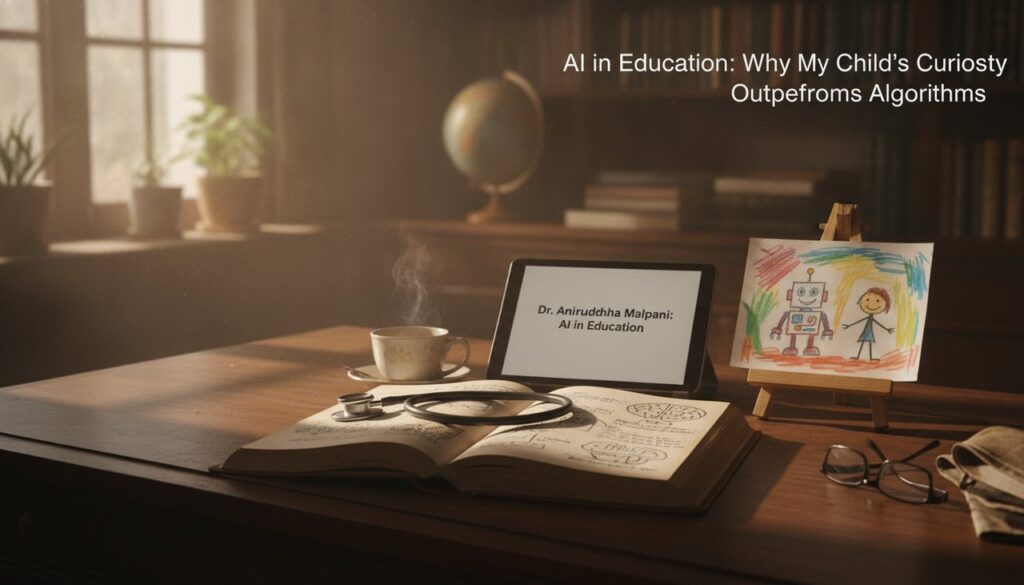
I’ve been observing my child lately, and it struck me how inherently curious they are. Watching them explore the world, ask relentless questions, and dive into activities with uninhibited enthusiasm is a reminder of the power of curiosity. This makes me reflect on the current buzz around artificial intelligence (AI) in education. As an advocate for educational reform and innovation, I’ve always been intrigued by the potential of AI. But, as I consider my child’s natural inquisitiveness, I find myself skeptical of AI’s ability to replicate or even nurture what comes so naturally to them.
I’ve invested in several ed-tech startups, and I’ve seen the allure of AI in education firsthand. The promises of personalized learning, adaptive algorithms, and smart tutors are enticing, no doubt. Yet, there’s a nagging question I can’t shake off: Can AI truly inspire the kind of curiosity that leads to profound learning and understanding?
There’s no denying that AI has made significant inroads in education. Platforms like DreamBox and Lexia are shining examples of how AI can tailor learning experiences to individual needs. DreamBox, an adaptive online math program, adjusts its difficulty based on a student’s performance. Lexia focuses on reading skills, providing structured lessons to enhance literacy. These tools are impressive, but they also highlight a fundamental flaw—AI excels at adapting to what a student knows but falls short in sparking the curiosity that drives genuine exploration.
Consider a recent interaction I had with a founder of an AI-driven educational platform. They explained how their system could guide students through complex problems, offering hints and nudges when needed. It’s a marvel of technology, and yet, I couldn’t help but wonder: Where’s the room for a child’s imagination? When a child is given all the answers—or even just the right hints—do they lose the thrill of discovery?
I remember a conversation I had with a patient years ago. They were anxious about the outcome of their IVF treatment, and I advised them to trust the process and remain curious about the possibilities. In both medicine and education, curiosity is a catalyst for progress. It encourages us to ask questions, seek out new solutions, and embrace uncertainty. In my experience, whether in healthcare or education, curiosity is the driving force behind meaningful change.
The rise of AI in classrooms presents a dual path. On one side, AI offers efficiency, scalability, and the promise of personalized learning. It can handle routine tasks, provide instant feedback, and free up educators to focus on more critical aspects of teaching. On the other side, there’s the risk of diminishing the very curiosity we should be nurturing in our children. If we’re not careful, we might end up with students who excel at answering questions but lack the drive to ask their own.
Let’s compare this to investing. When evaluating a startup, I don’t rely solely on algorithms or data points. I trust my gut feeling, the founder’s passion, and the potential for disruption. Similarly, in education, we must look beyond AI’s capabilities and consider what truly drives a child’s learning journey. It’s not just about getting the right answer; it’s about developing a lifelong love for learning.
One might argue that AI can model empathy, creativity, and curiosity, as seen with platforms like LittleLit. These systems attempt to simulate social-emotional learning by placing children in role-playing scenarios that encourage them to identify emotions and respond appropriately. It’s a noble effort, but can a machine truly teach empathy, a deeply human trait? In my opinion, these interactions can supplement but never replace genuine human connections.
The best learning experiences come from real-world interactions, where children engage with their environment and peers. They learn by doing, making mistakes, and discovering new perspectives. AI can be a tool in this process, but it shouldn’t be the sole driver. In fact, when AI tutors failed my child, it taught me the invaluable lesson that technology is just one piece of the educational puzzle. Real growth happens when curiosity leads the way.
So, how do we strike a balance? How do we integrate AI into education without stifling curiosity? The answer lies in intentional design and thoughtful implementation. AI should be used to augment, not replace, the learning experience. It should serve as a catalyst for curiosity, prompting students to ask more questions and explore new avenues.
For parents and educators, this means staying informed and involved. We must understand the tools our children are using and ensure they are designed with their best interests in mind. This means asking questions about privacy, safety, and the potential biases inherent in AI systems. It also means fostering an environment where curiosity is celebrated and encouraged.
As I watch my child navigate their world, I’m reminded of the incredible potential of curiosity. It’s a trait that has driven human progress for centuries. While AI can enhance our educational systems, it’s our responsibility to ensure it doesn’t overshadow the innate curiosity that makes learning a truly transformative experience.
In the end, it’s not about choosing between AI and curiosity—it’s about finding a way to let them coexist. Our children are growing up in a world shaped by technology, and it’s up to us to guide them in a way that fosters both intelligence and humanity. Let’s raise a generation that’s not only smart about AI but deeply curious about the world around them.