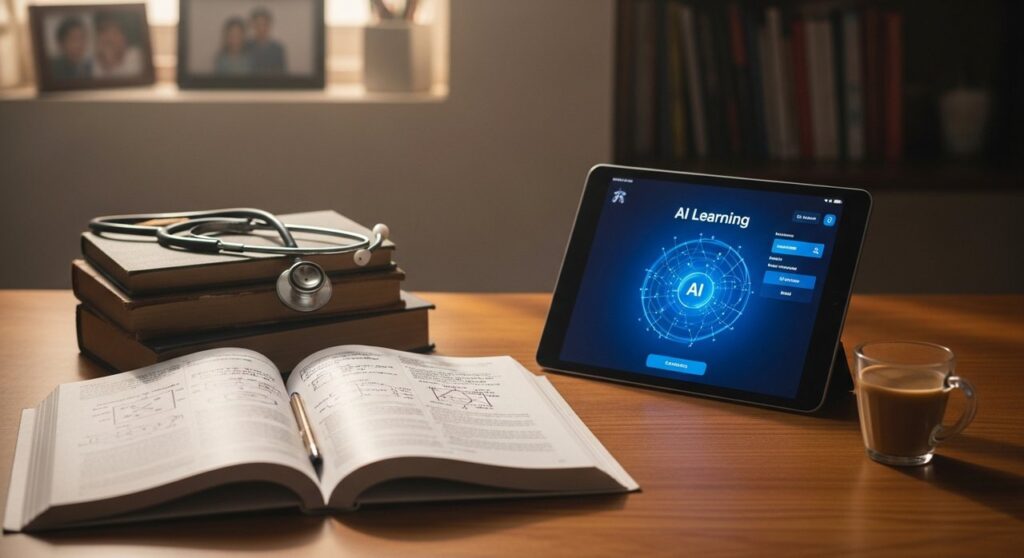
I’ve been thinking about my children’s education a lot lately, especially in the context of the rapid rise of AI tools in the classroom. My daughter came home the other day buzzing about how an AI assistant helped her with her math homework. As someone who has spent a good part of my life in the realms of both medicine and investment, I’m no stranger to the allure of new technologies. However, when it comes to my kids’ education, the question I ask myself is, “What do I truly want for them?”
AI tools have undeniably made their way into our educational landscape. They’re touted as the next big thing, promising to revolutionize learning by offering personalized education, saving teachers time, and even enhancing student engagement. But is all this enough to replace the age-old textbook? I don’t think so.
I still remember the satisfaction of cracking open a fresh textbook, its pages crisp with the promise of knowledge. Textbooks have been the bedrock of education for centuries, and for good reason. They provide a structured foundation, carefully curated content, and a sense of progression and accomplishment as one works through them. Sure, they might lack the interactivity of AI, but they offer something else: depth, reliability, and a tactile connection to learning.
AI, on the other hand, offers flexibility and adaptability. It can adjust to a student’s pace, provide instant feedback, and make learning more engaging through interactive simulations. But here’s where my concern lies: can it foster critical thinking? Can it inspire the same depth of understanding that comes from wrestling with complex ideas in a textbook?
In my practice as an IVF specialist, I’ve seen how technology can augment human capability but not replace human insight. The same principle applies to education. AI should be seen as a tool to complement traditional learning methods, not replace them. I worry that an over-reliance on AI could lead to a superficial understanding of subjects, where students know “how” to get the answers but not “why” those answers are what they are.
In investing, I’ve learned the value of balance—diversifying holdings to mitigate risk while maximizing potential return. Similarly, in education, balance is key. AI can handle repetitive tasks, provide personalized quizzes, and even help teachers identify students who need more support. But when it comes to teaching critical thinking, ethics, and the ability to question, traditional methods still hold their ground.
One founder I backed once told me, “Technology is only as good as the hands that wield it.” This rings true in education as well. It’s not enough to have AI in the classroom; we need educators who can integrate it thoughtfully into their teaching. They need to know when to let AI take the reins and when to rely on tried-and-tested methods.
Moreover, the use of AI in education raises important questions about data privacy and ethical usage. As a parent, I am concerned about the amount of data being collected on students and how it might be used. Transparency and clear guidelines are essential to address these concerns, ensuring AI serves as a benefit, not a liability.
I am not against AI in education. In fact, I believe it holds tremendous potential for enhancing learning experiences. But, as with any tool, its effectiveness depends on how we use it. We should not allow technology to overshadow the importance of human interaction and the foundational skills and values that textbooks have imparted for generations.
In conclusion, what I want for my kids’ education is a harmonious blend of the old and the new. I want them to experience the tactile joy of flipping through a textbook, wrestling with its challenges, and emerging more informed and insightful. At the same time, I want them to benefit from the adaptive learning and instant feedback that AI can provide. It’s not about choosing one over the other but about weaving them together to create a richer tapestry of learning.
Ultimately, education is not just about acquiring knowledge; it’s about shaping thinkers who can navigate a world that is constantly evolving. And for that, we need both the AI tools and the textbooks, working side by side.