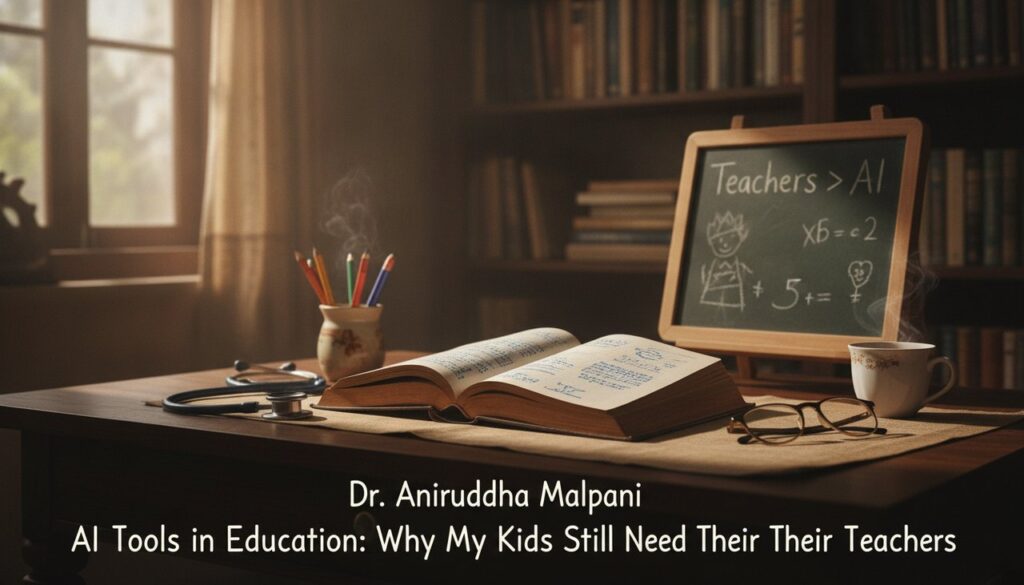
I’ve been reflecting on the ever-growing presence of AI in education—especially as I watch my own children navigate their school environment—and it’s clear that while AI tools are becoming increasingly sophisticated, the role of a good teacher remains irreplaceable. Just the other day, my daughter came home excitedly rattling off how her math class used an AI tool to solve complex equations. She was thrilled by the instant feedback and adaptive learning features. Yet, when I asked her what made the lesson truly resonate, she said it was her teacher’s ability to explain the “why” behind the math. This struck me as a profound reminder: AI can enhance learning, but it cannot replace the human touch that makes education deeply personal and impactful.
As someone deeply vested in both education and technology, I welcome the role AI plays in modern classrooms. It has the potential to save time, offer personalized learning experiences, and even assist teachers by handling mundane tasks, allowing them to focus on what they do best: teaching. However, the notion that AI could replace teachers is not only misguided but perilous. Let’s not forget that AI is a tool, not a teacher. It’s an enabler, not a replacement.
The promise of AI in education mirrors the promise and pitfalls I’ve seen in the startup world. Many founders I’ve backed have faced the temptation to automate too much too soon—hoping technology could solve problems that are inherently human. More often than not, I’ve had to remind them that technology can amplify a vision, but it can’t define it. Similarly, in education, AI tools can support teachers, but they can’t replicate the nuanced understanding a teacher brings to the classroom.
Consider AI’s ability to provide instant feedback. It’s a feature I’ve seen parents and educators laud as revolutionary. Indeed, students can receive immediate responses to their work, allowing them to learn and correct mistakes in real time. But let’s pause and consider what this feedback lacks: the context and empathy only a human can provide. A teacher’s feedback isn’t just about right and wrong; it’s about understanding a student’s unique learning style, emotional state, and even their home environment.
In my work with startups, I’ve seen how crucial mentorship is. Investors like me don’t just provide funds; we offer guidance, reassurance, and sometimes a needed reality check. Similarly, a teacher’s role extends beyond delivering curriculum content. A teacher mentors, inspires, and sometimes even changes the trajectory of a student’s life. AI can provide data, but it can’t provide wisdom. It can analyze performance, but it can’t understand potential. That’s the domain of humans.
One cannot discuss AI in education without addressing the issue of equity. AI tools require infrastructure—computers, internet access, and software—that not every school can afford. In India, where educational resources are already stretched thin, this creates a divide. The schools with the means to integrate AI fully will surge ahead, leaving others behind. This is why I believe AI should complement existing educational tools, not replace them. It’s crucial to ensure that AI serves as an equalizer, not an amplifier of disparity. This reminds me of a startup I encountered, which aimed to bring telemedicine to rural India. The technology was promising, but without addressing the infrastructure gaps, it risked widening the healthcare divide.
Moreover, AI algorithms are only as good as the data they are trained on. Bias can creep in, and if unchecked, it can perpetuate stereotypes and inequalities. Teachers, with their unique ability to adapt and question, are our best defense against this. They can use AI insights to inform their teaching but not let it dictate their approach. AI can flag a student as “at risk,” but a teacher will know whether it’s due to a learning challenge or perhaps something as simple as a temporary distraction due to personal issues.
In medical practice, I’ve often been reminded of the value of human intuition. AI can analyze big data sets to predict outcomes, but it can’t replace the seasoned judgment of a doctor who knows their patient’s history intimately. Similarly, a teacher’s intuition about a student’s needs can’t be coded into an algorithm. Teachers see the things that data points can’t capture—the nervous fidgeting before a test, the spark of curiosity when a lesson clicks, the subtle signs of a student in distress. These observations are invaluable.
One of the most compelling arguments for the irreplaceable role of teachers is their ability to inspire. I remember a teacher who profoundly impacted me not by the content of his lessons alone but by the passion with which he delivered them. He made learning exciting and alive. AI can provide information, but it can’t ignite inspiration. It can’t engage students in a way that leaves them pondering long after the lesson is over.
As I continue to watch my children grow and learn, I’m more convinced than ever that while AI is a valuable addition to education, it should never overshadow the human elements that make learning an enriching experience. Teachers are not just providers of knowledge; they are cultivators of curiosity, empathy, and resilience. These are qualities no machine can replicate.
In conclusion, AI has a rightful place in the educational landscape, but it is the teachers who breathe life into learning. They are the ones who can turn a room full of information into a space of inspiration and discovery. Just as in the startup world, where technology is a tool to realize a vision, in education, AI is a tool to enhance a teacher’s mission. My children—and indeed all children—deserve both the best of technology and the irreplaceable wisdom of their teachers. Let us ensure they have both.