Q1. What’s the “magic sauce” at Eklavya?
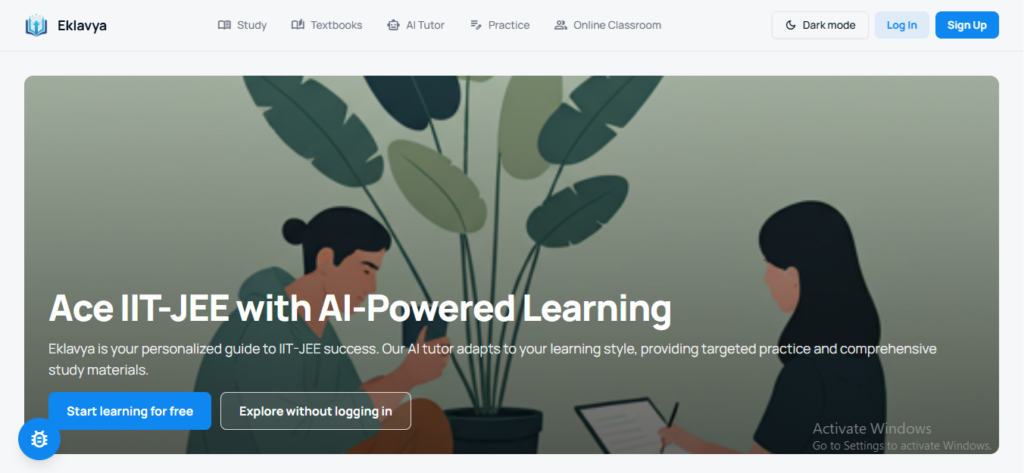
Two things: a personalised AI tutor that coaches you based on your learning journey, and a free, open-source online JEE Textbook. Together, they replace expensive tuitions and outdated books with an adaptive, living system designed around the learner.
Q2. Why pair an AI tutor with an open-source textbook?
The textbook gives you a clean, complete conceptual spine; the AI tutor wraps it with diagnostics, targeted practice, and step-by-step coaching. Read to understand, practice to internalize, and let the tutor point you to exactly what to fix next.
Q3. What does “student autonomy and agency” look like here?
You choose what to study, how deep to go, and when to switch gears. The platform provides guardrails—clear goals, instant feedback, and progress maps—so freedom becomes focus, not drift.
Q4. How is the online textbook better than printed guides?
Because it’s alive. Errors get fixed fast, new question types are added, and explanations evolve with student feedback. It’s multimedia too—audio for quick refreshers, video for visual intuition, and interactive widgets where useful.
Q5. What makes the AI tutor genuinely personalised?
It detects types of mistakes—conceptual gaps, procedural slips, careless errors, or pacing issues—and adapts your next steps: micro-lessons, targeted drills, scaffolding hints, and quick re-checks to confirm closure.
Q6. Can this really replace commercial tuitions?
Yes, for most students. Tuitions broadcast the same lecture to everyone; our tutor adapts minute-to-minute. If you still value human mentorship, use teachers for mindset and strategy while the AI handles explanations, diagnostics, and practice.
Q7. Is the textbook truly free—and open source?
Absolutely. You don’t need to buy expensive books or paywalls. Open source means the community can audit, improve, and extend content. Transparency beats marketing.
Q8. How do you ensure fundamentals over “tips and tricks”?
Every chapter follows a master sequence: intuition → definition → derivation → worked examples → varied problems → reflection. The tutor asks you to explain steps and compare methods so understanding—not memorization—drives progress.
Q9. What’s a high-impact daily routine?
15–20 min: skim/review the relevant textbook section (audio/video as needed)
40–60 min: adaptive problem set from the tutor (mixed difficulty, spaced)
10–15 min: error log + reflection (“what failed and why?”)
5 min: plan one micro-commitment for tomorrow
Q10. I’m starting late. Can Eklavya still help?
Yes. The tutor builds a “shortest bridge” plan, prioritizing high-yield nodes that unlock multiple topics. You’ll trade breadth for depth intelligently and avoid panic-grind cycles.
Q11. How does the platform prepare me for the exam, not just the syllabus?
Timed, mixed-topic sets simulate real pressure. Post-test analytics show accuracy vs. time, guess patterns, last-minute traps, and a pacing plan for the next mock. You practice performing, not just studying.
Q12. Will this work with low bandwidth or shared devices?
We optimize for light pages, downloadable practice, and printer-friendly error logs. Short sessions still count. Access is a design constraint, not an afterthought.
Q13. Does the textbook support multiple ways of learning?
Yes—concise derivations, visual intuitions, everyday analogies, and bilingual scaffolds where helpful, always returning to rigorous exam-grade language. Different paths, same destination: clarity.
Q14. Where do parents and teachers fit in?
Parents: be accountability partners—review weekly dashboards, celebrate consistency, avoid micromanaging. Teachers: use the tutor to surface class-level misconceptions, form peer-teaching groups, and target interventions precisely.
Q15. How do you keep me motivated without gimmicks?
By showing evidence. Mastery bars move only when you solve varied problems correctly and explain your reasoning. Streaks reward meaningful effort, not idle screen time. Progress you can feel sustains motivation.
Q16. What about privacy and data use?
Your learning data personalizes your journey—what to review, when, and how. We don’t sell personal data. Aggregated, anonymized patterns guide content improvements and fairness checks.
Q17. How do I use the textbook and tutor together, step-by-step?
Read the micro-section you plan to learn.
Attempt the tutor’s adaptive set.
Log and tag every error (conceptual/procedural/careless/pacing).
Revisit the exact subsection linked by the tutor.
Re-test to confirm closure.
Schedule spaced review automatically.
Q18. Is “free” low quality?
Free is a funding choice, not a quality verdict. Quality comes from open review, tight feedback loops with students, rapid fixes, and transparent metrics. Glossy brochures don’t beat community-verified clarity.
Q19. Can students contribute to the textbook and tutor?
Please do. Flag unclear items, suggest better hints, upload alternate solutions, or record 2-minute explainers. When learners teach learners, everyone gets smarter—including the contributors.
Q20. What’s the big picture?
We’re rebuilding JEE prep around the learner: autonomy over coercion, mastery over hacks, and equity over paywalls. The exam becomes a launchpad, not a treadmill—and you carry that agency into college, work, and citizenship.
Help us improve India’s first free AI Tutor for JEE students !