Q1. Why am I asking you to stop wasting time and money on commercial tuitions?
Because most of them reward passive listening and exam tricks. You feel busy, but you’re not getting better. Real JEE success comes from active thinking, not note-copying or shortcut memorization.
Q2. What’s wrong with canned videos and classroom lectures?
They create the illusion of mastery—your brain recognizes ideas without being able to use them. If you aren’t solving problems, explaining steps, and checking your reasoning, you’re not learning—only consuming.
Q3. So how is our AI tutor different?
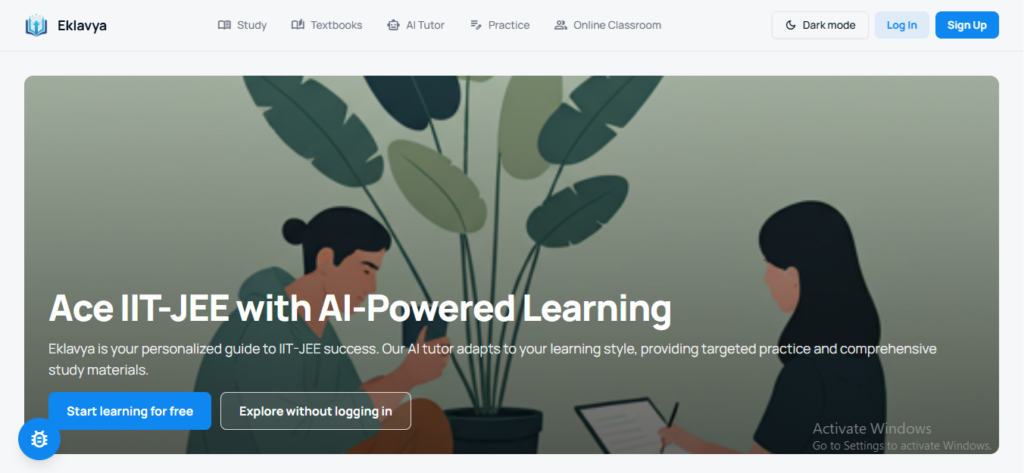
It’s interactive, adaptive, and available 24×7 at home. It diagnoses your gaps, personalizes practice, and nudges you to do the work—the kind that builds conceptual muscle, not just recall.
Q4. Will the AI tutor replace teachers or coaching?
No. Think of it as a co-pilot. It handles explanations, micro-practice, and error diagnosis so teachers and mentors can focus on strategy, mindset, and higher-order doubts.
Q5. What do “autonomy” and “agency” mean for a JEE student?
Autonomy means choosing what, when, and how you study; agency means owning outcomes and iterating. We give you guardrails—clear goals, instant feedback, mastery dashboards—so freedom never turns into drift.
Q6. How does the tutor ensure I master the basics?
Every concept runs a tight cycle: intuition → definition → derivation → worked example → varied problems → reflection. You’ll be asked to explain steps, compare methods, and apply ideas in new contexts—true mastery.
Q7. What does a high-impact daily plan look like?
15–20 min: concept recap or mini-lesson
40–60 min: adaptive problem sets (mixed difficulty, spaced)
10–15 min: error log + reflection (“what tripped me up and why?”)
5 min: plan tomorrow’s single micro-commitment
You can reorder—but never skip reflection.
Q8. How does the system find my weaknesses?
Your attempts are analyzed for type of error—conceptual, procedural, careless, or pacing. The tutor then prescribes a shortest-path remedy: micro-lessons, targeted problems, and a quick retest to confirm closure.
Q9. I’m starting late. Is there still hope?
Yes—if you’re strategic. We prioritize high-yield concepts that unlock multiple topics, cut low-ROI grind, and schedule focused practice. You’ll trade breadth for depth intelligently—no panic cramming.
Q10. How do you keep me motivated without gimmicks?
By showing real progress. Mastery bars move only when you demonstrate understanding across varied problems. Streaks reward consistent effort, not idle screen time. Evidence beats confetti.
Q11. Can I study in short, low-data sessions?
Absolutely. We optimize for light pages, downloadable practice, and printer-friendly error logs. Learning should work even with limited bandwidth and shared devices.
Q12. Does the tutor support bilingual or alternative explanations?
Where helpful, yes. We use bilingual scaffolds, visual intuition, and analogies—then bring you back to rigorous, exam-grade language so you’re ready for JEE phrasing.
Q13. How do I prepare for exam conditions—not just the syllabus?
Timed mixed-topic sets simulate pressure. Post-test analytics show accuracy vs. time, guess patterns, and “last-minute traps.” You’ll get pacing plans and warm-up routines for test day.
Q14. What about parents—how can they help without micromanaging?
Parents should be accountability partners, not taskmasters. Review the weekly dashboard together, ask, “What will you try differently tomorrow?” and celebrate consistency over raw scores.
Q15. Can schools or tuition teachers use this responsibly?
Yes—use it to raise the floor. Assign targeted sets, form peer-teaching groups around shared misconceptions, and monitor class-level mastery while preserving student choice and pace.
Q16. Is it really free? What’s the catch?
The core learning journey is free by design. Quality comes from tight feedback loops with students and open review of questions—not from paywalls. If optional premium features ever appear, the free path to mastery stays intact.
Q17. What about my data and privacy?
Your learning data personalizes your experience—what to review, when, and how. We don’t sell personal data. Aggregated, anonymized trends help us improve fairness and content quality.
Q18. How do I actually get started today?
Pick one weak subtopic. Do a 45-minute focused session: mini-lesson → 10–12 adaptive problems → error log → 2-line reflection. Set one micro-commitment for tomorrow. Repeat. Momentum > motivation.
Q19. What results should I expect—and when?
In 2–3 weeks of disciplined sessions, you should see fewer careless errors, clearer step-by-step reasoning, and better pacing. In 6–8 weeks, your mastery map will thicken and mocks will feel calmer and more predictable.
Q20. Can I contribute to make the tutor better?
Please do. Flag unclear items, propose better hints, upload alternate solutions, or record quick student explainers. Teaching others deepens your own understanding—and lifts the whole community.
Help us improve India’s first free AI Tutor for JEE students !