1. Why do some teachers feel threatened by AI tutors?
Because AI tutors expose their weaknesses. Let’s be honest — not every teacher is passionate, updated, or student-centric. Many rely on outdated notes, repetitive lectures, and intimidation rather than inspiration. When an AI tutor can explain a tough concept better, answer questions instantly, and never lose patience — such teachers suddenly feel dispensable. It’s not the AI they fear — it’s accountability.
2. So, does this mean AI tutors will replace teachers?
Absolutely not. AI tutors are tools — not replacements. Just like a calculator didn’t replace mathematicians, AI won’t replace great teachers. But it will replace mediocre ones. The role of teachers will evolve — from delivering lectures to mentoring, motivating, and helping students learn how to learn. AI tutors take care of the “teaching”; good teachers focus on the “learning.”
3. What makes a teacher “good” in the age of AI?
A good teacher welcomes technology because they care more about the student’s success than their own ego. They know AI tutors make learning faster, deeper, and fairer. These teachers use AI to personalize learning, identify weak spots, and free up class time for discussion and creativity. They don’t fear competition — they embrace collaboration.
4. What exactly does an AI tutor do that human teachers can’t?
An AI tutor is tireless, objective, and instantly available. It can:
- Explain the same concept ten times without losing patience.
- Adapt its teaching style to your pace.
- Provide immediate feedback on tests and mistakes.
- Track your progress continuously.
- Offer unlimited practice and revision.
No human teacher can do this 24/7. But the magic happens when humans and AI work together — the empathy of a teacher combined with the precision of AI creates the ultimate learning experience.
5. Why do bad teachers dislike AI tutors so much?
Because AI tutors eliminate their control. Many teachers thrive on authority — they enjoy being the “only source” of knowledge. AI democratizes information. Students can now fact-check their teachers, ask smarter questions, and learn ahead of the syllabus. This scares insecure teachers who prefer obedient students over independent thinkers. AI tutors shift power — from the teacher’s desk to the student’s screen.
6. But aren’t teachers essential for human connection and motivation?
Of course! Students still need empathy, encouragement, and emotional guidance. AI tutors can provide clarity and confidence — but only a good teacher can provide inspiration. However, when the routine explanation work is handled by AI, teachers finally get time to teach like humans: mentor, listen, and ignite curiosity. AI doesn’t destroy the teacher-student bond — it frees it from rote learning.
7. How do AI tutors help good teachers do their job better?
AI tutors handle the repetitive drudgery — grading, generating questions, revising basics. This lets good teachers focus on high-value teaching — critical thinking, problem-solving, and conceptual discussions.
Teachers can track student progress in real time.
They can tailor lessons based on data, not guesswork.
They can identify struggling students early and help them personally.
It’s like having a digital assistant in every classroom. The result: teachers become coaches, not clerks.
8. Won’t students become lazy if AI tutors make learning too easy?
Only if they were lazy to begin with! AI tutors don’t spoon-feed; they challenge students intelligently. They provide hints, not answers. They push you to think and reflect. The beauty of AI is that it rewards curiosity — the more you explore, the smarter it gets at teaching you. Lazy students can misuse anything — including teachers. But motivated learners use AI as a trampoline, not a crutch.
9. How does Eklavya’s AI tutor put students first?
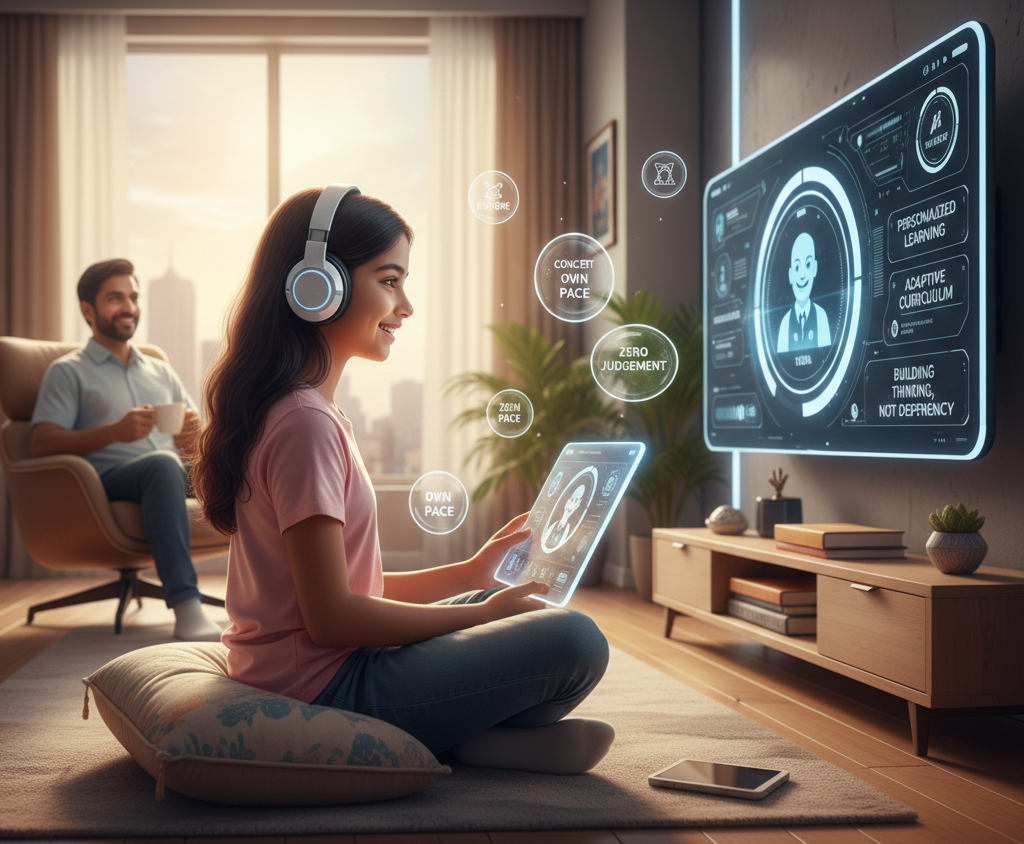
Traditional classrooms revolve around teachers — their timetable, their notes, their priorities. At Eklavya, the student is the center of the system. The AI tutor waits for you, teaches you at your pace, and never loses patience. You decide when, where, and how you learn. You can ask the same question twenty times without embarrassment. You can create your own private classroom, invite friends, and learn together — guided by a tireless AI companion.
10. How can teachers and AI tutors coexist?
By understanding their roles. The AI tutor is the explainer — it ensures every student understands the basics perfectly. The teacher is the enabler — they cultivate wisdom, confidence, and curiosity. In a truly modern classroom, AI tutors handle knowledge delivery, and teachers elevate thinking. Together, they can make education both efficient and inspiring.
11. What happens to the “chalk-and-talk” teacher now?
They evolve — or they disappear. The ones who evolve will become more valuable than ever. Instead of lecturing, they’ll mentor. Instead of disciplining, they’ll guide. Instead of fearing AI, they’ll use it to amplify their impact. The rest — the ones who cling to outdated authority and resist change — will fade away, just like typewriters in the age of laptops.
12. What does this mean for students preparing for JEE?
It means freedom and fairness. With Eklavya’s AI tutor, every student — regardless of where they live or how much they can pay — gets access to world-class guidance. No more bad teachers, no more biased evaluations, no more paying lakhs for generic coaching. Every learner can now create their own classroom, learn with friends, and get instant, personalized help 24/7. That’s not the future — it’s happening right now.
13. So, are AI tutors good or bad for education?
They’re as good or bad as the people using them. In the hands of bad teachers, AI can become a gimmick. In the hands of good teachers — and empowered students — AI becomes revolutionary. The goal isn’t to replace anyone, but to elevate everyone. Education should be about enlightenment, not ego.
Help us improve India’s first free AI Tutor for JEE students at app.jee.eklavya.io!
We want students to become independent, self-directed lifelong learners who use AI not to cheat — but to learn smarter, faster, and freer.