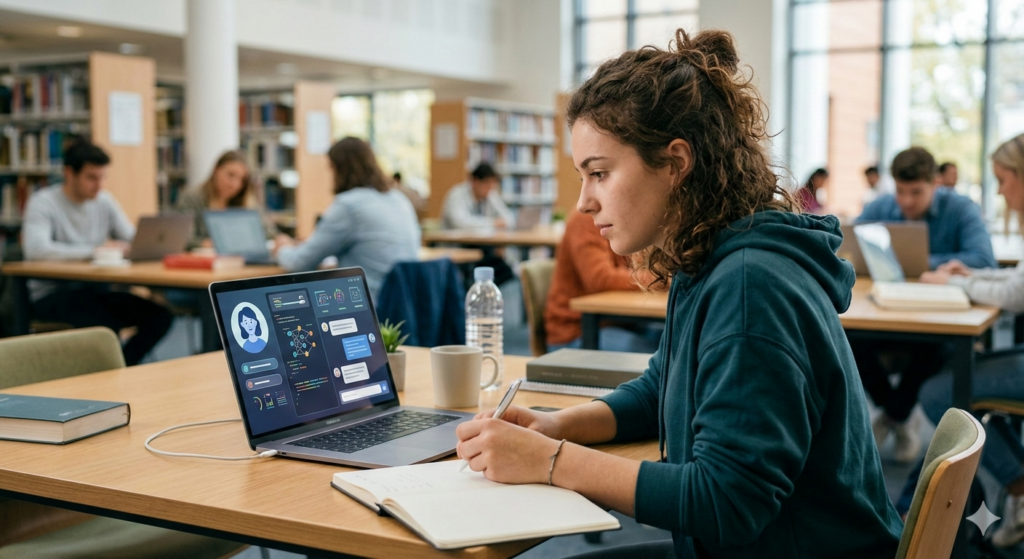
1. Parents themselves use AI at work — so why don’t they promote it for their kids?
Ironically, parents who rely on AI tools like ChatGPT, Copilot, or Grammarly to get smarter and more efficient at work often resist letting their children use the same technology to study. They fear AI might make kids “lazy” or “dependent.” The truth is, AI doesn’t replace learning — it enhances it. Just like a calculator didn’t stop people from learning maths, an AI tutor doesn’t stop students from thinking. Instead, it helps them learn faster, ask better questions, and explore deeper answers.
2. Isn’t AI just giving students shortcuts?
That’s a misconception. AI is not a cheat code — it’s a tool for understanding. When students use an AI tutor properly, they can ask “why” and “how” questions that textbooks and teachers don’t have time for. It’s like having a patient, infinitely available mentor who explains until the concept clicks. Using AI for self-learning teaches curiosity and independence — the very skills schools claim to value but rarely cultivate.
3. Why do parents prefer tuition teachers over AI tutors?
Parents often equate personal attention with physical presence. A tuition teacher sitting next to their child gives them the illusion of discipline and control. But most tuitions are glorified homework-monitoring sessions, not real learning. An AI tutor, on the other hand, adapts to the student’s level, never gets tired, and gives instant feedback — something no human teacher can consistently do for every child. What students need is not more supervision — it’s smarter guidance.
4. Isn’t it risky to let kids learn on their own?
Letting kids learn independently doesn’t mean abandoning them. Parents can act as learning coaches instead of taskmasters. They can help set goals, track progress, and encourage curiosity. With an AI tutor, learning becomes transparent — every question, answer, and error is visible. The risk is not in giving kids autonomy; the real risk is making them passive learners who can’t think without external instruction.
5. How can AI actually make learning more human?
It sounds paradoxical, but AI makes education more personal. Instead of forcing every child into a one-size-fits-all classroom, AI tailors lessons to each learner’s strengths and weaknesses. A shy student who hesitates to ask questions in class can freely interact with an AI tutor without fear of judgment. This builds confidence, emotional safety, and self-awareness — the true foundations of human learning.
6. What about screen addiction and distractions?
The problem isn’t screens — it’s what’s on them. A child watching random videos is wasting time; a child exploring physics experiments with an AI tutor is learning deeply. The key is purposeful screen time. Just as parents teach healthy eating habits, they must also teach healthy digital habits — balancing AI-based learning with play, discussions, and real-world exploration.
7. How does using AI prepare kids for the future?
Every profession — from medicine to marketing — now uses AI tools. The jobs of tomorrow will demand AI fluency. If parents want their kids to thrive, they need to stop shielding them from AI and start empowering them to master it. A student who learns how to collaborate with AI today will be a confident, capable problem-solver tomorrow. Ignoring AI is like refusing to teach English in the 1990s — it handicaps the child for life.
8. Isn’t school already enough for learning?
Sadly, most schools still follow a 19th-century model designed for clerks, not creators. Exams test memory, not understanding. Teachers rush through syllabi instead of nurturing thinking. AI learning bridges this gap — it makes education adaptive, interactive, and student-driven. Students can learn at their own pace, revisit topics, and connect concepts across subjects — something no fixed timetable allows.
9. How can parents get started with AI-based learning for their kids?
It starts with trust. Let your child explore AI tools like Eklavya’s free AI Tutor. Encourage them to ask their doubts, test themselves, and explain what they’ve learned. Parents don’t need to be subject experts — they just need to be cheerleaders of curiosity. The best gift you can give your child is not another tuition class, but the confidence to say, “I can figure this out myself.”
10. What if the AI gives wrong or incomplete answers?
That’s part of the learning journey. AI isn’t perfect — but that’s precisely why it’s valuable. When students learn to verify, cross-check, and question AI’s responses, they develop critical thinking. The goal isn’t to make them trust machines — it’s to help them learn how to think like scientists, evaluating every answer before accepting it.
11. Why is this shift urgent now?
Because the education system won’t reform itself. If parents keep outsourcing learning to schools and tuitions, we’ll raise another generation of obedient clerks instead of creative thinkers. AI gives families the power to reclaim education from bureaucracy — to make it personal, joyful, and effective again. Waiting for schools to change is like waiting for dial-up internet to come back — hopeless and outdated.
12. What’s the ultimate goal of AI in education?
It’s not to replace teachers or schools. It’s to liberate learners. Every child should have access to a patient, personalized tutor who helps them think, question, and grow. When students become self-directed, they stop studying for marks and start learning for mastery. That’s the revolution India needs.
Final Thought
If AI can help adults perform better at work, why shouldn’t it help children perform better in life? Let’s stop fearing the future and start preparing for it — one curious learner at a time.
Help us improve India’s first free AI Tutor for JEE students at app.jee.eklavya.io! We want students to become independent self-directed lifelong learners.