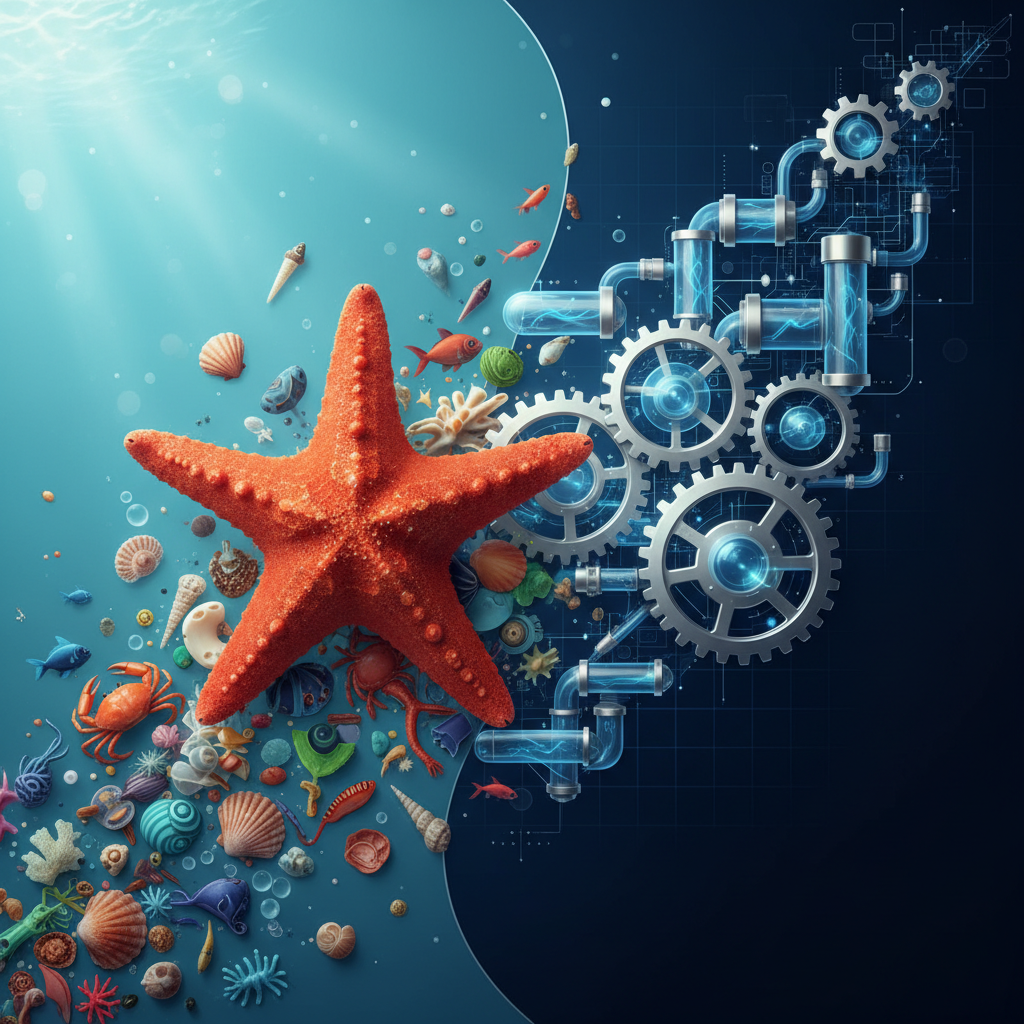
1. What is the “Starfish Approach” in education?
The Starfish Approach focuses on helping one student at a time—usually through scholarships, sponsorships, or charity. The story comes from a child throwing stranded starfish back into the sea, saving them one by one. Each saved starfish matters deeply, and the impact on that individual life can be transformative. Many education NGOs work this way: they identify bright or needy students and help them access better schooling.
This is noble, compassionate, and meaningful. But here’s the uncomfortable truth—it does not scale. Millions of equally deserving students remain untouched. When help is limited, selection becomes competitive, and education begins to feel scarce rather than abundant.
2. What are the limitations of the Starfish Approach?
The biggest limitation is scale. Helping one child at a time cannot solve a systemic problem affecting millions. Even worse, it unintentionally creates a scarcity mindset: students feel they must compete for limited opportunities, scholarships, or seats. This can breed anxiety, comparison, and dependence.
Charity helps individuals. Systems change helps societies.
If we truly want education reform, we must move beyond saving individual starfish and start changing the ocean.
3. What is the “Systems Approach” to education reform?
The Systems Approach focuses on fixing root causes rather than symptoms. Instead of asking, “Which student should we help?” we ask, “Why is quality education still inaccessible to most students?”
This approach looks at:
- Cost barriers
- Lack of autonomy in learning
- Overdependence on teachers and tuition
- Rote learning instead of thinking
- Unequal access to high-quality resources
When systems improve, every student benefits, not just a selected few.
4. Why is education still expensive when knowledge is abundant?
This is the key paradox. Today, high-quality educational content is widely available—often free. AI tutors, open resources, digital libraries, and interactive tools have dramatically reduced the cost of knowledge delivery. So why does education remain expensive?
Because traditional education sells structure, control, and certification—not learning. Schools often act as gatekeepers rather than enablers. The real barrier is not lack of content—it is lack of student autonomy and agency.
When students depend entirely on institutions, learning becomes costly. When students learn how to learn, education becomes affordable.
5. How does the Systems Approach create an abundance mindset?
The Systems Approach starts with a simple belief: There is no shortage of knowledge.
Every child can access high-quality learning resources if barriers are removed. Instead of competing for limited seats or scholarships, students can:
- Learn at their own pace
- Explore their interests
- Use AI tutors for guidance
- Build understanding independently
This shifts education from scarcity (“Who gets help?”) to abundance (“How can everyone learn?”).
6. What role do AI tutors play in systemic reform?
AI tutors are a game-changer. They make personalised learning available 24/7, at near-zero cost. But their real power is not in giving answers—it’s in encouraging thinking.
A good AI tutor:
- Asks questions instead of spoon-feeding
- Encourages reasoning and exploration
- Adapts to each student’s pace
- Removes fear and judgment
- Promotes self-directed learning
This transforms students from passive recipients into active learners.
7. Why is autonomy essential for real learning?
Because learning cannot be forced—it must be owned. When students are told exactly what to study, when to study, and how to study, they become dependent. When students are given autonomy, they become curious, engaged, and motivated.
Autonomy builds:
- Confidence
- Responsibility
- Critical thinking
- Lifelong learning habits
A student who learns independently today becomes a self-directed learner for life.
8. How does this approach change the role of teachers and schools?
It doesn’t eliminate teachers—it elevates them. Teachers shift from information providers to learning guides. Instead of delivering lectures, they:
- Encourage questioning
- Facilitate exploration
- Support problem-solving
- Help students reflect
Schools become learning ecosystems rather than instruction factories. The focus moves from teaching content to developing thinkers.
9. Can this approach truly reach millions of students?
Yes—because systems scale, charity doesn’t. Digital tools, AI tutors, and open learning platforms allow one innovation to reach thousands, even millions, simultaneously. When students learn how to think independently, they no longer need constant external instruction.
The goal is not to create a few success stories—it is to democratise learning.
10. What is the long-term vision of this reform?
To create a generation of independent, self-directed lifelong learners.
Students who:
- Ask questions instead of memorising answers
- Explore instead of obeying blindly
- Learn continuously, not just for exams
- Use technology intelligently
- Take ownership of their education
When students gain autonomy and agency, education stops being something delivered to them—and becomes something driven by them.
11. What is the core difference between the two approaches?
Starfish Approach: Changes individual lives.Systems Approach: Changes the future of education.
Both are compassionate. But only one is scalable.
12. What is the ultimate message for parents, educators, and policymakers?
Stop asking, “Which student should we help?” Start asking, “How can every student learn independently?”
Education reform is not about giving more—it’s about unlocking the learner within every child.
When students are trusted with autonomy, supported by intelligent tools, and encouraged to think for themselves, they don’t just succeed in school—they become lifelong learners prepared for the future.
Don’t just save starfish. Change the ocean. Empower students with autonomy, agency, and the ability to learn for themselves—and real education reform will follow.