Part 7 of 24 in School Is Not Education← Part 6Part 8 →
This chapter explores why educational systems are slow to change and how they maintain their current structures. It offers insights for parents on how to support their child’s learning beyond the traditional school system.
Quick Summary
-
Good people maintain bad systems because they are rewarded for familiar behavior.
-
Teachers face constraints like large class sizes, limited time, and rigid curricula.
-
Educational reform is slow due to multiple veto points and psychological barriers.
-
Parents often double down on existing systems due to sunk costs and survivorship bias.
-
Families can create parallel learning opportunities without waiting for systemic change.
Bad systems are rarely maintained by bad people. They survive because good people are rewarded for repeating familiar behaviour.
It is tempting to blame teachers. Parents see rushed classes, copied notes, predictable homework and exam drilling, and conclude that teachers are not trying hard enough.
That is usually unfair — and strategically useless.
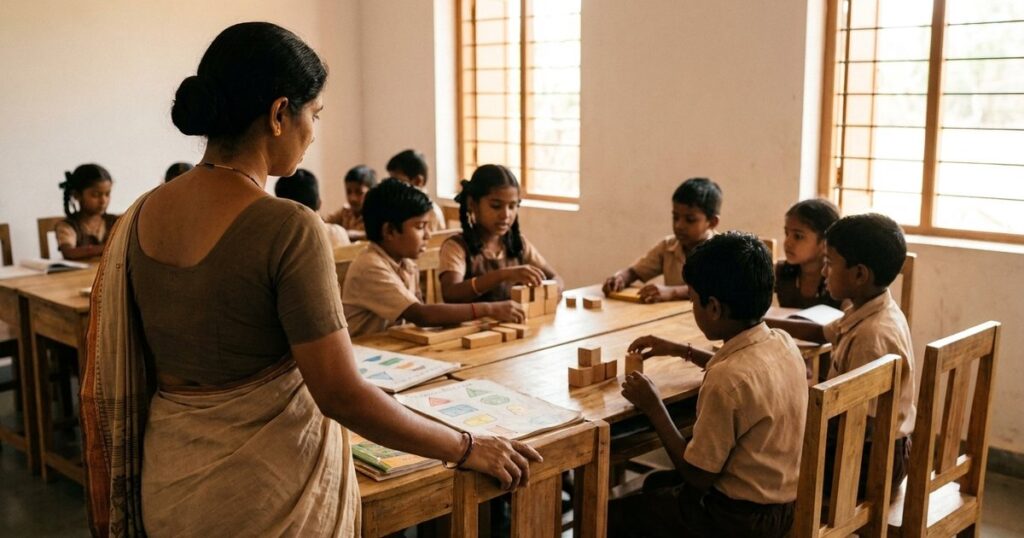
Teachers are products of the same system in which they now work. They were taught in classrooms, evaluated by examinations, trained through curricula, hired through credentials and placed inside institutions governed by timetables, prescribed syllabi, administrative paperwork and board expectations. Even a creative teacher faces constraints: forty students, mixed ability, limited time, parents who demand marks, and a syllabus that must be completed before the exam.
This is how institutional habits reproduce themselves.
The strongest teacher may want to let students debate a question for an hour, but the chapter schedule says she has twenty minutes. She may want to differentiate work for five levels of readiness, but she has 180 notebooks to check. She may want students to build a project, but parents ask whether it will come in the exam. She may want to reward curiosity, but the report card has no column for it.
So the system converges on what is scalable: lecture, notes, worksheet, test.
This also explains why reform is slow. Educational change has multiple veto points. Curriculum changes require teacher training. Assessment changes require universities to change admissions. Parents must trust new signals. Schools must invest in technology and support. Regulators must protect children without freezing innovation. A reform that looks obvious from outside can be difficult to execute across millions of classrooms.
And there is a psychological barrier: we defend systems that validated us.
Many successful adults say, “This school system worked for me.” Of course they do. They are the survivors and beneficiaries. The system selected for people who could succeed inside it, and those people now occupy positions from which they judge the system. This is a form of survivorship bias.
There is also sunk cost. If parents spent years chasing marks, paying fees and choosing schools based on rankings, it is uncomfortable to consider that some of those assumptions may have been wrong. The human response is to double down. A child is struggling? Add tuition. Still struggling? Add more hours.
The coaching industry flourishes in this gap because it makes a simple promise: we will help your child perform better in the system you already understand.
A learning redesign makes a more demanding promise: we will help your child become less dependent on the system.
That sounds risky. Parents worry, “What if my child falls behind?” But behind whom? On which metric? At what cost?
The practical answer is not to stage a revolution at home. It is to create a parallel track. Keep the credentials you need. Satisfy the regulatory requirements relevant to your situation. But use the hours around them to build the abilities the formal system underproduces.
This is why community microschools and AI companions are interesting. They do not require every board, school and teacher to change before a child can experience a different kind of learning.
System change may take decades.
A family can change Tuesday afternoon.
Parent reflection
• Where is a teacher in your child’s life being constrained by the system rather than failing personally?
• What can your family change without waiting for institutional reform?
Frequently asked questions
Why do educational systems change slowly?
Educational systems change slowly due to multiple veto points, psychological barriers, and the need for coordinated changes across various stakeholders.
How are teachers constrained by the system?
Teachers are constrained by large class sizes, limited time, rigid curricula, and the need to meet administrative and parental expectations.
What is survivorship bias in education?
Survivorship bias occurs when successful individuals defend the educational system because it worked for them, overlooking those it failed.
How can families support learning outside the traditional system?
Families can support learning by creating parallel tracks, such as community microschools and using AI companions, to build skills not emphasized by the formal system.