Part 4 of 24 in School Is Not Education← Part 3Part 5 →
This chapter discusses how standardized schooling often confuses activity with genuine learning. It helps parents reconsider what truly constitutes education for their children.
Quick Summary
-
Standardized schooling focuses on uniformity rather than individual learning needs.
-
Mass education systems prioritize efficiency over personalized learning experiences.
-
Children often learn to perform for the system rather than understand concepts deeply.
-
The Annual Status of Education Report highlights gaps between schooling and actual learning.
-
Parents should focus on environments that foster independent learning rather than just school attendance.
When everyone is moving in the same direction, it is easy to mistake motion for progress.
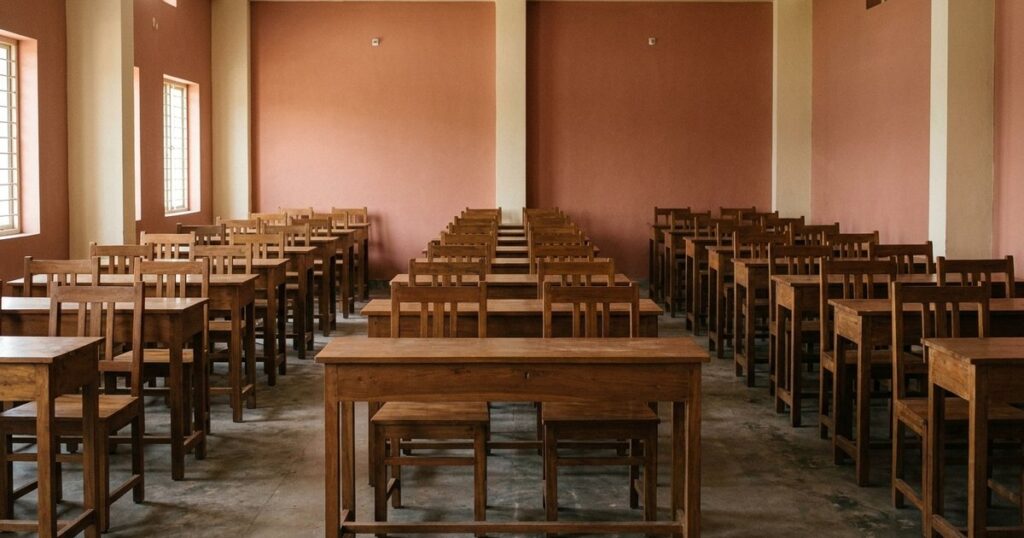
Imagine two children of the same age. One loves astronomy and can spend hours asking why stars die. The other loves taking apart broken appliances and figuring out how switches work. On Monday morning both enter classrooms where the bell rings at the same time, the chapter is the same, the pace is the same, the homework is the same, and the exam date is the same.
We call this equality. Often it is merely standardisation.
Mass schooling solved a real historical problem: how do you organise education for millions of children at a reasonable cost? The answer was an institution built around timetables, age batches, syllabi, textbooks, teachers, classrooms and examinations. That architecture is efficient for administration. It is not necessarily optimal for learning.
A school has to decide what thirty or forty children will do at 10:15 a.m. A child’s brain does not care about the timetable. One learner may already understand fractions and need harder problems. Another may still be confused about division. A third may understand the concept but freeze during tests. Yet the class must move on because the calendar moves on.
This creates a hidden bargain. The institution promises order; the learner gives up control over pace, sequence and often purpose. Children quickly learn what the system rewards. Do not ask too many questions if they delay the lesson. Do not pursue an interesting detour if it will not appear in the exam. Memorise the answer in the form expected by the evaluator. Finish the worksheet. Collect the mark.
Parents participate because the signals are reassuring. Uniforms, assemblies, homework diaries, report cards, ranks and board results look like evidence of education. They are evidence of activity. Sometimes they correlate with learning; sometimes they conceal its absence.
This is why a child can score well and still be unable to explain a concept in her own words. She may have learned how to recognise the pattern of a familiar question without building a durable mental model. She has learned the choreography of school.
The Annual Status of Education Report (ASER) makes this uncomfortable distinction visible. In rural India in 2024, only 27.1% of children in Standard III could read a Standard II-level text, and 33.7% could do at least subtraction. The numbers improved meaningfully after the pandemic, which deserves recognition, but they still remind us that years spent in school and foundational mastery are not the same thing. [1]
The right conclusion is not “schools are failures.” The right conclusion is “attendance is an input, not an outcome.” A parent should care about what the child can now understand, do, explain, create and apply.
Once you see this, an important question changes. Instead of asking, “Which school is best?” you begin asking, “Which learning environment gives my child the best chance to become an independent learner?”
That environment may include a school. It may include an AI learning companion. It may include a neighbourhood microschool, projects, libraries, sport, grandparents, online communities and apprenticeships. Education becomes an ecosystem rather than a building.
The conveyor belt asks whether the child is keeping up with the class.
A learning system asks whether the child is growing.
Parent reflection
• What evidence do you currently use to decide whether your child is learning?
• Which parts of your child’s week optimise for marks rather than mastery?
Frequently asked questions
What is the main critique of standardized schooling in this chapter?
The chapter critiques standardized schooling for prioritizing uniformity and efficiency over personalized learning and genuine understanding.
How does the chapter suggest parents assess their child’s education?
Parents should assess whether their child is becoming an independent learner and focus on environments that support growth beyond just school attendance.
What does the Annual Status of Education Report reveal?
The report reveals that a significant number of children in rural India struggle with basic reading and math, highlighting a gap between school attendance and actual learning.
What alternative learning environments are suggested?
The chapter suggests exploring AI learning companions, microschools, libraries, sports, online communities, and apprenticeships as part of a broader educational ecosystem.