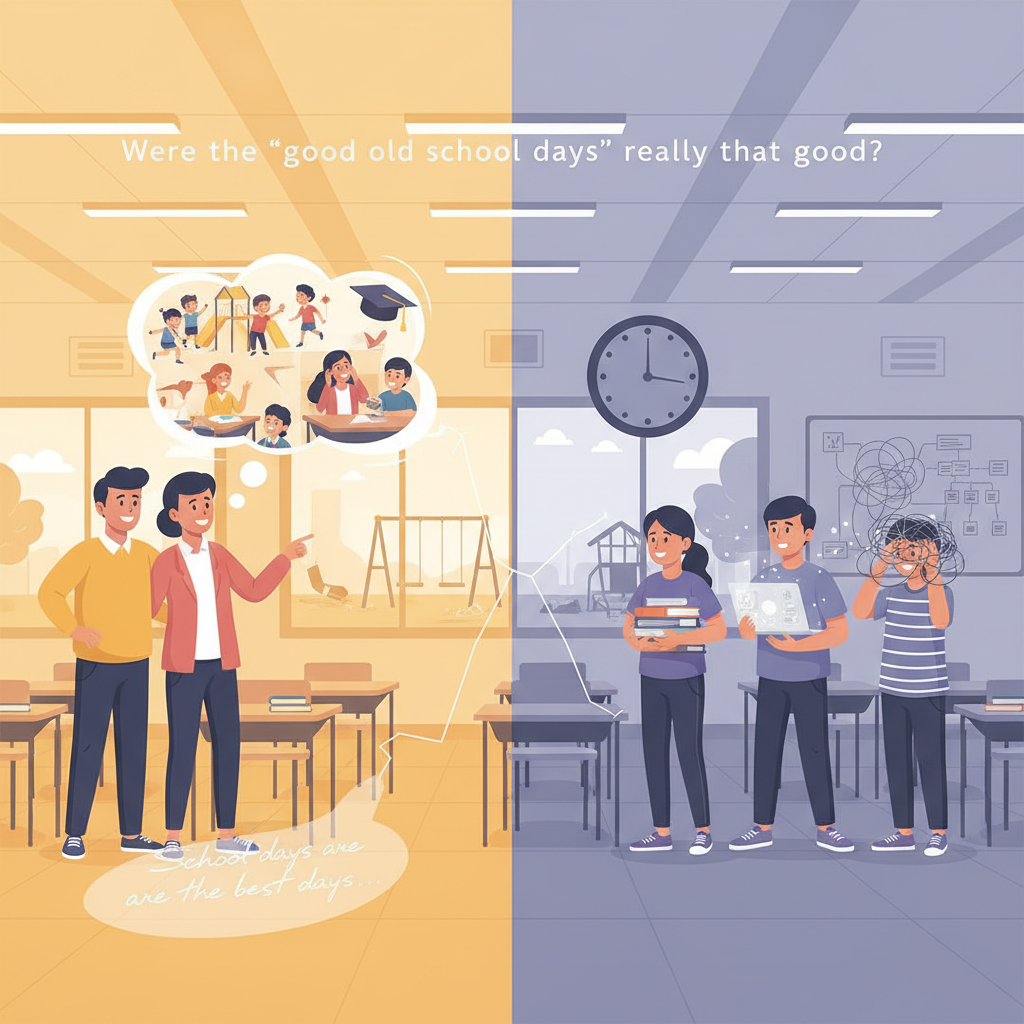
This is a slightly uncomfortable conversation.
1 . Parents say : “School days are the best days of your life.”
Many students quietly think: “Are you serious?”
Let’s unpack this honestly.
Memory is selective.
Parents remember:
Friends
Playground laughter
Annual day
That one inspiring teacher
They don’t remember:
Boring lectures
Fear of exams
Being scolded
Memorising pages without understanding
Nostalgia edits out discomfort.
But today’s schooling is different in one important way:
The pressure is far more intense.
Earlier:
Fewer competitive exams
Less social media comparison
Less parental micromanagement
Today:
Constant testing
Coaching after school
Performance anxiety
Career obsession starting at age 12
We haven’t just preserved the old system.
We’ve industrialised it.
2. Why do students seem trapped?
Look at a typical urban student’s day:
6:30 am: Wake up
8 am – 2 pm: School
3 pm – 6 pm: Coaching
7 pm – 9 pm: Homework
Weekend: More classes or tests
Where is:
Unstructured play?
Boredom?
Curiosity?
Daydreaming?
These are not luxuries.
They are essential for cognitive development.
Brains grow in free space — not under constant supervision.
3. Why do schools rely so much on lectures?
Because lectures are efficient.
One teacher.Forty students.One syllabus.One speed.
But efficiency is not the same as effectiveness.
Listening passively does not equal learning.
Real learning requires:
Questioning
Experimenting
Discussion
Reflection
Making mistakes
When students only listen, they become spectators.
Education becomes a performance.
4. Why do students go to school if they dislike it?
Let’s be honest.
Most students attend because:
Parents insist
Attendance is mandatory
Exams determine promotion
Society expects it
Very few attend because:
“I can’t wait to learn something new today.”
That should worry us.
When attendance is driven by compulsion rather than curiosity, something is broken.
5. Is discipline the problem?
No.
Children need structure.
But there’s a difference between:
StructureandControl.
Structure supports growth.
Control suppresses autonomy.
When every minute is scheduled and every answer predefined, students stop thinking independently.
They learn compliance.
Not curiosity.
6. What happens when free time disappears?
Free time is not “wasted time.”
It’s when:
- Imagination develops
- Social skills grow
- Risk-taking happens
- Identity forms
Play teaches:
- Negotiation
- Conflict resolution
- Creativity
- Emotional regulation
You cannot teach these in a lecture.
Over-scheduling children is like overwatering plants.
It looks caring.
But it suffocates growth.
7. Are coaching classes helping or hurting?
Coaching thrives because:
- Parents fear competition
- Schools don’t build confidence
- Exams reward pattern recognition
But coaching adds:
- More sitting
- More passive learning
- More dependency
It sends a subtle message:
“You cannot succeed on your own.”
That is dangerous.
Because the real world does not provide coaching.
It rewards self-learners.
8. What is the psychological impact?
When children have:
- No autonomy
- No downtime
- Constant evaluation
They may develop:
- Anxiety
- Burnout
- Loss of intrinsic motivation
- Fear of failure
And the saddest outcome?
They stop enjoying learning.
Not because they are lazy.
But because learning has been packaged as pressure.
9. Why do parents defend the system?
Because uncertainty scares adults.
Parents think: “If I relax, my child will fall behind.”
So they double down on:
- Extra classes
- Extra tests
- Extra monitoring
It feels responsible.
But sometimes it signals distrust.
Children sense that.
And slowly, they outsource responsibility for learning to adults.
That’s the opposite of independence.
10. What would a healthier model look like?
Let’s imagine something radical.
A school where:
- Lectures are minimal
- Projects dominate
- AI tools support exploration
- Students pursue passion projects
- Play is respected
- Reflection is built into the schedule
Learning becomes active. Not imposed.
Students would:
- Ask better questions
- Learn how to learn
- Collaborate
- Build portfolios
- Solve real-world problems
That prepares them for life — not just exams.
11. Should students be given choice?
Yes.
Choice builds ownership.
Ownership builds responsibility.
Responsibility builds maturity.
If students never make decisions about their learning, how will they learn to navigate adult life?
We protect them so much that we prevent growth.
Autonomy is not indulgence.
It is preparation.
12. What can parents do right now?
You don’t need to overthrow the school system tomorrow.
Start small.
Protect daily free time
Reduce unnecessary coaching
Ask “What did you explore?” instead of “How many marks?”
Encourage reading beyond the syllabus
Allow boredom
Most importantly:
Trust your child.
Curiosity is natural.
Suppression is learned.
13. What can students do?
Even inside a rigid system, you have choices.
You can:
- Learn beyond the textbook
- Use AI to explore deeper
- Build side projects
- Read widely
- Question respectfully
- Form study circles
- You may not control school structure.
- But you control your intellectual attitude.
Don’t become a passive passenger.
Become an active learner.
Final Thought
If school were truly the “best days of life,”students wouldn’t need to be forced to attend.
Education should not feel like captivity.
It should feel like expansion.
Children don’t hate learning.
They hate boredom and pressure.
When we give them autonomy, space, and trust, something beautiful happens.
They stop studying for marks.
And start learning for life.
That is the shift we need.
Not more lectures.
More ownership.