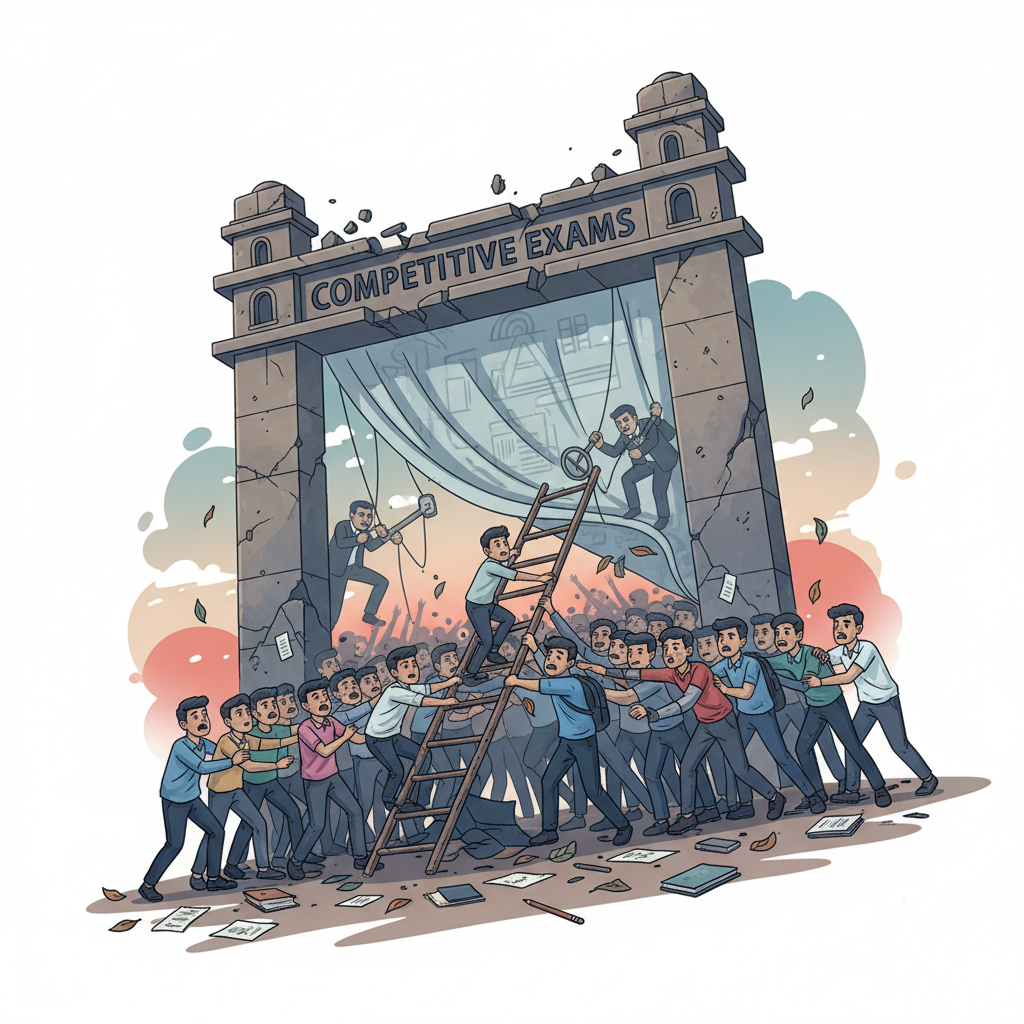
Let’s not pretend everything is fine.
Competitive exams in India were designed to be meritocratic ladders. Instead, they’ve become anxiety factories.
But shouting “system is broken” doesn’t help students. Understanding why it’s broken does.
So let’s break this down — calmly, honestly, and usefully.
1. Were competitive exams always this problematic?
No.
Originally, competitive exams were meant to:
- Provide a standardised, transparent selection method
- Reduce bias and nepotism
- Reward academic effort
In theory, they still do that.
In reality, scale has destroyed design.
When millions compete for a few thousand seats, exams stop being assessments of learning — and start becoming elimination tournaments.
The goal shifts from “Who understands?”to“Who can survive the filtering?”
That’s a very different game.
2. Why is mass cheating becoming common?
Because incentives are distorted.
When:
- A single exam decides your future
- Family prestige is attached to your rank
- Coaching costs lakhs
- Opportunities are scarce
Then cheating becomes a “risk calculation” for some people.
It’s not that students are more immoral.
It’s that the system is too high-stakes.
Add:
- Weak exam security
- Political interference
- Corrupt officials
- Digital hacking
And you get paper leaks and impersonation scams.
The uncomfortable truth?If one exam decides your destiny, people will try to game it.
The solution isn’t stricter policing alone. The solution is reducing single-point failure.
3. Why do exams mostly test cramming?
Because it’s easy to grade.
Testing memory is cheap and scalable.
Testing thinking is hard.
If you’re evaluating 2 million answer sheets:
Multiple-choice questions are fast
Formula-based answers are easy to standardize
Creative reasoning is messy to mark
So the system optimises for convenience — not intelligence.
Coaching centres then optimise for predictable patterns.
Students learn:
- Tricks
- Shortcuts
- Templates
- Pattern recognition hacks
- Very little deep understanding.
It becomes intellectual weightlifting without functional strength.
You can solve 100 physics MCQs — but may not understand how physics works in real life.
That’s not education.
That’s training.
4. Are coaching institutes the problem?
They are a symptom.
Coaching thrives because:
- School education is weak
- Exams are predictable
- Competition is brutal
- Parents are anxious
- Coaching centres don’t create demand. They respond to it.
But here’s the real issue:
They train for exams — not for life.
Students become dependent on:
- Notes
- Templates
- Predicted questions
- Faculty “shortcuts”
That kills intellectual independence.
If you cannot learn without coaching, you are not being educated — you are being managed.
That should worry us more than rankings.
5. Do reservations make marks meaningless?
This is emotionally charged, so let’s be rational.
Reservation policy was introduced to address historical structural inequality.
The intention was social justice.
But here’s the tension:
When:
- Cut-offs vary widely
- Seats are allocated by category
- Marks don’t directly translate to admission probability
- Students start feeling the system is arbitrary.
- Perception matters.
If effort doesn’t correlate clearly with opportunity, motivation drops.
However:
- Blaming reservations alone oversimplifies the problem.
- The real issue is scarcity.
- If high-quality colleges were abundant, competition would soften.
- When seats are few, every policy feels unfair to someone.
- Scarcity creates resentment.
- Abundance reduces it.
6. Is the real problem scarcity?
Yes.
India has:
- Millions of aspirants
- Limited high-quality institutions
- A prestige hierarchy
- We have artificially inflated the importance of a few colleges.
Why is admission to certain institutions life-defining?
Because employers and society overvalue brand names.
That’s a market distortion.
If skill mattered more than pedigree, the pressure would fall.
The system is brittle because we’ve made it brittle.
7. So what should students do? Just give up?
Absolutely not.
Here’s the uncomfortable but empowering truth:
Your life will not be decided by one exam.
Even if the system is flawed, your learning does not have to be.
Focus on:
1. Skill > Rank
Ask:
- Can I solve real-world problems?
- Can I communicate clearly?
- Can I learn independently?
Those matter longer than marks.
2. Build Evidence of Competence
- Projects
- Internships
- Portfolios
- Open-source contributions
- Research
- Writing
These are harder to fake than exam scores.
3. Learn How to Learn
If you can:
- Teach yourself
- Use AI tools wisely
- Evaluate information critically
- You become future-proof.
- Exams test memory.
- Life tests adaptability.
8. Should competitive exams be abolished?
No.
They need reform — not removal.
Possible improvements:
- Multiple smaller assessments instead of one big exam
- Open-book analytical tests
- Portfolio-based admissions
- Interviews testing reasoning
- AI-proctored transparency
- Public audit trails of paper-setting
Most importantly: Stop pretending one number defines intelligence.
That’s intellectually lazy.
9. What’s the deeper cultural issue?
We worship marks.
We don’t worship curiosity.
Parents ask:“How many marks?”
Rarely:“What did you learn?”
Until we shift that mindset, exams will remain high-pressure filtering machines.
Education should produce:
- Independent thinkers
- Ethical citizens
- Lifelong learners
- Not rank-holders who burn out at 25.
10. What is the path forward for students?
Here’s my slightly provocative advice:
- Treat competitive exams as a game — not as your identity.
- Play it strategically.
- But don’t let it define you.
At the same time:
- Build real competence
- Read beyond the syllabus
- Question assumptions
- Explore multiple career paths
- Use AI tools. Learn across disciplines. Stay curious.
- You don’t control policy.
- But you control your learning.
- And that is far more powerful.
Final Thought
The system may be flawed.
But you don’t have to be.
Be exam-smart.But more importantly — be life-smart.
The future will not belong to the best crammers.
It will belong to the best learners.