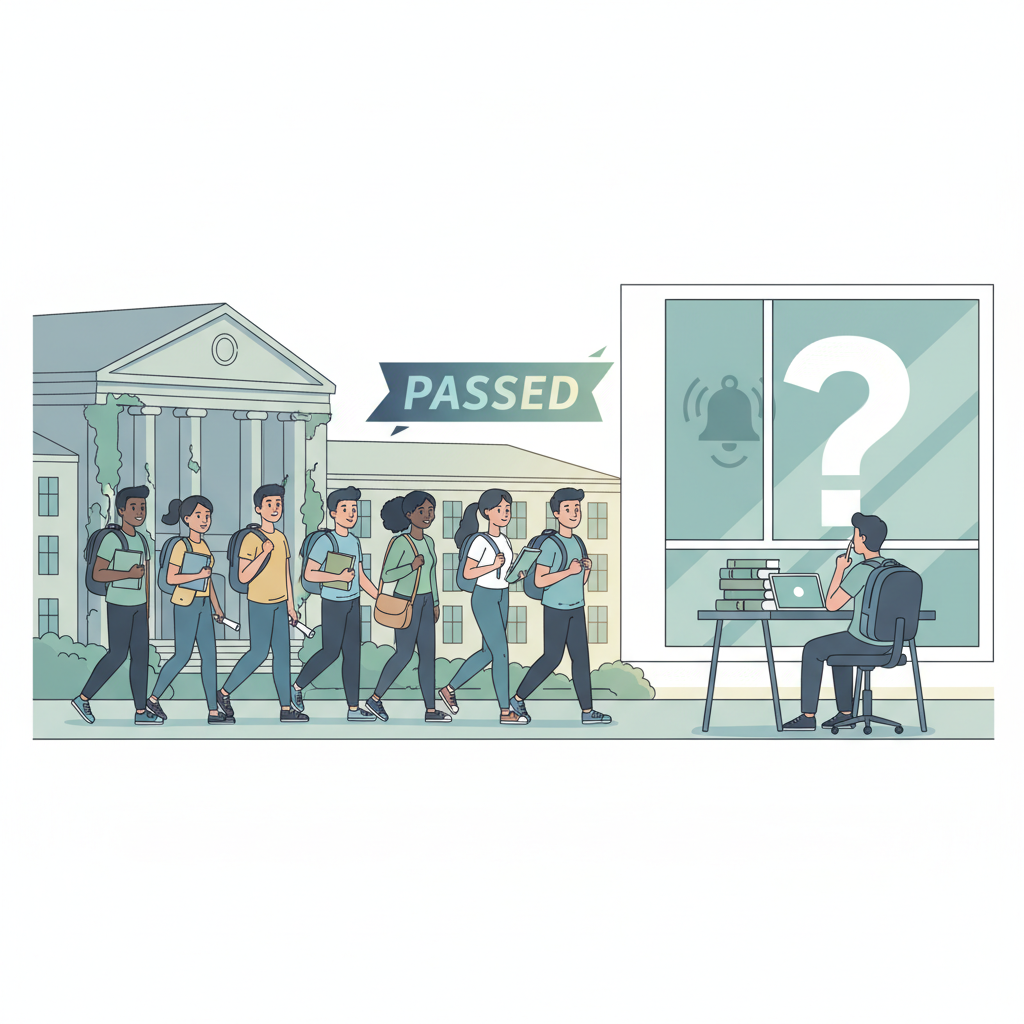
Now this is a deliciously uncomfortable question.
If a student can pass the exam…
Why force them to warm a chair for 75% attendance?
Are we measuring learning?
Or obedience?
Let’s examine this calmly — not emotionally.
1. Why is attendance compulsory in the first place?
Institutions argue that attendance ensures:
- Exposure to teaching
- Classroom discipline
- Structured learning
- Peer interaction
- Academic seriousness
On paper, it sounds reasonable.
But here’s the real question: Does physical presence equal learning?
If sitting in a classroom automatically produced understanding,India would have the most educated population in the world. We don’t.
2. What is attendance really measuring?
Let’s be honest.
Attendance measures compliance.
It tells us:
- Who showed up ?
- Who followed rules ?
- Who met administrative requirements ?
It does not measure:
- Curiosity
- Understanding
- Independent thinking
- Skill development
We confuse activity with achievement.
Sitting quietly for 6 hours is not the same as learning deeply for 2.
3. If a student can pass exams, isn’t that proof of learning?
Not necessarily — but it’s evidence of competence.
If a student:
Understands the material
Can demonstrate mastery
Passes fairly conducted exams
Then the system’s learning objectives have been met.
Why should we insist on attendance as well?
That suggests we value process over outcome.
And in education, outcomes matter.
But let’s be careful.
If exams only test memory, then passing them is not enough either.
So the deeper issue isn’t attendance.
It’s how we define learning.
4. Why do institutions fear optional attendance?
Because autonomy is scary.
If attendance becomes optional:
Weak teaching will be exposed
Students may skip boring lectures
Faculty accountability increases
Compulsory attendance protects institutions from feedback.
If students are forced to attend, teachers don’t need to earn attention.
That’s uncomfortable — but true.
In the real world, nobody is forced to listen to you.
You must be worth listening to.
5. What about discipline and responsibility?
This is the common counterargument:
“If we give students freedom, they will misuse it.”
Maybe.
But overprotection prevents maturity.
Responsibility develops only when:
- Choice exists
- Consequences are real
- Students own outcomes
If a student skips class and fails, that’s feedback.
But if a student skips class and still excels — what exactly is the problem?
We are not running attendance factories.
We are supposed to be nurturing thinkers.
6. Is learning confined to classrooms?
Absolutely not.
Some of the most powerful learning happens:
- Through internships
- Online courses
- Side projects
- Startups
- Community work
- Research
- AI-assisted exploration
- Self-study
The modern world has democratized knowledge.
You can learn coding, philosophy, design, economics — often better online than in traditional lectures.
So why restrict students to four walls?
Education should expand horizons — not limit them.
7. What about peer interaction?
This is important.
College is not just content delivery.
It’s about:
- Collaboration
- Debates
- Exposure to diversity
- Social growth
But forcing attendance is a poor substitute for meaningful engagement.
If classrooms are interactive, students will attend voluntarily.
If they are dull monologues, compulsory attendance only breeds resentment.
8. Would optional attendance create inequality?
Possibly.
Self-motivated students may thrive.
Others may drift.
But here’s the honest truth:
Even with compulsory attendance, many students drift mentally.
They are physically present and psychologically absent.
True equity comes from:
- Mentorship
- Skill-building
- Personalized feedback
- Encouraging self-directed learning
- Not from biometric attendance systems.
9. What would a healthier model look like?
Instead of enforcing presence, institutions could:
- Make attendance optional
- Use frequent low-stakes assessments
- Evaluate projects and portfolios
- Encourage experiential learning
- Offer hybrid formats
- Mentor students individually
Shift from:
“Did you attend?”
to
“What did you build? What did you understand?”
That’s a powerful transformation.
10. What should students understand about freedom?
Freedom is not license.
If attendance becomes flexible, students must:
- Manage time
- Plan learning
- Seek help proactively
- Build real skills
- Autonomy without discipline becomes chaos.
But discipline imposed externally creates dependency.
The goal is internal discipline.
That’s adulthood.
11. What are the risks of removing compulsory attendance?
Let’s be balanced.
Possible risks include:
- Reduced campus engagement
- Isolation
- Poor time management
- Academic underperformance
But the current system also has risks:
- Passive learning
- Burnout
- Resentment
- Learned helplessness
- Every model has trade-offs.
The question is: Which model builds independent lifelong learners?
12. So should attendance be compulsory?
Here’s my position.
At school level (younger students):
Some structure is necessary.
At college level (young adults):
Compulsory attendance is outdated.
If we claim students are adults capable of voting and driving,we must trust them with learning choices.
Education should transition from supervision to self-direction.
Otherwise, we produce graduates who wait for instructions.
And the real world does not provide attendance sheets.
Final Thought
Compulsory attendance assumes:
“Students will not learn unless forced.”
That belief is deeply pessimistic.
Young minds are naturally curious.
When we treat students as responsible learners, many rise to the expectation.
Some may stumble.
That’s part of growth.
If education is preparation for life,then autonomy must be part of the curriculum.
Because the ultimate goal is not:
Perfect attendance.
It is: Independent, self-directed, lifelong learning and that cannot be forced and must be chosen.