As a parent of a child entering Class 6, you’re probably asking yourself a very uncomfortable question:
Is my child actually learning anything useful in school?
On paper, things look fine. The school has smart classrooms, a thick syllabus, regular tests, and confident teachers. But dig a little deeper, and a worrying pattern emerges. Children are memorising more, understanding less, and becoming increasingly dependent on external help.
Class 6 is a turning point. This is where subjects start getting abstract. Maths stops being arithmetic and becomes logic. Science stops being stories and becomes concepts. English stops being reading and becomes comprehension. And yet, our education system continues to treat children like passive recipients of information.
01 . The Real Problem Isn’t the Syllabus
The problem is the method.
Most schools still operate on:
- One teacher, forty students
- One pace, regardless of learning ability
- One exam, one answer
- More homework instead of better understanding
This system was designed for an industrial age — not for 2026.
Children today have access to unlimited information, but schools still train them to wait for instructions. They are rewarded for memorising, not thinking. Asking questions is often seen as “disruptive” rather than curious.
02. Why Class 6 Is the Danger Zone
This is the age when:
- Children start losing confidence in maths
- Science becomes intimidating
- Rote learning replaces curiosity
- Parents begin outsourcing learning to tuition classes
Once a child starts believing “I’m bad at studies”, it becomes a self-fulfilling prophecy.
And here’s the hard truth:
Most tuition classes simply repeat the same broken system, louder and faster.
03. What Actually Works
Children don’t need more pressure.
They need clarity, curiosity, and control.
When children:
- Learn at their own pace
- Can revise concepts as many times as needed
- Are encouraged to ask “why” instead of memorising
- Learn visually and interactively
They don’t just perform better — they enjoy learning again.
This is where self-directed learning becomes powerful.
Instead of spoon-feeding answers, good learning systems teach children how to think, not what to think.
04. The Question Parents Should Ask
Not: “Which tuition should I join?”
But: “How can my child learn independently and confidently?”
Because the future doesn’t belong to children who can mug up chapters.
It belongs to children who can learn, unlearn, and relearn.
And that shift must begin in middle school — not after board exams.
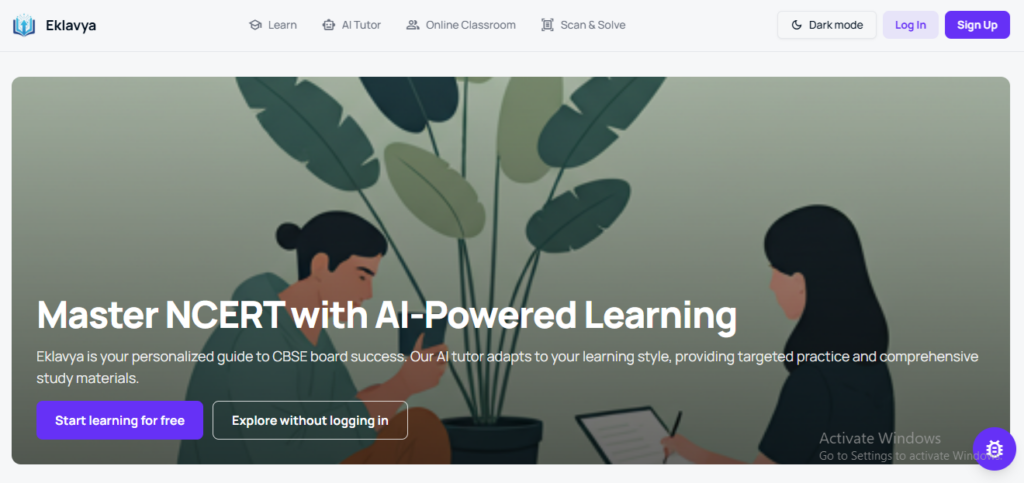
Stop wasting money on tuition classes and help your child to become a self-directed learner by using the free AI tutor at Eklavya.io