A FAQ for students, parents, and educators who believe learning should actually make sense
Q1. Who was Richard Feynman, and why does he matter to education today?
Richard Feynman was a Nobel Prize–winning physicist, but more importantly, he was a rebel teacher. He despised rote learning, blind memorisation, and education systems that rewarded parroting instead of thinking. His core belief was simple and radical: If you can’t explain something in simple words, you don’t really understand it.
That belief is painfully relevant today—especially in exam-driven systems like JEE prep, where students often memorise formulas without knowing where they come from or why they work.
Q2. What was Feynman’s biggest problem with traditional education?
Feynman hated what he called “cargo cult education”—where students go through the motions of learning without real understanding.
Students memorise derivations without intuition
Teachers rush to “complete the syllabus”
Exams reward speed, not curiosity
Sound familiar? Exactly. This is why Feynman would have looked at today’s coaching-factory model and politely… then brutally… torn it apart.
Q3. What is Eklavya, and how is it different?
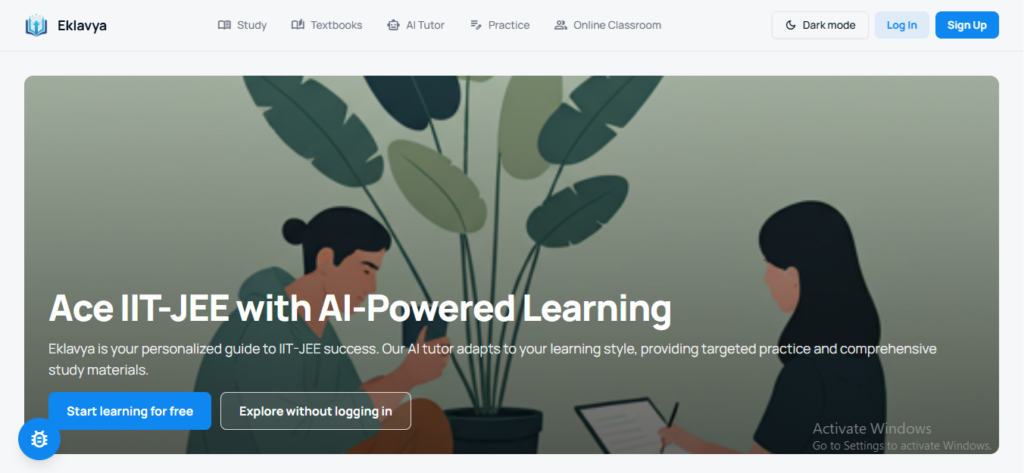
Eklavya is India’s first free AI Tutor designed to help students understand concepts instead of memorising them. It puts the student—not the syllabus, not the exam, not the teacher—at the center of learning.
Eklavya doesn’t lecture.
It converses, questions, nudges, and waits—just like a good mentor should.
If Feynman were alive today, he wouldn’t be running a coaching class. He’d be building something like Eklavya.
Q4. How does Eklavya embody the “Feynman Technique”?
The famous Feynman Technique has four steps:
- Learn a concept
- Explain it in simple language
- Identify gaps in understanding
- Refine and simplify again
- Eklavya does this automatically.
- It asks students to explain ideas in their own words
- It spots confusion instantly
- It rephrases explanations differently until clarity clicks
- No judgement. No embarrassment. Just learning.
Q5. Why would Feynman love an AI tutor instead of a human teacher?
Because a good AI tutor does what most classrooms cannot:
- Infinite patience
- No ego
- No syllabus anxiety
- No “this will come in the exam, skip the why”
Feynman believed students should ask stupid questions. Eklavya makes sure no question ever feels stupid.
Q6. Does Eklavya replace teachers or coaching classes?
No—and Feynman would strongly agree with this.
Great teachers inspire. But real learning happens when students wrestle with ideas themselves.
Eklavya is not a replacement. It’s a thinking partner—available 24×7, free of cost, and tuned to the student’s pace.
Think of it as a personal Feynman sitting next to you, saying:
“Okay, now explain this back to me.”
Q7. How does Eklavya give students autonomy and agency?
Traditional education says:
“Here’s what to study. Here’s how fast. Don’t ask why.”
Eklavya says:
- Learn at your pace
- Ask unlimited questions
- Explore sideways if curiosity strikes
- Revisit fundamentals without shame
This is agency. This is ownership. And this is exactly what Feynman believed education should cultivate.
Q8. What about exams like JEE—does curiosity really help?
Here’s the uncomfortable truth:
Students who understand deeply perform better—even in competitive exams.
Feynman proved this throughout his life. Understanding creates:
- Faster problem-solving
- Better retention
- Fewer silly mistakes
- Real confidence
Eklavya doesn’t train students to crack questions.
It trains them to think. The marks follow.
Q9. Why is Eklavya free—and why would Feynman approve?
Feynman believed knowledge should not be locked behind privilege.
Making Eklavya free is a moral choice, not a marketing one.
Talent is equally distributed. Opportunity is not.
Eklavya exists to fix that imbalance.
Q10. What kind of students thrive with Eklavya?
Curious students frustrated with rote learning . Quiet students afraid to ask doubts in class Bright students bored by spoon-feeding . Stressed students tired of coaching pressure
In short: students who want to actually understand what they are learning.
Richard Feynman once said:
“I don’t know anything, but I do know how to find things out.”
That sentence could be Eklavya’s mission statement.
Help us improve India’s first free AI Tutor students at eklavya.io!
We want students to become independent, self-directed, lifelong learners—and to fall in love with learning the way Feynman did.