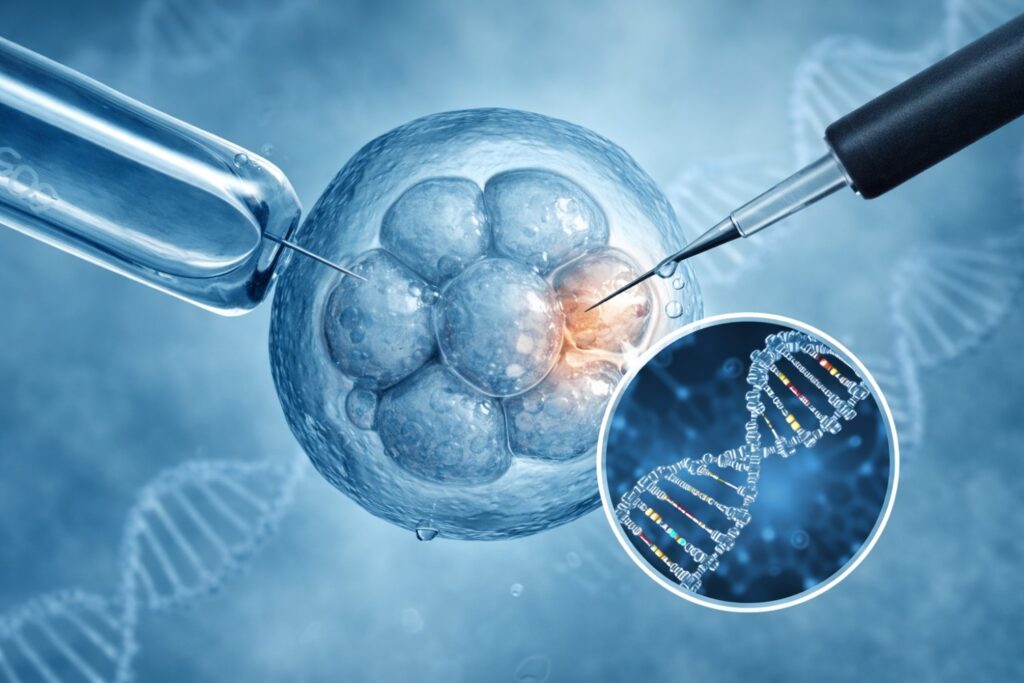
Many IVF clinics today are recommending to all their IVF patients that they do an embryo biopsy or PGD for all their embryos. They claim that this will increase the pregnancy rates , and reduce the miscarriage rates , but both these claims are completely false !
The one thing that PGD does very well is bamboozle patients , because doctors now get a chance to use very fancy genetic terms , which neither they nor the patient understand, which is why they sound so impressive and scientific !
They sell the PGD procedure by saying that by doing a genetic analysis on the embryo , we’ll be able to select the best embryos , which will increase your chances of getting pregnant . Since patients don’t understand much about genetics , this sounds like a very logical thing to do. After all , why would anyone want to transfer a genetically abnormal embryo? Doesn’t it make sense to test the embryo to make sure it’s genetically normal , and then transfer it ? Isn’t it intuitive that this will increase the success rates? Yes it’s intuitive , but just because it’s logical doesn’t mean that it actually works in real life !
Enough studies have been done to show that PGD does not help to increase pregnancy rates ! This may sound paradoxical, but embryo implantation has very little to do with whether the embryo is genetically normal or not , and even genetically abnormal embryos can and so implant all the time ! This is why babies are born with birth defects due to genetic abnormalities – because the embryo is able to implant ! Many IVF doctors are fairly clueless about genetic testing , but they are interested in upselling , and they know that the more tests they make the patient do , the more money they can earn !
What’s worse is that they tell patients who have failed an IVF cycle that if we do PGD , the chances of your next cycle working will increase , but again that is complete rubbish . Let’s understand why by reasoning from first principles.
All standard PGD testing does is to test the number of chromosomes in the embryo. This is called aneuploidy screening, or PGT-A ( doctors love coining new acronyms to confuse patients !). Now even if the chromosomes are normal ( this is called an euploid embryo), this doesn’t mean that the genes in that embryo are normal , because there are only 23 pairs of chromosomes , but there are 30,000 genes. This is why a chromosomally normal embryo ( as proven on PGD ) could still end up failing to implant – it could have a lethal genetic defect which causes it to arrest ( stop dividing after a certain stage).
What about the claim that it reduces the risk of a miscarriage ? Yes, it’s true that some chromosomally abnormal embryos will have an increased risk of a miscarriage , but this doesn’t include all the possible reasons for a miscarriage , which means you could have a chromosomally normal embryo after PGD , and still miscarry .
Yes, PGD will reduce the risk of a baby having a particular defect – but only that particular defect that you have tested for. The truth is that the number of genetic defects which we can test is very limited. It’s only the chromosomal aneuploidies (monosomies and trisomies ) which we can test for routinely – we still can’t test for all possible genetic abnormalities .
This is why a patient who does get pregnant after the transfer of a PGD normal embryo can still miscarry. And even if she does not, she will still have to do all the routine prenatal diagnostic tests which any other woman who gets pregnant ( either in her bedroom or after regular IVF ) needs to do , because the amount of information which you can get from the genetic tests done during PGD is very limited, because you’re only analyzing a few cells , and this is just not enough to make sure that the baby is completely normal . This means that whether you do a PGD or not , you will still end up having to do exactly the same testing during pregnancy , so there’s very little point in making patients waste their money on doing the PGD , which is expensive and complex, and riddled with the problems of false positives and false negatives, like any other test.
However, this limitation is not going to stop doctors , because PGD testing helps them to make more money , and it’s quite easy to convince patients to do whatever the doctor tells them to, and patients will obey, because they don’t know any better.
The holy grail of IVF is that we will be able to develop a test that will be able to help us identify which embryo will become a healthy baby , but that test is still a long way off . Please don’t waste your money on PGD because it will just cause a lot of heartbreak , heartburn and grief , when the cycle fails , or when you miscarry , and it will be very hard for you to trust your IVF doctor.
Still Confused ! You can get answers from Dr. Malpani instantly at https://www.drmalpani.com/chat-w-chatbot/index.html