Indian companies complain endlessly about one thing:
“We can’t find good workers.”
“And when we do, they leave.”
That’s not a talent problem.
That’s a strategy problem.
Here’s a smarter, more humane, and surprisingly effective solution—explained as FAQs.
Q1. Why is it so hard to recruit and retain blue-collar workers today?
Because the old social contract is broken.
Earlier, a stable job was enough. Today, workers want:
Growth, not just wages
Security, not just salary
A future for their children, not just survival for themselves
When companies treat blue-collar workers as “replaceable,” workers respond by behaving exactly that way.
Loyalty cannot be demanded.
It has to be earned.
Q2. Isn’t higher pay the obvious solution?
Higher pay helps—but only temporarily.
Money solves today’s problems.
Education solves tomorrow’s problems.
A ₹2,000 raise disappears into monthly expenses.
A computer that enables learning:
- Changes skills
- Changes mindset
- Changes aspirations
And most importantly—it changes how a worker sees the company.
Q3. How does an Education PC help with retention?
Because Indian families value education above everything else.
You may forget a Diwali bonus.
You will never forget the company that helped your child learn, grow, and dream bigger.
When a company invests in a worker’s learning ecosystem, not just their output:
- Attrition drops
- Engagement rises
- Pride replaces resentment
This isn’t charity.
It’s intelligent capitalism.
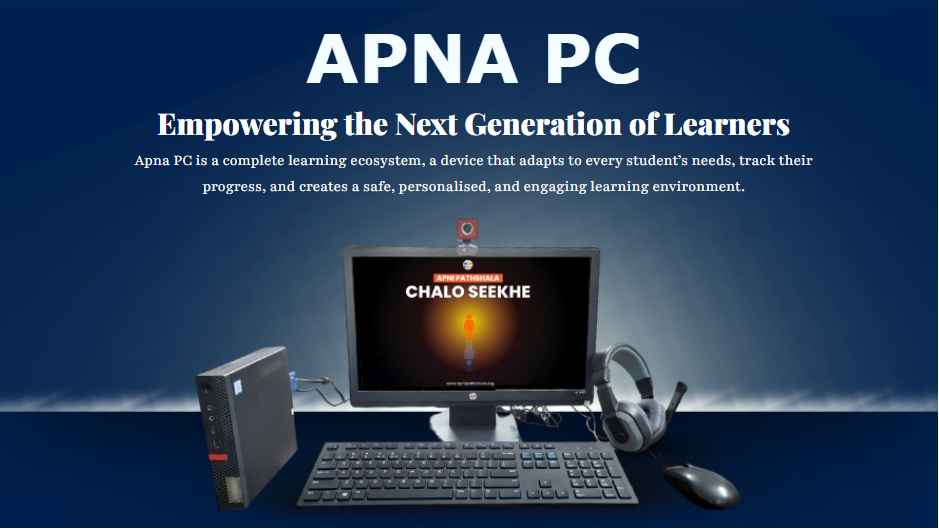
Q4. What exactly is the ApnaPC?
ApnaPC is India’s first Education PC—designed in India, for Indian families.
It’s not a gaming machine.
It’s not a distraction device.
It’s not a surveillance tool.
It is purpose-built for learning.
Q5. What makes ApnaPC different from a regular computer?
Three things that matter:
1. A Free AI Tutor
Every ApnaPC comes with a built-in AI tutor that:
Answers questions
Encourages curiosity
Supports self-paced learning
Never gets tired, angry, or judgmental
For first-generation learners, this is transformational.
2. A Free Student Safety Solution
Parents worry—rightly—about screens.
ApnaPC solves this by:
Tracking learning time
Documenting progress
Ensuring safe, age-appropriate use
Making learning visible and accountable
This builds trust—the rarest currency in Indian households.
3. Designed for Education, Not Addiction
No dark patterns.
No dopamine traps.
No “engagement at all costs.”
The goal is learning—not endless scrolling.
Q6. How does this help the worker directly?
Workers can:
Learn new digital skills
Improve language and communication
Upskill for better roles
Access free, world-class learning resources
This turns a job into a career pathway, not a dead end.
A worker who sees growth doesn’t look for exits.
Q7. How does this help the worker’s children?
This is where the real magic happens.
Children get:
Access to a safe learning computer at home
Exposure to AI tutors and digital tools
The ability to learn independently
A head start in a digital world
For many families, this is the first computer in the house.
That moment changes everything.
Q8. Why should corporates care about workers’ families?
Because workers don’t leave jobs.
They leave futures that feel small.
When a company helps a worker’s child thrive:
Gratitude deepens
Loyalty becomes emotional, not transactional
The company becomes a partner in progress
You can’t buy that with HR policies.
Q9. Can corporates white-label the ApnaPC?
Yes—and they should.
ApnaPC can be:
White-labelled with your company branding
Positioned as a learning gift, not a perk
Integrated into CSR, HR, or ESG initiatives
This is not a logo exercise.
It’s a statement of values.
Q10. Is this CSR or a business strategy?
Both.
From a CSR lens:
You’re supporting education
You’re bridging the digital divide
You’re empowering families
From a business lens:
You’re reducing churn
You’re improving morale
You’re building long-term goodwill
The best strategies don’t force you to choose.
Q11. Is this affordable at scale?
Yes. That’s the point.
ApnaPC is designed to be:
Affordable
Durable
Scalable
Sustainable
This isn’t a luxury gadget.
It’s infrastructure for human capital.
Q12. What kind of companies is this ideal for?
Any organisation that depends on blue-collar or frontline workers:
Manufacturing
Logistics
Retail
Construction
Facilities management
Hospitality
Healthcare support services
If people power your business—this matters.
Q13. What’s the long-term impact?
Short term:
Higher retention
Happier workers
Medium term:
Better skills
Internal mobility
Long term:
Stronger families
Stronger communities
A more capable workforce
That’s how nations grow—quietly, steadily, from the ground up.
Final Thought
Companies keep asking,
“Why don’t workers stay?”
A better question is:
“Why should they?”
When you invest in education, you don’t just build skills.
You build loyalty.
You build dignity.
You build the future.
ApnaPC isn’t a cost.
It’s a commitment.
Learn more at www.apnapc.com