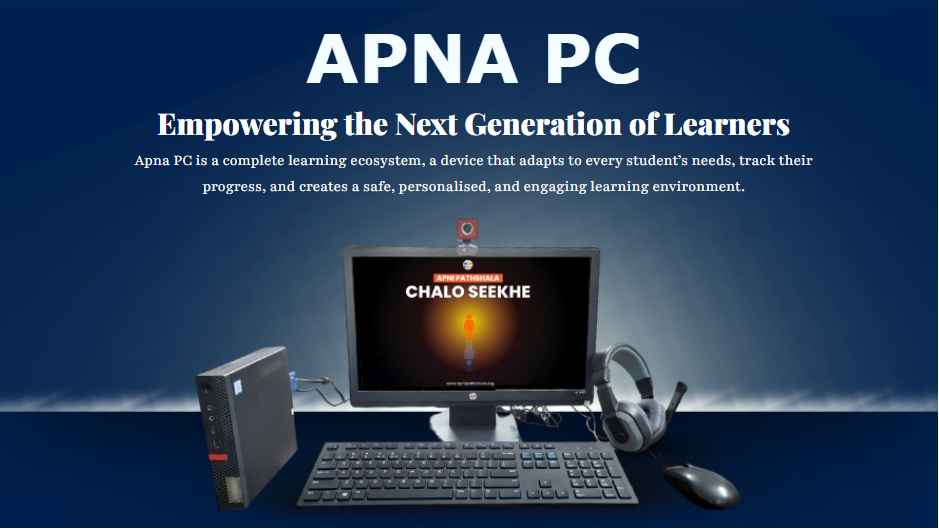
🎯 1. Vision: One Student, One Education PC
To provide every Indian student — regardless of income, geography, or language — with access to a personal learning device (ApnaPC) that enables self-directed learning, digital literacy, and equitable access to high-quality educational content.
This initiative aligns directly with NEP 2020, Digital India, and NDEAR (National Digital Education Architecture) goals.
💻 2. The Problem We’re Solving
India’s education challenge is not just access — it’s quality and engagement.
Textbooks are static and outdated the day they’re printed.
Teachers are overburdened and can’t personalize learning.
Students learn passively, with little room for creativity or curiosity.
Exams encourage memorization, not understanding.
Digital inequity persists — only urban or affluent children benefit from EdTech.
ApnaPC solves these simultaneously — by making learning personal, digital, and data-driven.
🚀 3. The Solution: ApnaPC – India’s Education PC
ApnaPC is a frugal, fully loaded educational computer preinstalled with:
- Digital multimedia textbooks in regional languages (aligned with NCERT/SCERT).
- AI tutor assistants for self-learning (like Eklavya).
- Student safety solution to keep students safe, and to monitor their online learning journey in real tile
- ApnaPC democratizes digital education — designed, assembled, and serviced in India.
🧠 4. Key Features and Educational Impact
🏫 5. Implementation Framework
Phase 1 (Pilot – 1 year)
100 schools / community learning pods across 10 states.
Focus on underserved rural and urban areas.
Preloaded content: Class 6–10 Science, Maths, Social Science in Hindi + local language.
Monitoring: AI-generated learning analytics reports every quarter.
Phase 2 (Scale-up – 3 years)
State-wide integration with DIKSHA and NDEAR.
Local content partnerships with SCERTs and NGOs.
CSR and PPP funding for device distribution.
Phase 3 (National Rollout – 10 years)
“One Student, One PC” mission across India.
Integration with skill-based curricula, digital internships, and national assessments.
💰 6. Funding and Partnership Model
CSR Partnerships: Corporates sponsor ApnaPCs for low-income families (with branding and dashboard access).
Public-Private Partnership (PPP): States co-finance device procurement and teacher training.
Community Learning Hubs: Panchayats or NGOs run shared ApnaPC hubs for remote learners.
🔐 7. Governance, Transparency, and Accountability
Central Digital Dashboard: Monitors usage, learning time, and outcomes.
Data Security: Student data anonymized, stored under Digital Personal Data Protection norms.
Periodic Third-Party Evaluation: Independent assessment of learning outcomes and equity metrics.
🌍 8. Expected Outcomes
Improved student engagement and learning outcomes.
Drastic reduction in dropout rates and digital divide.
Seamless integration of AI and digital literacy into mainstream education.
Scalable national learning data infrastructure for evidence-based policy.
Empowerment of teachers as mentors rather than rote instructors.
🧩 9. Alignment with Government Priorities
We request the Ministry of Education to:
Approve pilot projects under Samagra Shiksha or NDEAR innovation framework.
Facilitate coordination with NCERT/SCERTs for localized content integration.
Partner with CSR and state governments for equitable rollout.
Endorse the “One Student, One PC” mission as part of India’s Digital Learning Revolution.