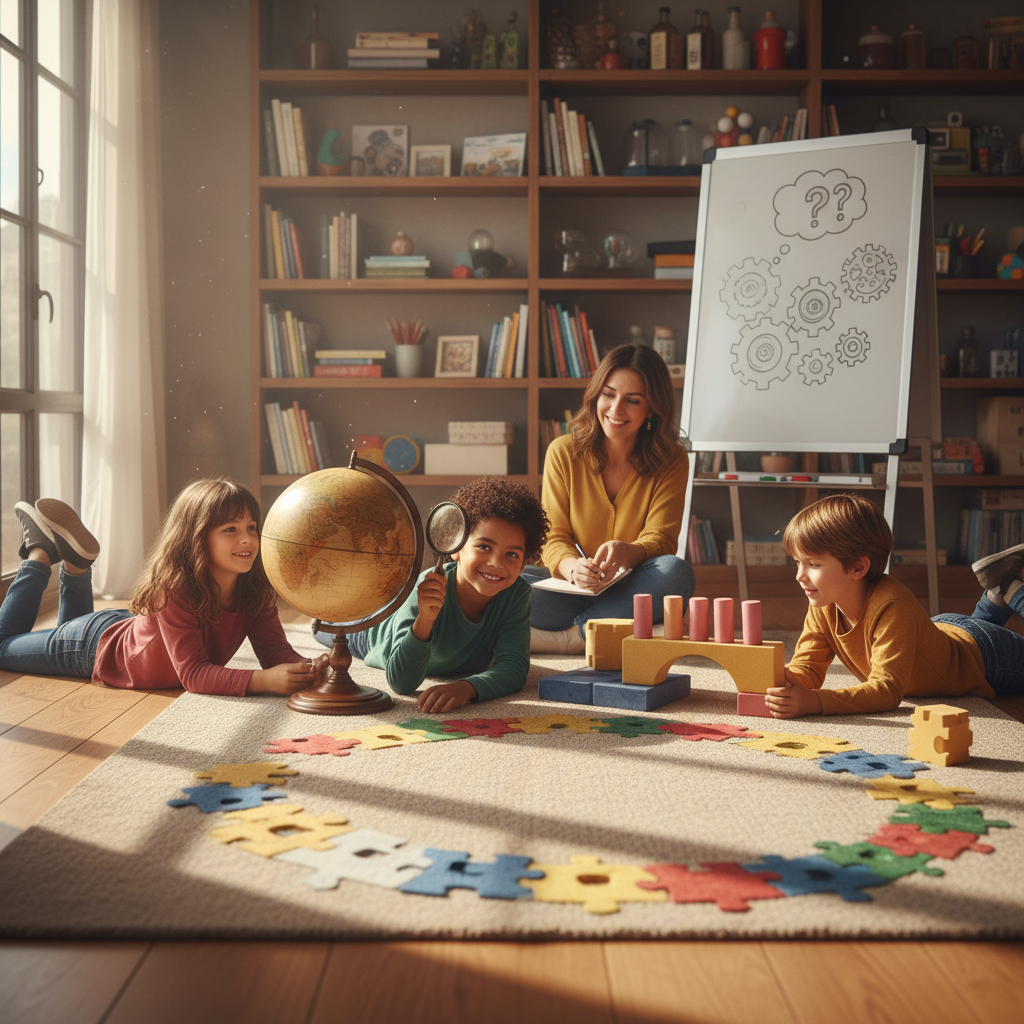
The Learning Game: Teaching Kids to Think for Themselves, Embrace Challenge, and Love Learning by Ana Lorena Fábrega
1. What is the central argument of the book?
Fábrega argues that the dominant schooling model — age-based classes, standardized tests, teacher-led lectures — is broken. It encourages students to game the system of school (grades, teachers, correct answers) rather than learn for life.
As someone committed to student-centred change, I wholeheartedly back this: true education is about empowering learners, not about submitting them to a conveyor-belt.
2. What are the key problems with our current system, according to the book?
Here are several of Fábrega’s critiques:
- Confusion and fragmentation: Subjects are taught in silos, with little real-world context, leaving students disengaged and unsure why they’re learning what they are.
- Over-emphasis on obedience and external reward: Schools often teach compliance, ranking, and performance over deep thinking
- Fear of failure and a fixed mindset: Wrong answers are punished, risk is minimised, and thus students learn to avoid challenge
- Illusion of learning via memorisation and labels like “learning styles”: Fábrega debunks the myth of fixed “learning styles” and questions rote memorisation without meaning.
In short: the system trims out curiosity, creativity and agency — elements I believe are essential if we are to reform education.
3. How does the book propose we shift the paradigm?
Fábrega sketches a new vision:
- Give children autonomy (choice in what they learn and how).
- Encourage purpose-driven projects, not just “cover the syllabus
- Treat failure as part of learning, not only success.
- Build learning environments like well-designed games: clear goals, meaningful feedback, appropriate challenge, connection to purpose.
- Equip parents and educators with mental models and tools (thinking habits, frameworks) to support children’s thinking and self-direction.
From my viewpoint as a reformer, this means shifting from “teacher-telling” to “student-doing”; from “what will they test” to “what will they value for life”.
4. What does the author say about motivation and games?
A strong theme: the design of great games offers a blueprint for engaging learning.
In games you have autonomy: you decide your moves.
You face the “Goldilocks” challenge: not too easy, not too hard.
You receive immediate, clear feedback.
Failure is low-stakes and leads to retrying until mastering.
She argues: if children can invest hours in video games, why not channel that same engagement for serious learning?
In the reform context: our microschools and pods must incorporate this “game” architecture — kids must play to learn, not just learn to play the school game.
5. What about the role of parents (and educators) in this new model?
Fábrega emphasises that parents and educators must move from passive overseers (just ensuring homework gets done) to co-designers of learning experiences.
They should involve children in decision-making — giving them “skin in the game”.
They must allow children to take risks, fail, and learn from it — and resist over-protecting them.
They should adopt tools like mental models (thinking hats, elastic thinking) that help children learn how to think, not just what to think
In our reform efforts, this means that community pods and parents will have to be active partners, not just passive consumers of “schooling”.
6. How does the book address assessment and success?
Rather than measuring success by test scores and rank, the book recommends measuring by real competency, self-direction, resilience, curiosity.
Memorisation without meaning is de-emphasised.
Instead of “How did you score?”, ask “What did you try?”, “What did you learn from your mistakes?”.
Traditional assessment systems are part of the “game of school” and should be replaced or supplemented by richer, meaningful assessments (projects, portfolios, self-reflection).
For us in India, pushing microschools, digital pods and autonomy-driven learning, this shift is unavoidable: standard metrics will not map well to self-directed lifelong learning.
7. What are some actionable strategies from the book?
Here are practical take-aways you can apply right away:
- Let children pick a passion project, make a plan, execute, reflect.
- Create challenge zones (slightly beyond current comfort) rather than always staying in safe zones.
- Use stories: connect learning content to real people, narratives, context to increase meaning
- Make learning multi-sensory, integrated (not subject silos).
- Encourage “confusion” or “productive struggle” — when kids are a little lost, that’s when deep learning happens
For parents: set up boundaries together, co-design rules for screen time, challenge, etc — autonomy matters.
For educators: provide feedback on process, not just outcome — praise effort, reflection, use of thinking tools.
These align with the vision of giving students agency, letting them shape their journey.
8. Why should someone like me — involved in education reform — care about this book?
Because the book speaks exactly to the change we need: shifting from industrial-age schooling to human-centred learning.
It affirms that students must be agents, not passive vessels.
It offers frameworks to design learning environments (pods, microschools) around autonomy, creativity, resilience.
It highlights that our real goal is not “what grade did you get” but “how ready are you for a world of change, uncertainty, self-direction?”
It gives us vocabulary and tools to persuade skeptical stakeholders: e.g., “we’re not ditching standards, we’re expanding success metrics”.
In short: if we want to reform education in India, giving young learners autonomy and agency, this book helps articulate the why and the how.
9. Are there any limitations or cautions?
Yes. Fábrega herself and reviewers point out:
- Implementing this model requires time, commitment, resources. Schools/pods must be willing to change adult mind-sets.
- Some children may still benefit from structured scaffolding — autonomy doesn’t mean no guidance.
- Systems of policy, accreditation, national exams will not vanish overnight; reform must negotiate within them.
The “game-design” metaphor is powerful but not a silver bullet — engagement must be purposeful, not superficial “gamification”.
As we push the change, we must stay pragmatic: transition, not revolution overnight; scaffold children and educators; respect constraints.
10. If I had to sum up the book in one sentence — what is it?
Stop teaching kids how to play school — teach them how to love learning for life, by giving them autonomy, challenge, meaningful feedback, and space to fail and grow.