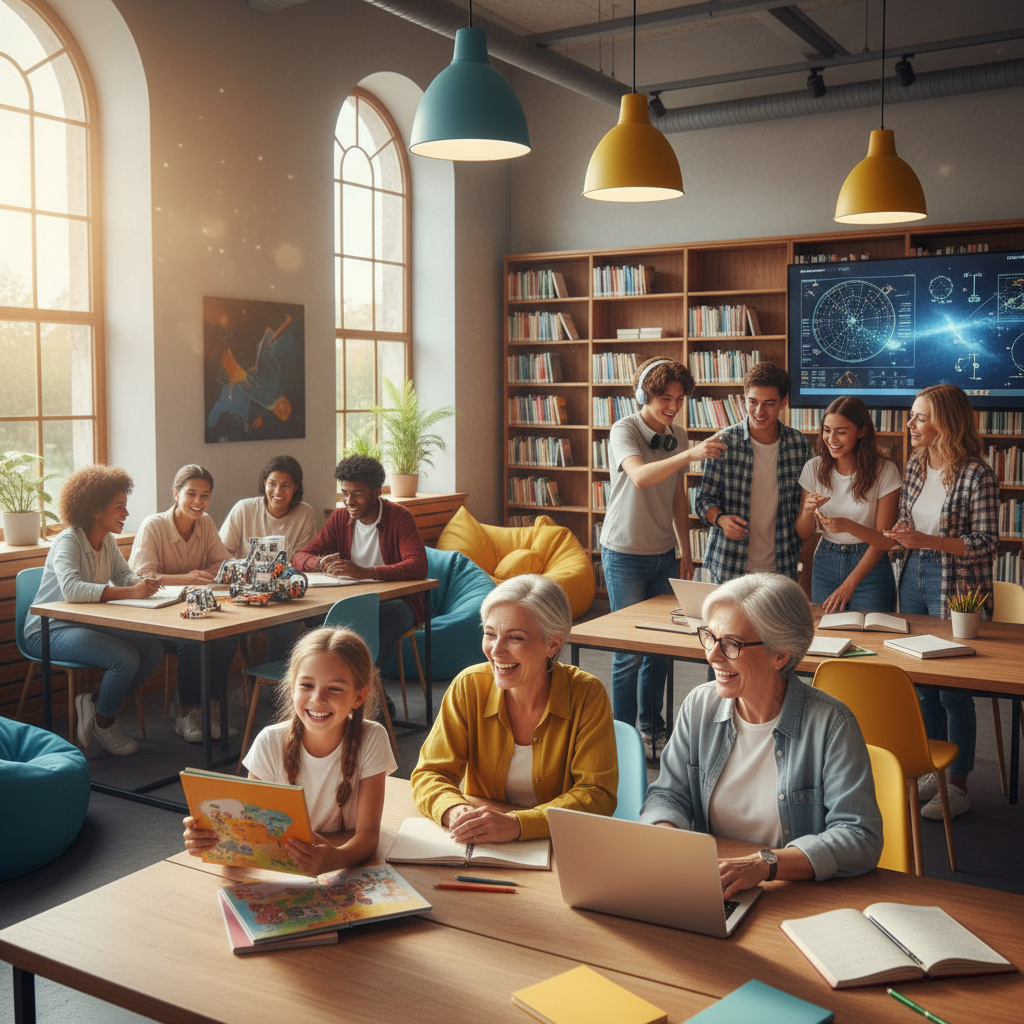
If The Joy of Sex celebrated the art of human intimacy, The Joy of Learning celebrates an intimacy of a different sort — the lifelong romance between a curious mind and the world. Real learning isn’t a mechanical act. It’s not a performance for examiners or a ritual of fear. It’s a delicious, exploratory, deeply personal experience that grows richer the more agency, freedom, and playful curiosity a learner is allowed.
Sadly, our education system has treated learning the way Victorian manuals once treated sex — as a stiff, supervised, standardised process. No improvisation. No experimentation. No discovery. And definitely no joy. Children are instructed, inspected, corrected and graded as though they are factory parts. We’ve turned classrooms into conveyor belts and curiosity into collateral damage.
It’s time to bring joy back into learning — with the same tenderness, respect, and permission that revolutions of the heart require.
1. Learning is a Relationship, Not a Regimen
Real learning is intimate. It’s a quiet dialogue between the learner and the subject. It’s private wonder. It’s the thrill of uncovering something that you want to understand, not what a timetable commands.
A child absorbed in learning — truly learning — looks remarkably like a person in love: wide-eyed, unselfconscious, radiant with discovery. They stay up late reading, tinkering, exploring, not because someone said so, but because their mind is humming.
Compare that with the drooping eyes and clenched anxiety of a child forced to memorise pages of redundant information. That’s not learning. That’s coercion dressed up as curriculum.
The difference is simple:
In one, the learner chooses.
In the other, the learner submits.
Agency is the aphrodisiac of education.
2. The Body has Instincts. The Mind does Too.
Alex Comfort argued that humans are wired for pleasure. Children are wired for curiosity. Put a toddler in any room and they’ll explore corners adults have forgotten exist. They learn by touching, tasting, breaking, rearranging, experimenting — just like scientists, but shorter.
What kills this instinct?
A system that says:
Don’t explore — follow instructions.
Don’t ask — answer.
Don’t try — comply.
A fearful system produces fearful learners.
But a joyful learning environment respects the mind’s natural desires:
- to test
- to play
- to question
- to fail safely
- to try again with new daring
Just as intimacy flourishes in safety and trust, learning flourishes in freedom without fear.
3. Technique Matters — but Not the Way Schools Think
In The Joy of Sex, technique is about enabling pleasure, not enforcing it.
In education, technique is not about torturing children with methods, frameworks, worksheets, and jargon. It’s about designing the right environment:
A space where children can follow what excites them
Tools that respond to the learner, instead of the learner chasing the tool
A mentor who guides like a dance partner, not a drill sergeant
Feedback that feels like encouragement, not verdict
The right technique is what lets curiosity bloom, not wither.
Just as no two lovers are identical, no two learners are identical. Good education must be personalised, not standardised.
4. The Forbidden Fruit: Autonomy
Conventional schooling treats autonomy like something dangerous — to be rationed in small bites. Students are told what to study, when to study, how to study, and even how to think about what they’ve studied.
Yet autonomy is not a threat. It is the greatest stimulant of deep learning.
Give a student a choice, and watch their energy change. Suddenly:
A dull subject becomes a puzzle.
A tough concept becomes a challenge, not a punishment.
A classroom becomes a workshop of ideas.
Autonomy doesn’t mean chaos. It means ownership. And ownership produces mastery far more reliably than obedience.
5. Rediscovering Pleasure in Learning
There is an unmistakable pleasure in knowing something deeply — a satisfaction that hums in the fingertips. It’s the pleasure of competence, of mastery, of stretching your abilities and tasting the sweetness of growth.
A system afraid of pleasure makes learning sterile. A system that welcomes it makes learning unstoppable.
We must create spaces where children learn the way humans naturally learn:
- through adventure
- through curiosity
- through doing
- through reflection
- through building
- through failing
- through succeeding
- through pursuing what matters to them
This is not indulgence. This is pedagogy aligned with human nature.
6. The New Kama Sutra of Learning: Tools That Empower
Every revolution needs the right tools.
Just as intimacy flourishes with the right environment, learning flourishes with the right technology — not screens used as digital textbooks, but intelligent, responsive tools that put students in the driver’s seat.
Imagine a PC that doesn’t merely display content, but:
- adapts to each learner’s pace
- encourages exploration
- offers personalised challenges
- gives meaningful feedback
- hosts a world of free learning resources
- protects students from distractions
- tracks real learning progress
- empowers them to build their own portfolios and projects
This is not the future. This is available now.
7. A Call for an Educational Renaissance
Learning should not be a chore. It should be one of the great pleasures of life. We owe our children an education system that treats curiosity with respect, agency with trust, and intelligence with dignity.
Let children fall in love with learning, again and again, throughout their lives.
That is the true joy of learning — a joy that lasts decades longer than exam scores.
Help your child to become an independent self-directed lifelong learner by buying them India’s first fully-featured Education PC !