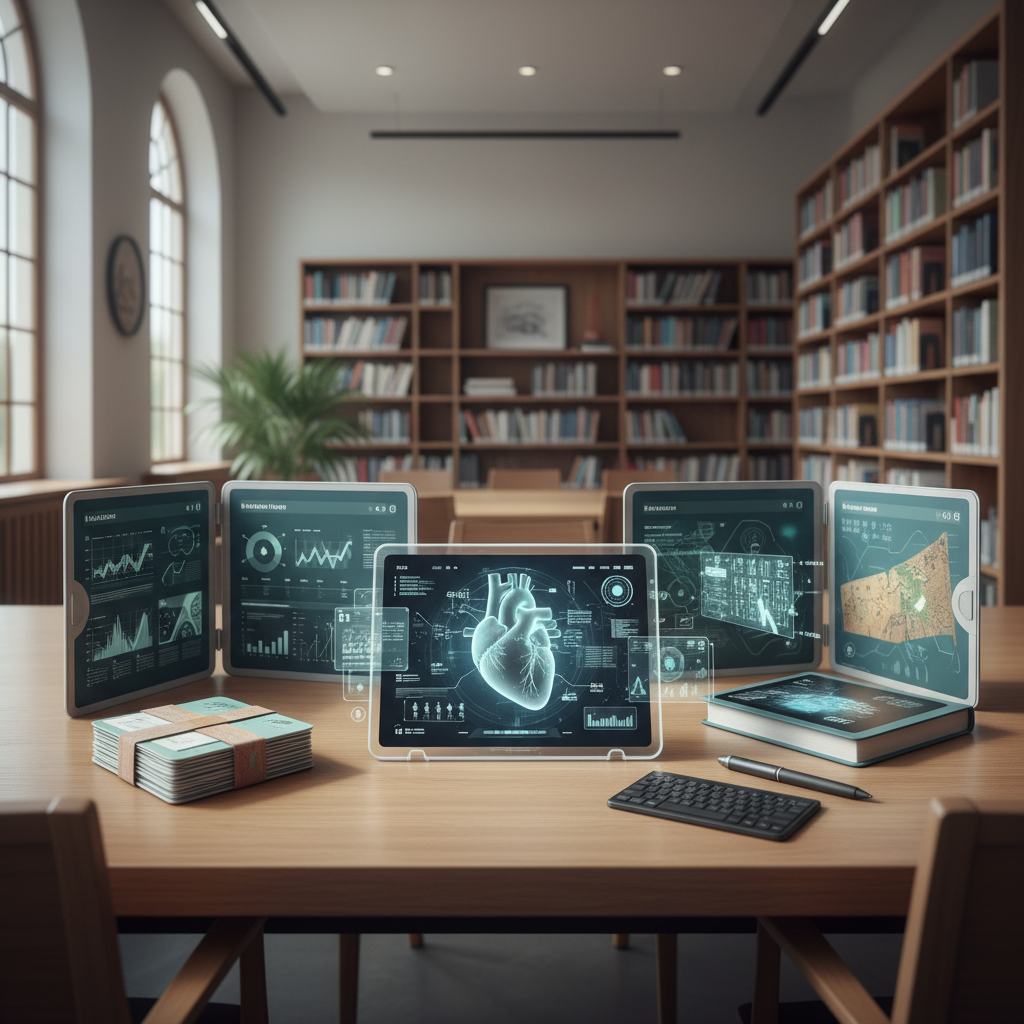
The Biggest Problem with Education Isn’t Teachers. It’s Textbooks.
For over a century, we have expected textbooks to educate our children. They were designed in an era when information was scarce, libraries were rare, and printing books was revolutionary.
Today, information is everywhere. Artificial intelligence can explain any concept in seconds. Yet our classrooms still revolve around static printed books that expect children to memorize facts instead of understanding ideas.
The sad reality is that most textbooks are optimized for passing exams, not for developing intelligent human beings.
It’s time to stop updating textbooks and start reinventing them.
A Printed Book Cannot Keep Up with a Changing World
The moment a textbook is printed, it begins becoming obsolete.
Science advances. Technology changes. New discoveries emerge. But students continue reading outdated examples because changing a printed book is expensive and slow.
A digital textbook should behave like software, continuously improving with new content, better explanations, and updated examples.
Knowledge evolves. Our learning resources should evolve too.
Every Child Learns Differently
Traditional textbooks assume every student learns at the same pace and in the same way. Anyone who has ever taught a child knows this is simply untrue.
A modern digital textbook should allow every learner to choose their own path.
One student may need a simple explanation. Another may want a detailed derivation. A third may prefer a visual animation or a real-life analogy.
The book should adapt to the child—not force the child to adapt to the book.
AI Can Become Every Child’s Personal Tutor
The greatest opportunity offered by artificial intelligence is not replacing teachers. It is giving every student access to unlimited personalized guidance.
Imagine every page containing simple buttons:
- Explain this in easier language.
- Give me another example.
- Test my understanding.
- Show me where this applies in real life.
- Explain this as if I were ten years old.
Instead of creating dependency, AI can build confidence and independence.
A child who can ask unlimited questions without fear learns far more than one who is afraid of looking foolish in class.
Stop Organizing Books Around Chapters. Organize Them Around Questions.
Children are naturally curious.
Instead of presenting endless definitions and formulas, digital textbooks should begin with questions.
Why does this happen?
How do we know this is true?
What would happen if this assumption were wrong?
Questions stimulate thinking. Answers simply end conversations.
The best education teaches students how to think, not what to think.
Mathematics Is the Perfect Example
Take JEE Mathematics.
Current books throw hundreds of similar problems at students until they recognize patterns through repetition.
A better approach is to build intuition first.
Show the graph before the equation.
Show the animation before the formula.
Help students understand the concept before asking them to memorize shortcuts.
When understanding comes first, speed follows naturally.
Students should be able to say, “I understand mathematics. The JEE exam is simply another application of what I know.”
Learning Should Be Personal and Social
The best digital textbook is not just a book.
It becomes the student’s personal knowledge repository, filled with highlights, notes, questions, reflections, and connections built over years.
At the same time, it should encourage collaboration through peer explanations, discussions, and shared insights, because the fastest way to master a concept is to teach it to someone else.
Learning should never be a lonely activity.
The Future Belongs to Thinking Tools
Digital textbooks can dramatically reduce educational inequality by being multilingual, affordable, continuously updated, and accessible even in low-bandwidth environments.
Combined with AI tutors and low-cost devices like APNA PC, they can make high-quality education available to every child, regardless of geography or income.
The biggest barrier is not technology.
It is mindset.
Many institutions fear digital textbooks because they shift power from the system to the learner.
An obedient child memorizes.
An educated child questions.
And questioning children grow into innovative adults.
That is exactly what India needs.
The future of education will not be built by printing better books.
It will be built by creating better thinking tools.