Talk with Swami Vivekananda
There are questions you don’t ask anyone.
Little things that bother you throughout the day. About your work, your family, the person you thought you’d be by now. You can’t take them to your boss, and you don’t want to worry the people who love you. You can talk about it with Swami Vivekananda instead.
What's on your mind?
Pick whichever feels most relatable. Nobody is watching, and there is no right way to phrase it.
Swami Vivekananda does not offer comfort. He offers a solution.
Five great lines in his own words, so you know what you are walking into.
The greatest sin is to think yourself weak.
All the powers in the universe are already ours. It is we who have put our hands before our eyes and cry that it is dark.
Take up one idea. Make that one idea your life; dream of it; think of it; live on that idea.
Comfort is no test of truth. Truth is often far from being comfortable.
They alone live who live for others; the rest are more dead than alive.
These lines are from the nine volumes of his Complete Works.
Why Vivekananda, and why now
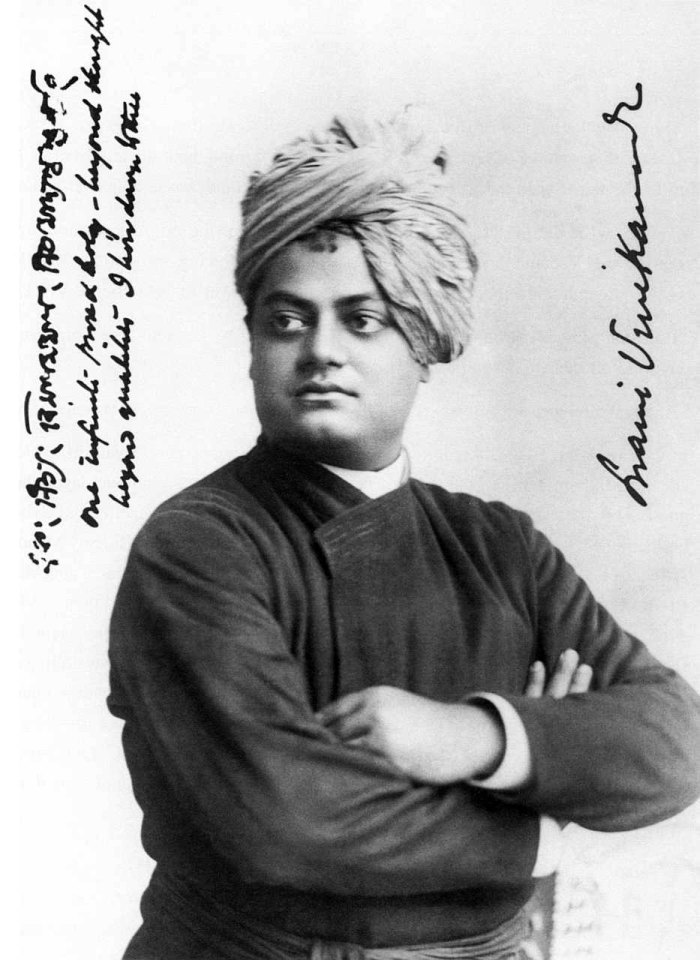
He has been reduced to a poster on a classroom wall. He deserves far better than that.
He was thirty years old when he walked onto a stage in Chicago and, in a few sentences, changed how the world saw India. He was dead at thirty-nine. In the years between, he wrote thousands of letters and gave hundreds of talks.
What surprises people who actually read him is how little of it is about ritual or religion. It is about fear. Work. Money. Duty to your parents. Self-doubt. Grief. Anger you cannot put down. What to do when you have failed publicly. How to keep going when nothing is working yet.
He spoke to students, to labourers, to housewives and to businessmen, and he told every one of them the same difficult, useful thing: you are far stronger than you have been told.
He is blunt. He will not flatter you and he has no patience for self-pity. He is also funny, and completely on your side. If you are carrying something heavy right now, there is a very good chance he wrote something about it more than a century ago.
How the conversation goes
ONE
Say what is really going on.
Not the tidy version you give at dinner parties. The messy one. You do not have to explain your whole life first.
TWO
Push back. Argue. Ask again.
If an answer feels too easy, say so. Ask what it means for your situation, your job, your family. Keep going until it is useful.
THREE
Take what helps. Leave the rest.
Nothing here is binding, and nobody is keeping score. Come back tomorrow with the next question.
Why I made this
I am a doctor. For forty years, people have come to me with problems that were not medical at all — a marriage coming apart, a business failing, a child they had lost touch with, a fear they could not name. I could not prescribe anything for those. But I noticed that the ones who came through intact almost always had something to hold on to.
Mine has been Swami Vivekananda. I think he is the most practical Indian who ever lived, and he has been badly served by us — flattened into a poster and one quotation about arising and awaking. Read him properly and he is fierce, funny, and entirely on your side.
But almost nobody is going to sit down and read nine volumes. So we built this instead: a way to simply ask him. It costs nothing. Use it as often as you like, and please pass it on to anyone you think needs it.
Dr. Aniruddha Malpani Angel investor, IVF specialist, and reader of Vivekananda
So, what would you ask Vivekananda?
There is no wrong question, and no charge, and no one to impress.
Worth knowing
These conversations draw on Swami Vivekananda’s own lectures, letters and books — his Complete Works. The guidance you get is his, not ours. Think of it as a way of reading him by asking, rather than by searching.
It is not a replacement for a doctor, a therapist, or a friend who knows you properly. If you are in real distress or thinking of harming yourself, please talk to a person tonight. In India, Tele‑MANAS is free and open around the clock on 14416.